Hospitals and academies are indicators of the early activation of commercial districts. These industries require initial investment in facilities and interior design, and once they secure customers, they can operate stably for up to 10 years or more, making thorough commercial district analysis inevitable. Therefore, when hospitals and academies move in early, the entire commercial district is more likely to be activated as the area has a solid demand base.
Once these leading industries are confirmed, related businesses such as study rooms, bookstores, health food stores, and pharmacies also start to move. This is because related industries can expect a trickle-down and fountain effect, where people using hospitals or academies use these services simultaneously.
- Gimpo Hangang Metrojai’s three complexes begin move-in from July, with hospitals and academies as initial leading industries confirmed to move in one after another
Gimpo Hangang Metrojai is a landmark large-scale apartment complex in Gimpo Hangang New Town, consisting of a total of 4,229 households across complexes 1 to 3. Among these, move-in will begin sequentially from complexes 2 and 3 starting mid-July this year.
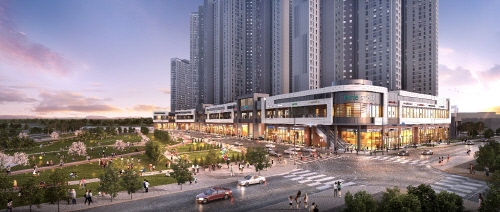
Ahead of the move-in of this large apartment complex, the commercial space within the complex, Pine Star, is signing lease contracts with hospitals and academies, which are indicators of early commercial district activation.
According to the person in charge of Hangang Metrojai’s commercial space, “Recently, a hospital that has long been established in the Gimpo area signed a lease contract, and English, math, and Taekwondo academies are also signing lease contracts one after another. As these leading indicator industries confirm their move-in, inquiries from other industries are flooding in,” they reported.
- Within a 1km radius, there is a demand base of 10,000 households, increasing expectations for the new commercial space effect
The Gimpo Pine Star commercial space is surrounded by apartment complexes including Gimpo Hangang Metrojai, Ostar Paragon, and Woobang IU Shell, totaling 6,400 households. Moreover, it has a demand base of about 10,000 households within a 1km radius.
Commercial space experts predict that stable operation is possible with a demand base of about 2,000 households, and Gimpo Pine Star boasts a demand base five times that size, at 10,000 households.
Newly developed commercial spaces in areas with a solid demand base can enjoy a new commercial space effect similar to the new apartment effect. Early tenants can benefit from the so-called 'opening boost,' where customers flock to newly opened stores, and they can enter without key money to form a new commercial district and generate key money. Especially, commercial spaces within apartment complexes with secured stable demand experience an even greater new commercial space effect. Additionally, with a solid demand base, stable operation is possible even in the face of unexpected variables like COVID-19.
Real estate agents in the Gimpo area analyzed, “As the Gimpo real estate market gains upward momentum, the move-in for Hangang Metrojai will proceed quickly. We have also heard news that a high rate of moving reservations was recorded during the recent pre-move-in inspection. From the perspective of commercial space tenants, the risk of move-in disappears, so demand for leasing commercial spaces will increase to take advantage of the first-mover effect.”
With the move-in of the large apartment complex securing the demand base, and leading indicator industries signing lease contracts one after another, Gimpo Pine Star commercial space is establishing itself as a landmark commercial space in the Gimpo area.
© The Asia Business Daily(www.asiae.co.kr). All rights reserved.

















