Second Half Nationwide Jeonse Prices Rise 1.5%... Annual Increase Expected at 2.6%
Domestic Construction Orders in 2024 Expected to Decrease 6.1% Year-on-Year to 155.9 Trillion Won
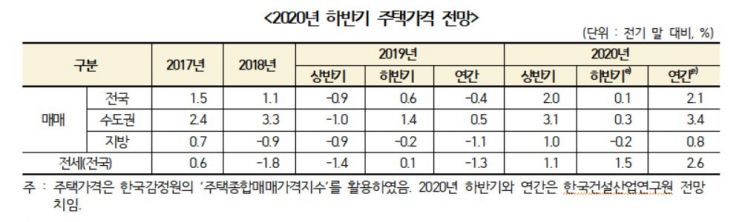
[Asia Economy Reporter Yuri Kim] "In the second half of 2020, nationwide housing sale prices are expected to rise by 0.1%, while jeonse prices will increase more significantly by 1.5%."
The Korea Research Institute for Construction Industry (KRICI) announced this forecast on the 2nd in its report titled '2020 Second Half Construction and Housing Market Outlook.' Domestic construction orders this year are expected to decrease by 6.1% compared to the previous year, totaling 155.9 trillion KRW. Following a 3.1% decline in the first half, an 8.4% drop is anticipated in the second half, indicating a deepening downturn.
Jeonse prices are projected to rise 1.1% in the first half and increase by 1.5% in the second half, resulting in an annual growth of 2.6%. Senior Researcher Kim Seong-hwan of KRICI noted, "If jeonse supply previously provided by multi-homeowners shifts to sales, there is concern over a reduction in quality jeonse supply. Considering demand generated by existing tenants remaining in the jeonse market due to loan restrictions from the June 17 measures, migration to areas near the 3rd New Towns, and the three lease laws, jeonse prices may rise more sharply than in the first half."
The real economy's weakness caused by the novel coronavirus disease (COVID-19) is expected to remain a risk factor for the housing market in the second half. Kim said, "Except for transaction volume, COVID-19 had little direct impact on the housing market in the first half. However, if the real economy's weakness, such as unemployment and inflation rates, continues into the second half, it could exert downward pressure on the housing market."
Sale prices are expected to diverge between the metropolitan area (0.3% increase) and non-metropolitan areas (-0.2% decrease). Regarding metropolitan area sale prices, Kim stated, "Although there will be many listings from corporations and multi-homeowners due to policy factors, demand driven by low interest rates will prevent a decline." Regionally, buyers are expected to focus more on so-called 'smart single homes' located in central areas, but the number of buyers able to purchase such properties is expected to be limited. In provincial markets, disparities will appear not only between regions but also among products within regions, with some sales demand responding to specific issues. However, this is expected to be curtailed by the government's swift expansion of regional regulations.
The pre-sale market is anticipated to see a significant gap between housing and non-housing sectors. Kim analyzed, "Housing pre-sale markets are highly attractive to buyers due to policies like the price ceiling system, and for construction companies, a booming pre-sale market is an opportunity to secure operating funds. However, the mid- to long-term supply shortage caused by policy effects must be considered." Meanwhile, the non-housing market, which has recently seen high supply and faces difficulties such as those experienced by self-employed individuals due to COVID-19, is expected to diverge significantly from the housing pre-sale market.
Domestic construction orders this year are forecasted to decrease by 6.1% from the previous year to 155.9 trillion KRW. In particular, after a 3.1% decline in the first half, an 8.4% decrease is expected in the second half, deepening the downturn.
The main cause of the decline in construction orders is a drop in private orders. Senior Researcher Park Cheol-han of KRICI said, "Public orders are expected to increase by 9.9% compared to the previous year due to increased public institution projects, but this will not be enough to offset the decline in private orders. Private orders are expected to fall by 12.6% year-on-year due to sluggish housing and non-housing construction orders."
Meanwhile, construction investment, a coincident indicator of the construction market, is also expected to decline by 1.6% year-on-year in the second half, continuing a three-year downward trend. Park noted, "Government construction projects, which sharply increased from the fourth quarter of last year, continued into the first half, so construction investment in the first half is expected to be relatively favorable. However, the capacity for growth from public projects will gradually diminish in the second half." He added, "Private construction projects are expected to worsen in the second half, with residential and non-residential construction investments, which have a high private sector share, leading the decline in construction investment."
KRICI emphasized the need for the government to swiftly promote preliminary feasibility exemption projects while striving for early public project orders to minimize the impact of the economic downturn caused by COVID-19 in the second half. They also suggested increasing next year's SOC budget compared to this year to respond to prolonged economic stagnation and ensure ongoing projects proceed without disruption.
Senior Researcher Park said, "Construction companies need to strengthen their crisis response capabilities by promptly advancing projects and securing liquidity in preparation for increased economic uncertainty and prolonged downturn in the second half."
© The Asia Business Daily(www.asiae.co.kr). All rights reserved.
![Clutching a Stolen Dior Bag, Saying "I Hate Being Poor but Real"... The Grotesque Con of a "Human Knockoff" [Slate]](https://cwcontent.asiae.co.kr/asiaresize/183/2026021902243444107_1771435474.jpg)
















