Bipartisan Support for $44.5 Billion Nuclear Power Modernization Budget
Democrats, Once Emphasizing Denuclearization, Seem to Shift Stance Amid Anti-China Sentiment
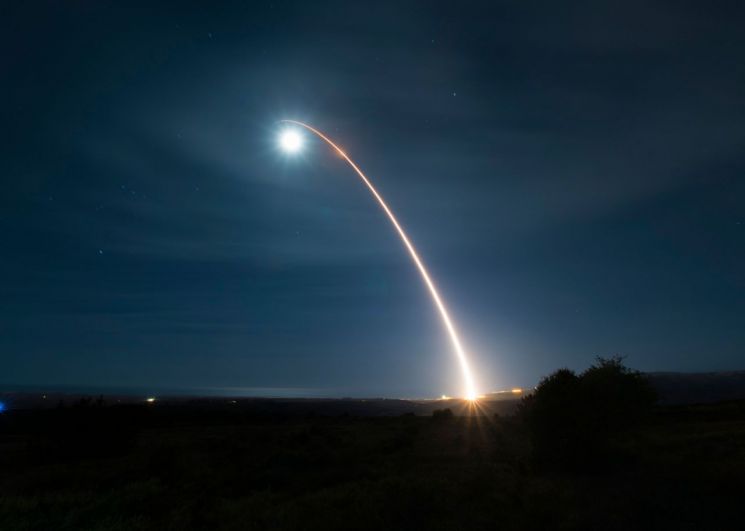 The Minuteman 3 intercontinental ballistic missile (ICBM) test-fired last February at Vandenberg Air Force Base in California, USA [Image source=Yonhap News]
[Asia Economy Reporter Hyunwoo Lee] The U.S. Democratic Party has unusually remained silent on the $44.5 billion (approximately 53.48 trillion KRW) nuclear force enhancement budget included in the 2021 fiscal year National Defense Authorization Act (NDAA). Since the inauguration of the Trump administration in 2017, the Democrats have consistently opposed increases in nuclear-related budgets, arguing that strengthening nuclear forces would rather fuel nuclear competition, but this year they have shown a completely different stance. This is interpreted as reflecting the rising anti-China sentiment across both parties in the U.S. ahead of the presidential election.
According to Forbes and others on the 1st (local time), Adam Smith, Chairman of the House Armed Services Committee for the U.S. Democratic Party, recently stated regarding the nuclear force modernization program within the 2021 fiscal year NDAA, "Although there were differences with the Republicans on nuclear weapons development issues, most issues were resolved in a bipartisan manner." Earlier, on the 27th of last month, the budget review for the nuclear force modernization program held at the Armed Services Committee also passed without significant disagreements.
The Trump administration requested a budget of $44.5 billion for nuclear force modernization, which is a 20% increase compared to last year. The Democrats' change of heart is drawing attention because it is significantly different from their previous 'denuclearization' stance. Senator Elizabeth Warren, who was a presidential candidate, proposed the 'No First Use of Nuclear Weapons' bill in February last year, and at that time, Chairman Smith also agreed, stating, "Strengthening the U.S. nuclear force could promote nuclear development competition rather than deter China and Russia."
The Democrats' change in position appears to be largely influenced by China. The nuclear force enhancement targets not only Russia but also China. Especially at a time when U.S.-China conflicts such as the enforcement of the Hong Kong National Security Law have heightened anti-China sentiment in the U.S., there were concerns that opposing the budget could backfire in the upcoming November presidential election.
© The Asia Business Daily(www.asiae.co.kr). All rights reserved.

















