Statistics Korea Announces June Consumer Price Trends
Some Impact from Emergency Disaster Relief Funds Entering Market
Meat Prices Rise Sharply While Oil and Public Service Prices Fall
[Sejong=Asia Economy Reporters Kim Hyunjung and Joo Sangdon] As the emergency disaster relief funds provided by the government were released into the market, consumer prices last month escaped the negative trend. However, due to the weak international oil prices and the decline in public service prices caused by expanded educational support, prices did not turn upward. Prices rose sharply mainly for items on the dining table such as pork, domestic beef, and napa cabbage, which saw a surge in demand, resulting in a noticeable gap between perceived inflation and official inflation.
According to the 'June Consumer Price Trends' announced by Statistics Korea on the 2nd, the consumer price index last month was 104.87 (2015=100), the same as June last year (104.88). When rounded to one decimal place, the official figure shows 0.0%, indicating no change, and to two decimal places, it shows a slight decrease of -0.01%. Ahn Hyungjun, Director of Economic Trend Statistics at Statistics Korea, explained, "The inflation rate is officially reported to one decimal place according to the manual, and the second decimal place has no statistical significance, so it is accurate to consider it as 0.0%."
The consumer price inflation rate remained in the 0% range throughout last year (except for -0.4% in September), recovered to the 1% range from January to March this year, but fell to 0.1% in April due to the impact of COVID-19, and dropped further to -0.3% in May. In June, although prices of agricultural, livestock, and fishery products rose, reduced outdoor activities slowed the rise in dining-out prices, and the decline in international oil prices combined with expanded educational support led to a drop in public service prices, maintaining a low inflation trend. Petroleum products (-0.68 percentage points) and public services (-0.28 percentage points) alone pulled down the inflation rate by 0.96 percentage points.
Excluding seasonal factors and temporary shocks to identify long-term trends, the core inflation index, which excludes agricultural products and petroleum-related items and covers 407 items, rose 0.6% compared to the same month last year. The 'Food and Energy Excluding Index,' comparable among OECD countries, increased by 0.2% during the same period.
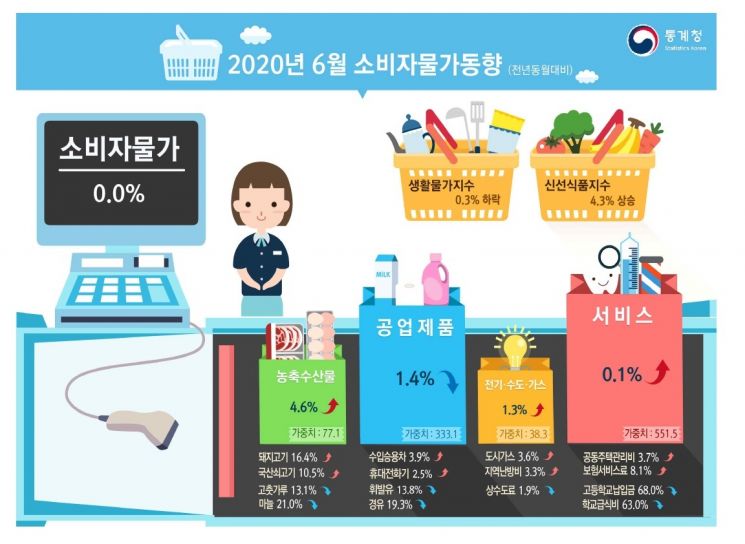
Among individual items, fresh foods, which saw increased household consumption due to COVID-19, showed the most significant price increases, with pork and domestic beef prices rising 16.4% and 10.5% year-on-year, respectively. Napa cabbage (58.1%), sweet potatoes (30.2%), and mackerel (14.5%) also saw large increases. When categorized into fishery and vegetables, prices rose 7.9% and 9.8%, respectively. Fruit prices, which increased in production due to good harvests, fell by 3.2%. Items influenced by the government's disaster relief funds, such as sofas (12.1%) and recreational facility usage fees (22.0%), recorded upward trends. Gasoline and diesel prices fell by 13.8% and 19.3%, respectively, while high school tuition fees and school meal costs dropped sharply by 68.0% and 63.0%, respectively.
By item type, goods prices fell 0.2% year-on-year. Agricultural, livestock, and fishery products and electricity, water, and gas prices rose 4.6% and 1.3%, respectively, while industrial products fell 1.4%. Service prices overall rose 0.1%, with rent and personal services increasing 0.2% and 1.0%, respectively, but public services decreased by 2.0%. Ahn Hyungjun, Director of Economic Trend Statistics at Statistics Korea, commented on future inflation trends, stating, "Oil prices, which hit a low in April, rose until June and will have an impact, and recent retail sales recovery and increased demand in some service sectors will be factors pushing prices up next month. However, the expansion of educational support lowering public service prices will act as a downward pressure throughout the year."
© The Asia Business Daily(www.asiae.co.kr). All rights reserved.

















