Measures Immediately After Hong Kong Security Law Enforcement Draw Global Attention
US, Europe, India Follow with Sanctions and Business Exclusions on Chinese Companies
[Asia Economy Reporter Hyunwoo Lee] The Australian government announced that it will invest more than 1 trillion won in the cybersecurity sector to respond to China's ongoing cyberattacks. This move by Australia came immediately after China decided to enforce the Hong Kong National Security Law despite opposition from Western countries, drawing attention to whether the response to China will expand. In particular, as reports of cyberattack damages by China have emerged not only in Australia but also in the United States, Europe, India, and other countries worldwide, cases of sanctioning or excluding Chinese IT companies such as Huawei and ZTE from business are also increasing.
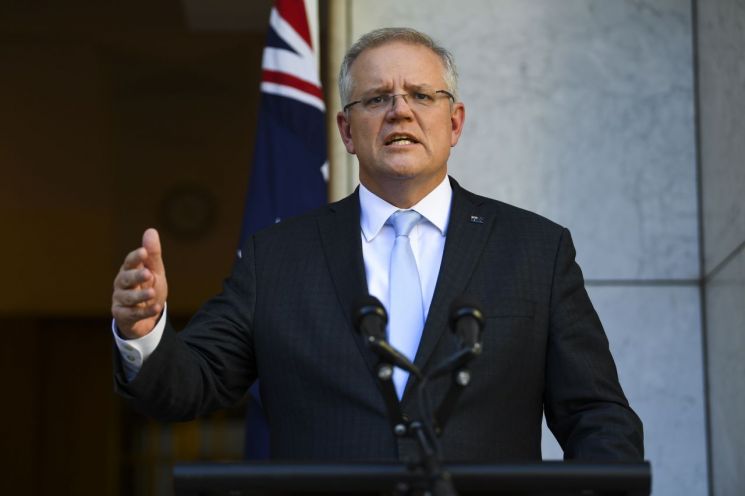
According to foreign media including The New York Times (NYT) on the 30th of last month (local time), Prime Minister Scott Morrison stated in a press release that "As sophisticated cyberattacks targeting Australia continue, we will invest $1.35 billion (approximately 1.1122 trillion won) in cybersecurity budgets over the next 10 years," adding, "We will recruit more than 500 cyber hackers to develop capabilities not only for cyber defense but also for counterattacks." The scale of this cybersecurity budget and personnel expansion is reported to be the largest ever.
Prime Minister Morrison did not directly mention the perpetrator of the cyberattacks against Australia on that day. However, the prevailing assessment is that China is the culprit. Australian police and intelligence agencies revealed that on the 26th of last month, they searched the home of Xiao Qet Mozelmane, a New South Wales state legislator from the Australian Labor Party, on suspicion of colluding with China and investigated signs of confidential information leakage. Peter Jennings, former head of the Australian Strategic Policy Institute (ASPI), mentioned that cyberattacks on the Australian Parliament's computer systems, the Australian Department of Defense, and the Australian National University continue, explaining, "The frequency and scale of China's cyberattacks are increasing unprecedentedly, revealing various espionage activities both large and small."
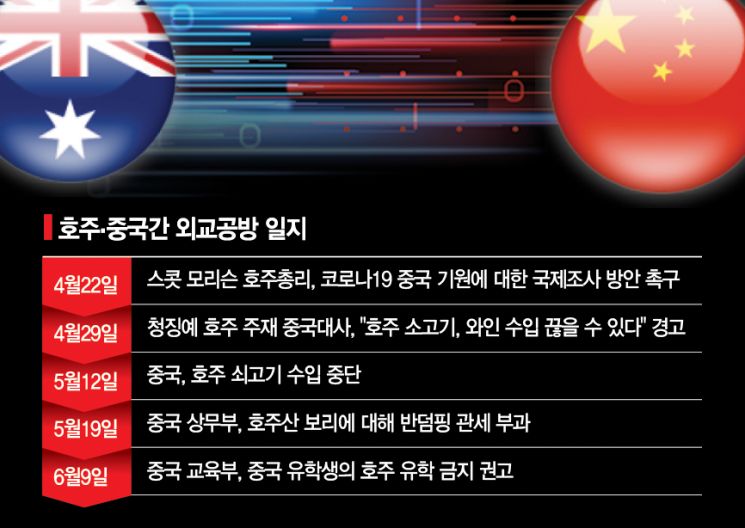
The conflict between Australia and China has deepened gradually, starting with the investigation into the origin of the novel coronavirus (COVID-19). China, on the contrary, accused Australia of illegally dispatching spies to China. On the same day, China's state-run Global Times reported that Chinese judicial authorities had uncovered an Australian spy ring in 2018 and arrested Australian intelligence agents.
The Global Times reported that Peng Chongyi, a Chinese-Australian professor at the University of Technology Sydney who was arrested during a visit to China in 2017, was one of the Australian spies. Subsequently, the Global Times' sister paper, Huanqiu Shibao, reported that Australian intelligence agencies attempted to install eavesdropping devices at the Chinese Embassy in Australia. The Australian government denied these claims as baseless rumors.
The United States also supported Australia's offensive. On the same day, the U.S. Federal Communications Commission (FCC) announced sanctions against Chinese IT companies citing China's cyberattacks and security breaches. Chinese telecommunications companies Huawei and ZTE were designated as "threats to U.S. national security," officially initiating sanctions. Accordingly, U.S. companies are fundamentally prohibited from using $8.3 billion in government subsidies to purchase equipment from these Chinese companies.
In particular, as China's cyberattacks continue, cases of terminating business with Chinese IT companies are also increasing. Last month, Greece canceled its 5G contract with Huawei and selected Finland's Nokia as its partner. The Czech Republic, Poland, Sweden, and Romania also canceled their 5G contracts with Huawei. U.S. Secretary of State Mike Pompeo stated last month, "Considering the risks posed by the Chinese Communist Party, trusted equipment suppliers rather than Huawei are being chosen."
Due to China's enforcement of the Hong Kong National Security Law, IT businesses linked to Hong Kong are also being restricted. On the 25th of last month, Google and Facebook announced plans to modify their submarine cable projects connecting the U.S. mainland and Hong Kong to instead connect to other regions such as Singapore. Earlier, the U.S. State Department had advised that if submarine cables connected to Hong Kong, U.S. information could leak to China, posing national security risks.
© The Asia Business Daily(www.asiae.co.kr). All rights reserved.


















