Urgent Redevelopment Needed Due to Aging, Not Rising Housing Prices
Land Transaction Permit System Extends to Redevelopment Areas
Government Expands from Seoul to Gyeonggi Province
Restricts Area 70 Times Yeouido Starting the 4th
Price Surge Cited as Urgent, but Includes Forest and Paddy Fields in Maintenance Zones
Criticism of Excessive Policy Use Despite Sufficient Autonomy
[Asia Economy Reporter Lee Chun-hee] Following the central government and Seoul Metropolitan Government, Gyeonggi Province has also utilized the Land Transaction Permission System to curb rising housing prices, sparking criticism of excessive policy overuse. Contrary to the original purpose of the Land Transaction Permission System, residential areas and redevelopment project zones have also been designated as permission zones, leading to accusations of unreasonable regulation.
According to industry sources on the 1st, from the 4th of this month, 221.98㎢ within Gyeonggi Province will be designated as land transaction permission zones. This area is more than 70 times the size of Yeouido (2.9㎢). The reason given by Gyeonggi Province for this designation is to "fundamentally block speculative land investment by planned real estate investors."
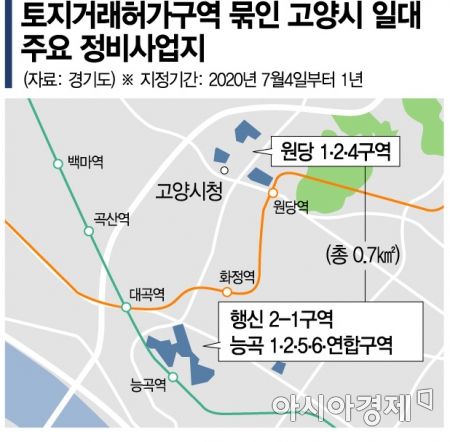
However, the designated areas include not only forest land and paddies where planned real estate speculation is rampant but also redevelopment and reconstruction project zones in the Goyang City area, causing controversy. The redevelopment project zones included in the permission zones cover a total of 700,000㎡, including Neunggok 1, 2, 5, and 6 districts and Wondang 1, 2, and 4 districts in the Deogyang-gu redevelopment promotion district, as well as Neunggok 2-1 and Haengsin 2-1 districts in the general redevelopment project zones. Gyeonggi Province stated that "speculative transactions aimed at capital gains rather than actual residence are increasing" in these areas.
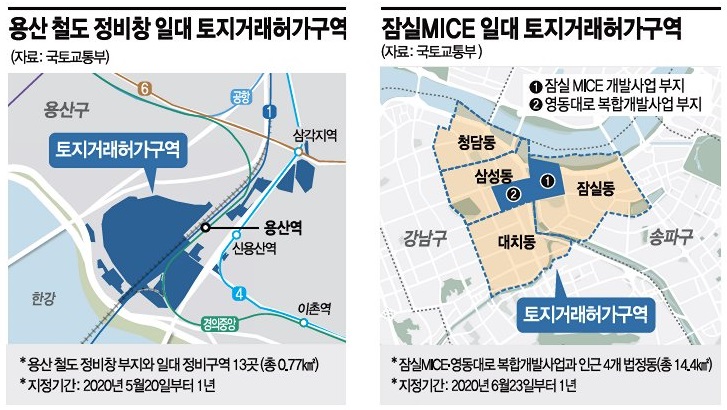
In this process, Gyeonggi Province applied the same 10% standard area criterion as Seoul City did when designating Yongsan Maintenance Depot and the Jamsil MICE (Meetings, Incentives, Conferences, and Exhibitions) and Yeongdong-daero complex development areas as permission zones. In these areas, any real estate transaction exceeding 18㎡ for housing or 20㎡ for commercial space based on land share requires permission from Goyang City.
A Gyeonggi Provincial Government official explained, "There was an active request from Goyang City," adding, "According to Goyang City data, the transaction price per 3.3㎡ in the area has jumped from 7 to 8 million KRW to 23 to 25 million KRW over the past five years," and "the urgency was recognized by the Urban Planning Committee as well."
In the market, criticism is rising that following the central government and Seoul Metropolitan Government, Gyeonggi Province is also designating land transaction permission zones with the aim of controlling housing prices, likened to "using a sledgehammer to crack a nut." An industry insider who requested anonymity said, "Isn't this contrary to the original purpose of the Land Transaction Permission System?" and added, "Designating residential areas is effectively a housing transaction permission system, which carries constitutional risks, so it seems they are overusing the Land Transaction Permission System."
In fact, 286.64㎢ in the Gyeonggi area had already been designated as land transaction permission zones, but most of these areas were related to sites for expanding housing supply in the Seoul metropolitan area, such as the 3rd New Towns, the Yongin semiconductor cluster project, and industrial complex regeneration projects. Another official said, "The Land Transaction Permission System is a system to bundle lands currently used as fields, factories, or forests during large-scale developments like new towns to provide fair compensation to original owners," and added, "The government is rushing and thus bringing in excessive regulations."
There are also concerns about a slump in the redevelopment market. In 2005, the Roh Moo-hyun administration enacted the "Special Act on Urban Redevelopment Promotion," inserting a clause that automatically designates redevelopment promotion districts as land transaction permission zones upon designation and announcement. As a result, many New Town areas such as Eunpyeong and Gireum were designated as permission zones.
However, even then, side effects occurred, such as a balloon effect concentrating on small-share real estate within the zones and redevelopment areas not yet designated as promotion districts. This clause was eventually abolished in 2016, with the reasoning that "uniformly designating and managing all areas as land transaction permission zones may excessively restrict citizens' rights."
This recent designation of permission zones is also criticized as excessive regulation that may hinder redevelopment in areas urgently needing renewal due to aging. Kim Hak-ryeol, head of the SmartTube Real Estate Research Institute, said, "Wondang and Neunggok areas were the first to be developed when Goyang City Hall moved there in 1961," adding, "They are severely aged and urgently need redevelopment."
Kim also said, "Moreover, the Goyang real estate market has been stagnant for the past 10 years and is only now catching up to inflation levels," and "The market autonomy should be sufficiently trusted, but the government is stirring up trouble unnecessarily."
© The Asia Business Daily(www.asiae.co.kr). All rights reserved.


















