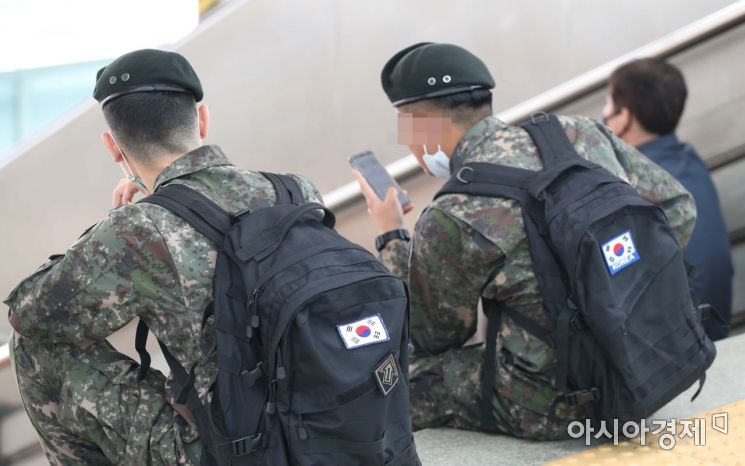
 On the 8th, when the military leave that had been restricted to prevent the spread of the novel coronavirus infection (COVID-19) was resumed normally, soldiers departing for leave were waiting for the train at Seoul Station. Photo by Moon Honam munonam@
[Asia Economy Reporter Yang Nak-gyu] The Ministry of National Defense announced that it will officially implement the use of soldiers' mobile phones after work in all military units starting this month, following a pilot operation that began in April last year. On weekdays, usage hours are from 6 p.m. to 9 p.m. after work. On holidays and weekends, mobile phones can be used from 8:30 a.m. to 9 p.m. The Ministry expects that mobile phone use will have a positive impact on soldiers' adaptation to service, mission performance, and self-development.
However, soldiers stationed at guard posts (GP) within the Demilitarized Zone (DMZ), naval ship crew members, and new recruits undergoing basic training are not allowed to use mobile phones. For soldiers on shift duty rotating every two months, the Ministry plans to grant six days of compensatory leave after the shift, and for naval ship crew members, it will extend mobile phone usage time by about two hours once they return to land after duty.
The Ministry of National Defense recently reported that mobile phones played a significant role in reducing stress among isolated soldiers when outings were restricted to prevent the spread of the novel coronavirus (COVID-19). In preparation for full mobile phone allowance, the Ministry has completed the establishment of a 'security control system' that blocks photography, and plans to minimize side effects through the establishment of punishment regulations and preventive education. According to the Ministry, during the pilot operation period, when soldiers used mobile phones under the same conditions, there were no security incidents such as secret external leaks via soldiers' mobile phones.
However, some concerns remain about side effects related to mobile phone use, such as digital sex crimes and internet gambling within units. It is known that Private First Class Lee Won-ho (19) of the Army, who was involved in the Telegram 'Doctor's Room' case, continued digital sex crimes using his mobile phone during service. In February this year, controversy arose when an Army Private was found to have shared code words (prearranged words for identifying friend or foe) in a KakaoTalk group chat.
A Ministry of National Defense official stated, "We will take strict measures against violations of usage rules and security regulations and continue efforts to establish a stable mobile phone usage culture."
© The Asia Business Daily(www.asiae.co.kr). All rights reserved.
![User Who Sold Erroneously Deposited Bitcoins to Repay Debt and Fund Entertainment... What Did the Supreme Court Decide in 2021? [Legal Issue Check]](https://cwcontent.asiae.co.kr/asiaresize/183/2026020910431234020_1770601391.png)