The 'Open-run' Phenomenon: Rushing to Stores at Opening Time
Purchased Products Resold at High Prices in the Secondhand Market
General Consumers: "Stores Are Inconvenient, Can't Shop Properly"
Experts: "Harms Market Economy but No Way to Stop It"
 Last March, as a department store in Seoul opened, waiting customers rushed to enter one after another.
 Photo by Yonhap News
[Asia Economy Reporter Han Seung-gon, Intern Reporter Kim Seul-gi] "Why buy something you won't even use?"
Recently, as 'Shatech' (a portmanteau of luxury brand 'Chanel' and investment), Starbucks 'Summer Ready Bag', and Nintendo's 'Animal Crossing: New Horizons (Modongsot)' have gained popularity, consumers are engaging in 'Open-Run' to purchase these items. 'Open-Run' is a newly coined term referring to rushing to a store at opening time to buy something before others.
The problem is that these practices effectively eliminate or severely limit consumers' choices. Most products involved in 'Open-Run' have insufficient supply due to limited stock or limited quantities, making them easy to resell. There are even resellers who specialize in buying these products and selling them at a premium.
Experts say there is no legal way to regulate these 'resellers,' but suggest that suppliers need to ensure smooth supply.
On the 28th, a post titled "(Starbucks) Selling 30 Ready Bags" appeared on the secondhand trading platform 'Danggeun Market,' sparking controversy. A user on an online community expressed frustration, saying, "Only one per person is allowed, so is it okay to hoard and resell like that? Because one person bought 30, the other 29 people couldn't even see the Ready Bag."
These 'resellers' who hoard limited quantities and resell them are selling at prices ranging from twice to ten times the original product price. For example, Starbucks Ready Bags can be exchanged during the event period by purchasing about 70,000 won worth of drinks, but in the secondhand market, they are traded at an average price of around 150,000 won, which is higher.
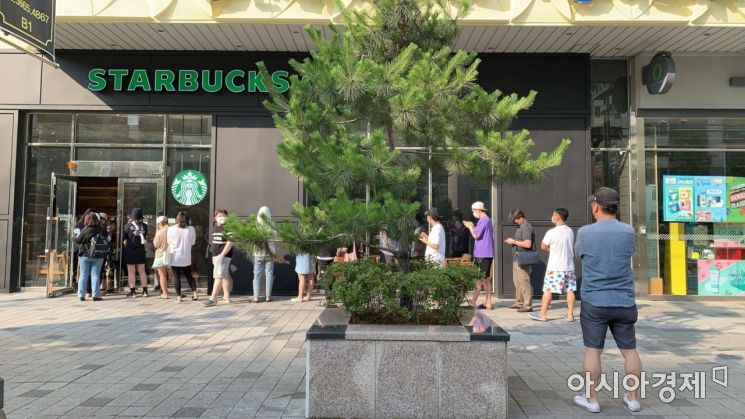 On the 20th, people lined up before opening in front of a Starbucks store in Seoul to receive the Starbucks summer limited product, the 'Summer Ready Bag.'
 Photo by Seulgi Kim, Intern Reporter sabiduriakim@asiae.co.kr
A man in his 20s, office worker A, said, "The problem is that they resell by exploiting people's psychology even though they won't actually use the items. What's the difference between adding a 'premium' and reselling like this and ticket scalpers for concerts?" He added, "Once the price goes up like that, it doesn't come down and stays high, and people want to have the item, so they are willing to pay that price." 'Premium' here refers to buying at the normal price and reselling at a higher price.
He continued, "I can understand that people doing 'Open-Run' have personal freedom, but I can't understand the mentality of reselling items bought at store opening times to make much more profit than the original price."
Earlier in early May, a boom of 'Shatech' occurred following news of price increases for the luxury brand 'Chanel.' At a department store in Seoul, a physical fight broke out among people crowding to purchase Chanel products, resembling a melee.
B, a man in his 30s who participated in the 'Shatech Open-Run,' said, "I didn't buy it because I needed it immediately, but because I thought I could make a profit if the price went up later. After all, buying the product and how to use it is up to the buyer."
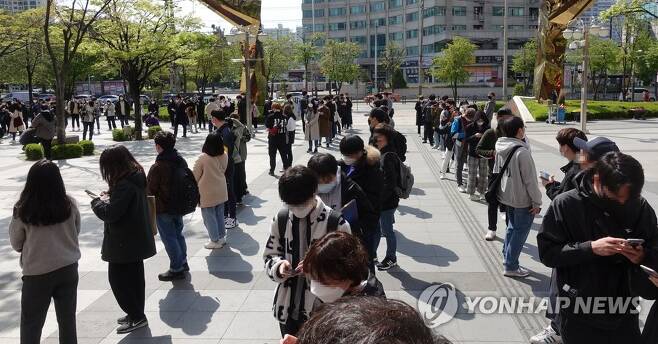 In front of Sindorim Technomart in Guro-dong, Guro-gu, Seoul, citizens are lined up waiting to enter a lottery for purchasing the Nintendo Switch Animal Crossing edition. 2020.4.23 / Photo by Yonhap News
At the same time, the Nintendo game series 'Animal Crossing: New Horizons (Modongsot)' edition was supplied in limited quantities in the domestic market, causing a shortage.
C, a college student in his 20s who gave up buying the game console due to high prices in the secondhand market, said, "They sell a 260,000 won game console for 400,000 won. Does that make any sense?" He claimed, "If it's a used product, the price should go down, but it seems more and more people are adding a 'premium' and selling."
Professor Lee Eun-hee of Inha University's Department of Consumer Studies explained, "The reason phenomena like 'Shatech' occur is because even ordinary consumers have the desire to own luxury goods at least once from a consumer perspective. They seem to gain satisfaction by owning the product first and then reselling it to achieve their desired goal."
Professor Lee added, "However, resellers, who are not ordinary consumers, have a negative impact on the market economy because high demand makes purchasing difficult. It seems difficult to regulate them by law. To reduce this phenomenon, suppliers need to provide sufficient supply, but since they intentionally limit supply to increase brand value despite being able to supply enough, this is also not easy."
© The Asia Business Daily(www.asiae.co.kr). All rights reserved.



















