Heukseok 11 District Urban and Architectural Innovation Pilot Project General Planning by Kyung-Bkeun Kang, Honorary Professor at Konkuk University
Breaking Away from the Uniform Apartment Republic
Seoul Declares an Urban Planning Revolution
Guidelines Presented in Advance for Reconstruction
Reflecting Diverse Stakeholder Opinions
Optimally Designed to Match Local Characteristics
Including Yeouido Financial City Residential Areas
[Asia Economy Reporter Jo In-kyung] If medieval lords built castles and fortresses, modern people built and moved into apartments. Under the name of efficiency, individuals live in isolated environments within their own houses and rooms in monotonous and standardized floor plans. Economic value is determined by who lives in the bigger and stronger walled castle, and the desire for this has caused side effects and drawbacks.
Seoul City has declared an 'urban planning revolution' to prepare for the future image of Seoul where the city and life harmonize by escaping the isolated and uniform 'Apartment Republic' and restoring diverse landscapes such as mountains and rivers. Instead of the previous method where the private sector established reconstruction and redevelopment maintenance plans and then received Seoul City’s review, Seoul City will first present customized guidelines.
As the first step, we met with Kang Byung-geun, Honorary Professor at Konkuk University (College of Architecture, Director of the Barrier-Free Living Environment Research Institute, photo), who participated as the general planner in the Heukseok 11 District Urban and Architectural Innovation Pilot Project, to hear about the direction and changes that large-scale reconstruction and redevelopment projects in Seoul will take in the future.
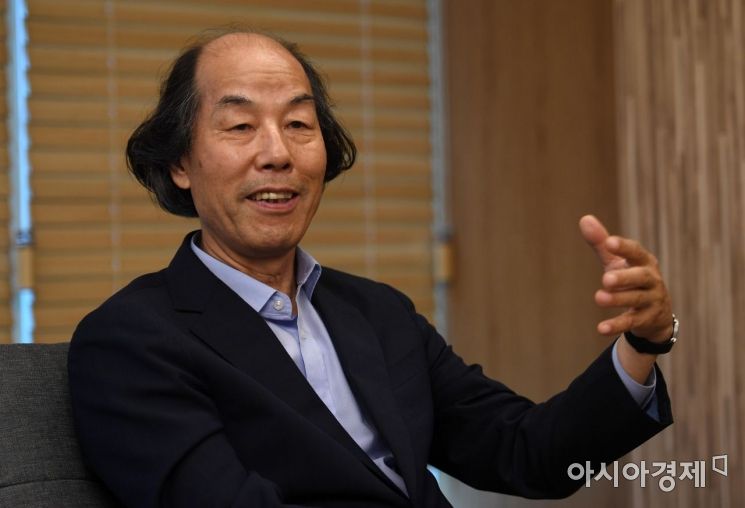 Professor Emeritus Kang Byung-geun of Konkuk University emphasized, "Cities must also be accompanied by spatial planning and policies that reflect the opinions of various members of society from the planning stage." Photo by Kim Hyun-min kimhyun81@
- What was the focus in the Urban and Architectural Innovation project?
▲ In the coming era, architectural planning that considers humane living is necessary. Large-scale apartment complexes that are isolated and closed off from their surroundings were intended to be transformed into open residential complexes that communicate with the local community. Cities also go through processes of growth and change. Future cities require policies and designs different from those so far, moving away from growth-centered urban planning and development. The theme of 'more humane' is always kept in mind as the background and purpose of urban planning.
- There are criticisms that public intervention is excessive in private reconstruction and redevelopment projects.
▲ Even though buildings are privately owned, once constructed, they become public instruments. Therefore, it is necessary to play a role that acknowledges private ownership but draws a certain line by checking whether they harmonize with the landscape and comply with various regulations. How apartment complexes are built inevitably affects all surroundings. If the public sector does not manage (support) this, individuals have no opportunity to look into such aspects and are unwilling to do so. Cities also require spatial planning and policies that reflect the opinions of diverse members of society from the planning stage. It is about presenting plans considering public interest, not forcing or interfering. If the public sector enters the private domain and adjusts things arbitrarily, that is not right.
- From the project stakeholders’ perspective, profitability must be the most important consideration.
▲ In redevelopment and reconstruction projects, it is difficult for stakeholders to reach agreement. In the case of Heukseok 11 District, public and private sectors considered both project feasibility and public interest together and completed the maintenance plan decision process within four months. It was a method that reflected individual tastes and demands while the public sector presented standards and reduced trial and error. If built with uniform designs stamped out like with a seal, construction costs might be reduced immediately, but this is a very short-term view. Even if built in the same location and size, the added value can differ by several times, which is much more profitable from an investment perspective.
- Reconstruction in areas like Apgujeong, Yeouido, and Mokdong is a hot topic. Will Urban and Architectural Innovation be applied there as well?
▲ Those areas about to undergo reconstruction are originally planned complexes and planned cities. The entire city was planned and developed at that time, but because reconstruction proceeded at different times for each complex, there is a side that cannot predict the future and each project proceeds independently. It is necessary to consider which complexes will be reconstructed immediately and which later, how roads and public facilities will be arranged, how landscapes will be adjusted, and how apartment complexes will organically fit with the functions of the region and city.
If residents see only individual pieces, the public sector must draw a big picture so that the pieces fit together like a puzzle. In Yeouido’s case, it is an apartment complex but also a financial special zone, so its function must be considered. The public sector must clearly present the direction for how residential areas in the international financial city should be reborn. Mokdong is already a structured city, so reconstruction requires increasing floor area ratio and ultimately vertical expansion by increasing the number of floors. However, if floors are increased without considering the dynamics with existing streets, complexes, and surroundings, it will result in a dense and bland high-rise complex. As the number of floors increases, the space between apartment buildings should be much wider.
© The Asia Business Daily(www.asiae.co.kr). All rights reserved.

















