Yongsan-gu Successfully Holds Academic Conference on Historical Significance of Yongsan Military Prison at Yongsan Cultural Center Auditorium on 27th... 20 Participants Including Professor Emeritus Jeong Jae-jeong of University of Seoul... Presentations and Discussions on Prison History, Spatial Arrangement, and Preservation Measures
[Asia Economy Reporter Park Jong-il] Yongsan Military Prison.
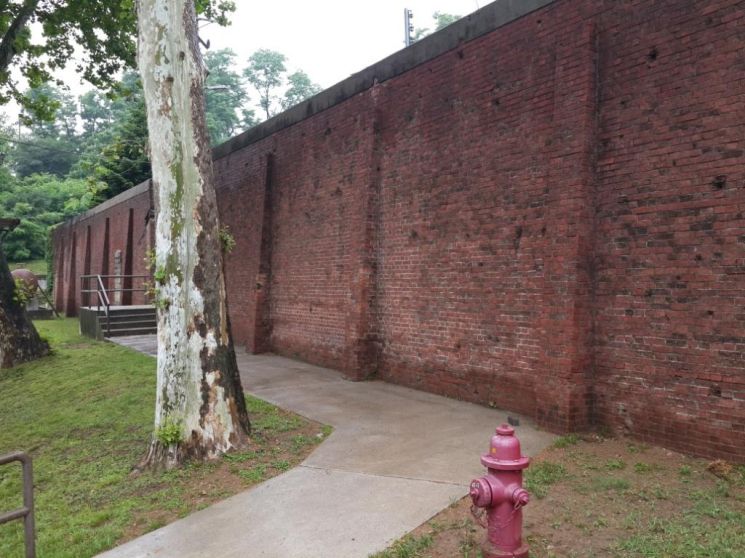
It is a military facility built within the base by the Japanese 20th Division, which was stationed in Yongsan, Seoul during the Japanese colonial period, to imprison Japanese soldiers and military personnel who violated the Military Penal Code. Although it was completed in 1909 and 111 years have passed, part of the building still remains in its original form within the Yongsan US military base.
On the 27th, Yongsan-gu (Mayor Seong Jang-hyun) and the Yongsan Cultural Center held an academic symposium titled “Research on the Historicity and Locality of Yongsan Military Prison (hereafter Military Prison)” in the large auditorium on the 3rd floor of the Cultural Center.
The purpose was to clarify the meaning and value of the Military Prison as a modern historical cultural heritage and to effectively preserve and utilize it.
The event lasted four hours in the order of guest introductions, greetings, keynote presentations, and panel discussions, with 20 participants including Park Sam-gyu, Director of Yongsan Cultural Center (host), Cha Sang-seok, Vice Chairman of Hanil Historical Materials (sponsor), and Jeong Jae-jeong, Professor Emeritus at the University of Seoul (chair).
To prevent the spread of the novel coronavirus disease (COVID-19), the number of attendees was minimized, and quarantine guidelines such as temperature checks and social distancing were strictly followed.
The keynote presentations were given by Kim Cheon-su, Head of the History and Culture Research Office at Yongsan Cultural Center; Kim Kwang-man, PD of The Channel; Nam Yong-hyeop, Researcher at Jium Architecture and Urban Research Institute; and Choi Hye-young, Professor in the Department of Civil and Environmental Engineering at Sungkyunkwan University (in order of presentation).
History of Yongsan Military Prison
First, Director Kim Cheon-su gave an overview of “The History of the Military Prison during the Japanese Colonial Period.” He stated, “The Military Prison was used as a military prison during the Japanese colonial period and was also used as a detention center for the US 7th Division after liberation when the US military was stationed at Yongsan Base. It is a very important subject of study from the perspective of historical continuity,” and then discussed the construction process of the Japanese Yongsan military camp and the Military Prison.
He also reexamined the independence activist leader Kang Gi-dong (1884-1911), who was imprisoned in the Military Prison in 1911, through various documents and newspaper articles. After the disbandment of the Korean Empire army in 1907, Kang Gi-dong was selected as an assistant to the Japanese military police and worked at the Goyang Military Police Substation in Yangju County, Gyeonggi Province. After witnessing the reality of Japanese suppression of the independence army, he turned into an independence fighter and was very active in areas such as Pocheon and Yangju in Gyeonggi Province.
In September 1909, Kang Gi-dong fled to North Gando to escape the Japanese “Southern Korea Large-scale Suppression” operation. In February 1911, he was captured by Japanese police in Wonsan, South Hamgyong Province, transported to Seoul, and was executed by firing squad at the Yongsan Japanese military execution ground on April 17. He was posthumously awarded the Presidential Medal of the Order of Merit for National Foundation in 1962.
Director Kim said, “Besides Kang Gi-dong, there may be others who were soldiers of the Korean Empire who were active as military police assistants or independence fighters and were imprisoned in the Military Prison. Further discovery of materials and research are needed.”
Osaka Military Prison
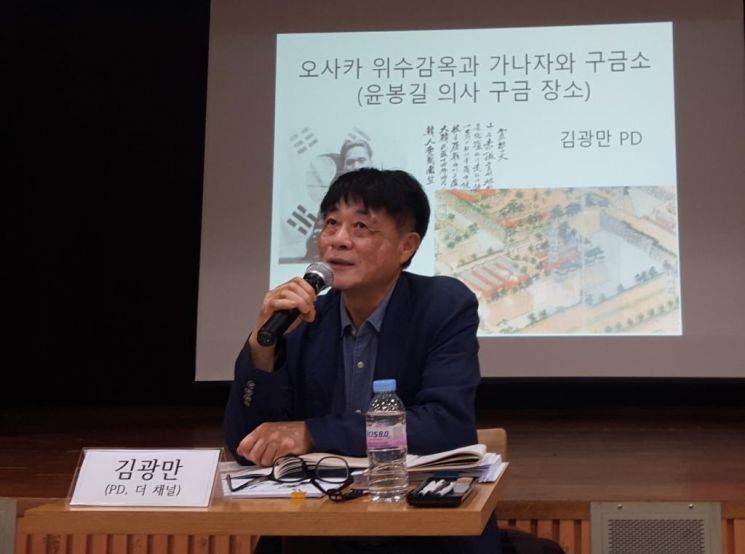
Next, PD Kim Kwang-man presented on the “Japanese Osaka Military Prison,” known as the detention site of independence activist Yun Bong-gil (1908?1932). The Osaka Military Prison was a military prison built by the Japanese 4th Division. It was located inside Osaka Castle, which was built by Toyotomi Hideyoshi during the Sengoku period.
On April 29, 1932, Yun Bong-gil threw a bomb at the Japanese military leadership in Hongkou Park, Shanghai, China. On May 25, he was sentenced to death at a military tribunal of the Shanghai Expeditionary Army. On November 18 of the same year, he was sent to Osaka Military Prison, then transferred on December 18 to the detention center of the Japanese 9th Division in Kanazawa, where he was executed by firing squad the next day at a nearby engineering worksite.
PD Kim disclosed that a few years ago, he found and publicly shared aerial photographs taken in 1928 of the Osaka Military Prison area and a survey map created in 1931 at the Osaka City Hall archives and Nakano-shima Library in Japan.
He said, “The Japanese military prison that does not exist in Japan is uniquely preserved in Yongsan in the world. We must diligently consider ways to preserve, restore, and utilize it well.”
Military Prison and Yongsan Park
Next, Researcher Nam Yong-hyeop discussed the “Military Prison from an Architectural Perspective.” According to him, the Military Prison was divided into a “cell area” and a “management building area.” While the prison walls and parts of the cell area (guard room, kitchen, and bathroom) still remain, the management building area was lost after the US military base was used.
Researcher Nam explained the spatial structure of the Military Prison by comparing it with Seodaemun Prison, Mapo Prison, and Kanazawa Prison, and said, “Unlike now, the Yongsan base during the Japanese colonial period was probably fenced off by unit rather than as a whole block.”
The Military Prison likely had direct access from Noksapyeong-daero rather than from inside the unit as it does now.
Finally, Professor Choi Hye-young gave a presentation titled “Military Prison from a Landscape Architecture Perspective.” As the lead landscape architect of West8, who led the design of Yongsan Park, Professor Choi attracted attention by revealing several revised park design plans over the past few years.
Professor Choi said, “Perceptions of uncomfortable history have changed a lot recently. Our memories are fundamentally place-based. The history and stories of the middle layer of Yongsan Base should be reflected in the park design.”
She also emphasized, “The visualization of memory must go beyond simple signs or explanatory texts.”
After the presentations, a discussion followed. Park Kyung-mok, Director of Seodaemun Prison History Hall, spoke on “The History of Seodaemun Prison and Comparison and Differences with the Military Prison.” Shin Ju-baek, Director of the Independence Movement History Research Institute, discussed “The Historicity of Yongsan Military Camp and Military Prison during the Japanese Colonial Period.” Kim Jong-heon, Professor in the Department of Architecture at Paichai University, talked about “The Locality of the Military Prison from an Architectural Perspective.”
In particular, Director Shin Ju-baek positively evaluated the event, saying, “There have been many symposiums on the general theory of the Yongsan Park project, but this is the first time to deal with detailed topics like today. It presented a new type of public discourse.”
In addition to the academic symposium at the Cultural Center, the district plans to actively lead the park project through support for the Ministry of Land, Infrastructure and Transport’s temporary opening project of the US military base (officer housing site), a resident awareness survey on the Yongsan Park development project, enactment of ordinances supporting the creation of Yongsan Park, and historical and cultural walking tours around the base area (planned).
Seong Jang-hyun, Mayor of Yongsan-gu, said, “As a cradle of modern and contemporary Northeast Asian history, the core of the US military base Yongsan Park project lies in historicity and locality. Academic conferences like this should be held continuously, and their content should be shared with citizens to take a step closer to the complete creation of the park.”
© The Asia Business Daily(www.asiae.co.kr). All rights reserved.


















