Increase in 20s Giving Up Job Search Due to COVID-19
Youth Say "No Jobs Available" and Quit Looking
Experts Say "Youth Feel Powerless... Need to Achieve Small Goals First"
 A job seeker is taking a break at the Youth Job Center in Jung-gu, Seoul. The photo is not related to any specific expression in the article. Photo by Asia Economy DB
[Asia Economy Reporter Seunggon Han, Intern Reporter Joohee Kang] "Why bother preparing for a job when you're going to fail anyway."
# Mr. A, in his 20s, who was preparing for employment until recently, has recently given up on job hunting. The already difficult job market has become unpredictably contracted due to the impact of the novel coronavirus infection (COVID-19). Mr. A said, "Until a few months ago, I used to submit resumes whenever job postings appeared, but I was repeatedly rejected during the document screening process. I have never even had an interview so far," adding, "Now, even if a job posting appears, I don't even think I will get accepted, so I don't even feel like applying."
As COVID-19 spreads and the domestic economic situation worsens, the number of so-called young 'NEETs' who give up on job hunting is increasing due to a reduction in jobs such as new hires. 'NEET' is a newly coined term referring to young unemployed people who are not working and have no intention to work (NEET: Not in Education, Employment or Training).
According to the 'May 2020 Employment Trends' survey released by Statistics Korea on the 10th, the economically inactive population last month was 16,548,000, an increase of 555,000 (3.5%) compared to the same month last year (15,992,000).
Among the economically inactive population, those who have the ability to work but have no plans to seek employment or simply chose to 'rest' without any particular reason numbered 2,286,000, marking the highest level for five consecutive months since exceeding 2 million in January, an increase of 322,000 (16.5%) compared to the same month last year.
The 'resting' population increased across all age groups, but especially among those in their 20s, it rose to 424,000, a 32.8% increase compared to 105,000 in the same month last year, showing the largest increase among all age groups.
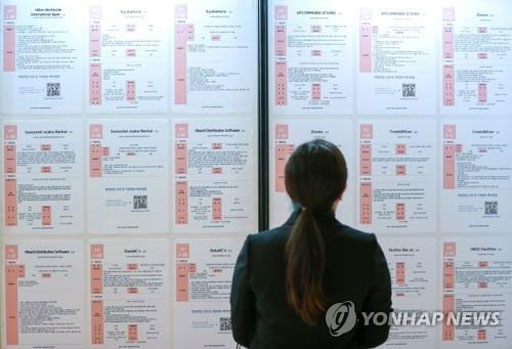 Amid the worsening domestic economic situation due to the impact of the novel coronavirus infection, the number of so-called youth 'NEETs' who give up job hunting as new hires and job opportunities themselves decrease is increasing. Photo by Yonhap News
Youths complain that even if they want to work, they become helpless because there are simply no jobs available.
Another job seeker in their 20s, Mr. B, said, "These days, there really are no jobs, and even if there are, the competition is tremendous. Even getting accepted for a short-term internship is like reaching for the stars," adding, "There is no sign that COVID-19 will subside, and there is no hope that the situation will improve. You can't wait endlessly forever. As this situation continues, the motivation to get a job has disappeared before I knew it."
Given this situation, there is also a research study predicting that by the end of this year, the non-job-seeking NEET population will reach 10% of the youth population (12,238,000).
The Korea Labor Institute (Senior Researcher Jaeryang Nam) analyzed raw data from the Economically Active Population Survey from January to May this year and projected that the youth non-job-seeking NEET population will be 530,000, accounting for 10.4% of the total youth population.
Researcher Nam expressed concern, saying, "If this trend continues, the non-job-seeking NEET population will increase to 1,273,000 by the end of this year, and as the number of young NEETs increases, social problems such as low birth rates could also become more serious."
Experts advised that to overcome the sense of helplessness caused by the employment crisis, it is necessary to increase self-achievement through small goals or light hobbies.
Professor Kumju Kwak of the Department of Psychology at Seoul National University explained the reason for the increase in young NEETs, saying, "The employment crisis has not been continuously improving, and recently, the economy has worsened further due to COVID-19, deepening the psychological helplessness of young people," adding, "Many young people are trying to get a job, but after repeated failures, they end up giving up everything."
She continued, "There is no sign that the economy is generally improving or that the situation is getting better. The future is unpredictable and uncertain, so the helplessness of young people can only grow," expressing concern that "If the youth employment crisis continues, it will lead to economic burdens and eventually to issues such as marriage and childbirth."
© The Asia Business Daily(www.asiae.co.kr). All rights reserved.


















