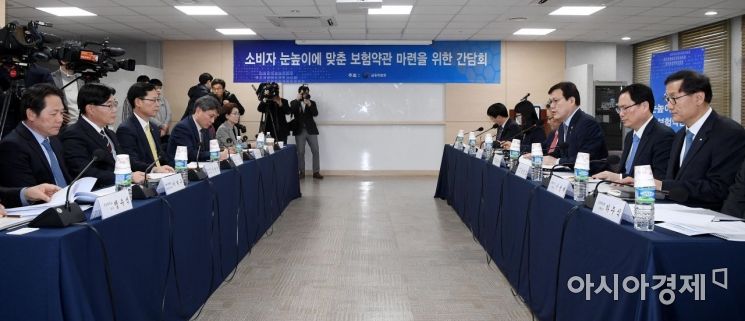
 Financial Services Commission Chairman Choi Jong-gu (third from the right) is delivering opening remarks at the "Meeting for Preparing Insurance Terms and Conditions Tailored to Consumer Perspectives" held on the 26th at the Insurance Development Institute in Yeouido, Yeongdeungpo-gu, Seoul. Attendees included Chairman Choi Jong-gu, officials from the Financial Supervisory Service, Insurance Development Institute, Korea Insurance Research Institute, life insurance companies, non-life insurance companies, the Consumer Citizens' Coalition, and insurance consumers (agents and policyholders). Photo by Kim Hyun-min kimhyun81@
[Asia Economy Reporter Oh Hyung-gil] In the first quarter of this year, complaints in the insurance industry increased compared to the same period last year.
According to the Financial Supervisory Service on the 27th, out of a total of 22,121 financial complaints in the first quarter, 5,530 were related to life insurance. This represents a 15% (723 cases) increase compared to the same period last year. Complaints related to non-life insurance also rose by 12.1% (851 cases) to 7,862 compared to the first quarter of last year.
In life insurance, complaints related to insurance solicitation accounted for the largest share at 53.7%, followed by insurance claim calculation and payment (17.3%), and exemption and liability decisions (10.8%).
For non-life insurance, complaints were mainly about insurance claim calculation and payment (43.0%), contract establishment and cancellation (10.2%), insurance solicitation (7.7%), and exemption and liability decisions (6.2%).
A significant number of complaints arise during the insurance contract solicitation and payment stages, indicating that agents may not be providing sufficient explanations to customers at the time of contracting insurance.
Recently, a decision was made that if an insurer fails to adequately explain important terms of the insurance policy, insurance benefits for general cancer should be paid even for metastatic cancer.
The Korea Consumer Agency's Consumer Dispute Mediation Committee ruled that an insurer must pay general cancer insurance benefits after refusing payment on the grounds that thyroid metastatic cancer is a minor cancer, not general cancer, stating that the insurer did not properly notify the scope of coverage, which is an important term of the policy.
Mr. A, in his 60s, subscribed to two products from the insurer via telemarketing in January and September 2016. In May 2018, he was diagnosed with thyroid cancer and thyroid metastatic cancer and filed a claim for cancer insurance benefits. The insurer paid only the minor cancer benefit for the initially diagnosed thyroid cancer and refused to pay the general cancer benefit for the thyroid metastatic cancer.
The insurer argued that secondary cancers such as metastatic cancer are paid based on the initially diagnosed cancer, as specified in the insurance policy, and that Mr. A agreed to this at the time of subscription.
Thyroid metastatic cancer refers to cancer cells from the thyroid spreading to lymph nodes or other organs and is classified as a secondary cancer. Minor cancers are those for which 20-30% of the general cancer insurance benefit is paid, and most cancer insurance policies classify thyroid cancer and other skin cancers as minor cancers.
However, the mediation committee judged that although the clause stating that benefits are paid based on the initially diagnosed cancer is a major term of the insurance contract, the insurer neglected its duty to clearly state and explain this clause, and thus ordered the insurer to pay Mr. A 37.4 million KRW in general cancer insurance benefits.
It was also considered that the clause is not a general matter that can be sufficiently anticipated without separate explanation, and that under the "Act on the Regulation of Terms and Conditions," if a contract is concluded in violation of the duty to clearly state and explain terms, the clause cannot be used as grounds for denying insurance benefits.
The Dispute Mediation Committee stated, "This decision is significant in that it points out the problem of insurers unjustly refusing to pay insurance benefits despite neglecting their duty to clearly state and explain policy terms."
© The Asia Business Daily(www.asiae.co.kr). All rights reserved.
![Clutching a Stolen Dior Bag, Saying "I Hate Being Poor but Real"... The Grotesque Con of a "Human Knockoff" [Slate]](https://cwcontent.asiae.co.kr/asiaresize/183/2026021902243444107_1771435474.jpg)
















