[Asia Economy Reporters Seulgina Jo and Aeri Boo] "In reality, new hiring is zero (0)."
The competition to secure specialized personnel in artificial intelligence (AI), which will lead the 4th Industrial Revolution, has been directly hit by the novel coronavirus disease (COVID-19). Domestic companies, which never hesitated to travel long distances to the US, Europe, and other places to connect with AI experts and international students, have been completely immobilized. Major meeting venues such as global AI conferences have all been replaced by online formats, and many companies have lost their hiring capacity due to increased economic uncertainty. If this continues, there are growing concerns that not only will the government's declaration of becoming an AI powerhouse be difficult to achieve, but even leading the 'Digital New Deal,' a part of the post-COVID measures, will be challenging.
Overseas Talent Recruitment Severely Cut Off by COVID-19... Domestic AI Workforce Shortage Deepens
According to the business community on the 26th, the domestic companies' AI workforce shortage has worsened this year due to difficulties in recruiting overseas talent amid the COVID-19 aftermath. A representative from a major domestic company said, "All recruitment efforts for overseas AI personnel that we had been in contact with have come to a complete stop," adding, "If we consider only hiring 'AI experts' rather than internal personnel reallocation, it is virtually zero this year."
Naver, which had used the International Conference on Computer Vision (CVPR) held annually in the US in June as an opportunity to recruit AI talent, is also in a difficult situation. Most events were canceled or replaced online, eliminating opportunities to scout talent. The 'Naver AI Colloquium,' which invited AI researchers worldwide to Seoul as a platform for exchange, is also at a standstill. Naver Labs Europe, established by Naver to nurture AI talent in Europe, is also facing challenges. A Naver official said, "Until last year, we actively exchanged AI technology and personnel with Naver Labs Europe, but this year, we have yet to set any concrete plans."
Kakao's plan to recruit AI talent through developer conferences has also fallen through. A Kakao representative lamented, "Due to COVID-19, it is impossible to operate recruitment booths overseas," adding, "There is also a limited domestic AI talent pool, so even if we want to hire, we cannot." A representative from a mid-sized company mentioned Samsung Electronics' recent appointment of Sebastian Seung, a world-renowned AI scholar from Princeton University, as head of Samsung Research, saying, "Recruiting overseas AI experts who receive billions in annual salary is just a dream."
Given this situation, some companies have given up on recruiting AI experts and shifted their focus to 'internal talent development,' but even this is difficult. Most programs conducted in collaboration with domestic graduate schools such as KAIST by companies like Samsung Electronics and LG Electronics have been canceled. AI talent development programs targeting university and graduate students are also struggling. For example, Kyung Hee University canceled its 'AI Youth Talent Development Program,' which had been running for two years.
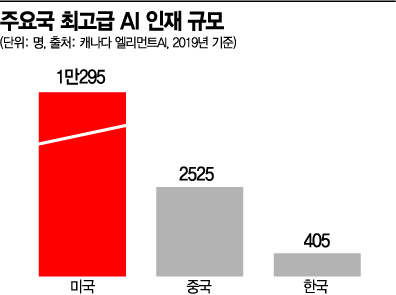
The AI workforce shortage is due to an imbalance in supply and demand caused by the rapid growth of the AI industry and the slow progress of talent development through educational institutions. According to data released last year by Canadian research institute Element AI on AI experts in major countries, the US has 10,295, China 2,525, the UK 1,475, while Korea has only 405. The Software Policy & Research Institute predicted that nearly 10,000 AI talents will be lacking domestically by 2022.
The Korean delegation to the Organisation for Economic Co-operation and Development (OECD) pointed out, "Although the technology adoption rate of Korean professionals is above the average of the G20 countries, there are more outflows than inflows," adding, "Many are working abroad rather than in Korea." This is the background behind Kakao Chairman Beom-su Kim's appeal at the 2018 National Assembly audit regarding the persistent AI workforce shortage. The existing talent tends to move overseas where there are high salaries and freer corporate cultures, while domestically, the repeated recycling of existing personnel makes it difficult to secure high-level talent that requires long-term accumulation of skills and knowledge."
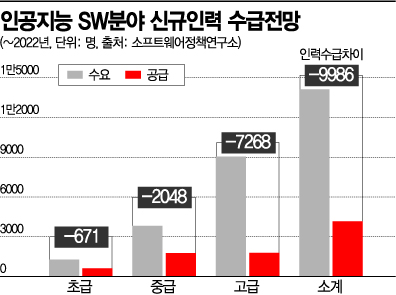
AI specialized personnel are broadly categorized into three types: ▲ academic research-focused experts who deeply handle core AI technologies ▲ practical AI technology personnel who can collaborate in industrial sites to commercialize products ▲ 'AI+X' experts who conduct research by integrating AI with various fields such as finance, healthcare, gaming, and autonomous driving. The problem is that both expert and technical personnel are far below the levels companies require.
Academia is raising voices to actively nurture personnel who can industrialize AI technology and integrate it with other industries. Choi Yang-hee, Chair of the AI Committee at Seoul National University, emphasized, "If the required level of AI research personnel focusing on core technologies is 1, then personnel for product commercialization should be 10, and convergent AI+X personnel should be 100." Shin Jin-woo, a professor at KAIST Graduate School of AI, said, "Since this is a new technology, the shortage of personnel is not unique to Korea; the US faces the same issue," adding, "It takes time to nurture talent."
Earlier, the Ministry of Science and ICT announced a national AI strategy including talent development, such as expanding top-level AI graduate programs and implementing mandatory AI education in elementary, middle, and high schools starting in 2022.
© The Asia Business Daily(www.asiae.co.kr). All rights reserved.
![User Who Sold Erroneously Deposited Bitcoins to Repay Debt and Fund Entertainment... What Did the Supreme Court Decide in 2021? [Legal Issue Check]](https://cwcontent.asiae.co.kr/asiaresize/183/2026020910431234020_1770601391.png)

















