Seoul Comprehensive Disaster Prevention Center and Seoul Medical Support Team Jointly Develop Guidelines for Nationwide Distribution
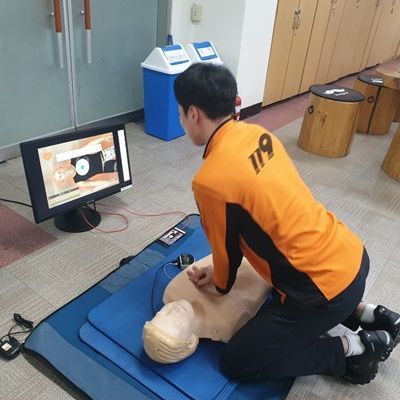
[Asia Economy Reporter Jo In-kyung] A standardized guideline has been released to help emergency medical technicians continue chest compressions via video call until they arrive at the scene when a patient experiences sudden cardiac arrest.
The Seoul Comprehensive Disaster Prevention Center and the Seoul Emergency Medical Support Team announced on the 26th that they have developed the 'Video Medical Guidance Guideline for Cardiac Arrest Patients' for the first time in Korea and will distribute it to 119 call centers nationwide.
The golden time for cardiac arrest patients is 4 minutes. According to the newly developed guideline, 119 call operators will guide chest compressions via voice call and then immediately switch to video call to correct posture and improve effectiveness.
Simulation results also showed that video call medical guidance is actually effective in increasing the survival rate of cardiac arrest patients compared to voice calls. When receiving guidance via video call, the depth of chest compressions was on average 5 mm deeper than with voice calls, the rate of finding the correct chest compression position was over 10% higher, and the chest compression speed was on average more than 2 minutes faster.
Providing medical guidance for emergency treatment of cardiac arrest patients through video calls is a very rare case worldwide, and the Seoul Fire & Disaster Headquarters expects this guideline to be internationally applicable.
Meanwhile, the number of cardiac arrest patients in Seoul was 9,355 in 2017, 10,657 in 2018, and 10,345 in 2019. During the same period, the number of cardiac arrest patients reported to Seoul Fire 119 and transported to hospitals was 3,942, 4,100, and 3,975, respectively.
Since the Seoul Comprehensive Disaster Prevention Center of the Seoul Fire & Disaster Headquarters first introduced 'Smart Video Emergency Treatment' in 2017, the number of emergency treatments supported via video call was 1,151 in 2017, 1,215 in 2018, and 1,542 in 2019. Among these, guidance for cardiac arrest patients increased annually with 429, 510, and 594 cases respectively.
Shin Yeol-woo, head of the Seoul Fire & Disaster Headquarters, said, "Cardiac arrest patients can occur anytime around us," and added, "We hope that spreading this video medical guidance guideline for cardiac arrest patients to 119 call centers nationwide will help increase patient survival rates."
© The Asia Business Daily(www.asiae.co.kr). All rights reserved.

















