Despite Strong Government Real Estate Measures, Housing Prices Rise in the Seoul Metropolitan Area
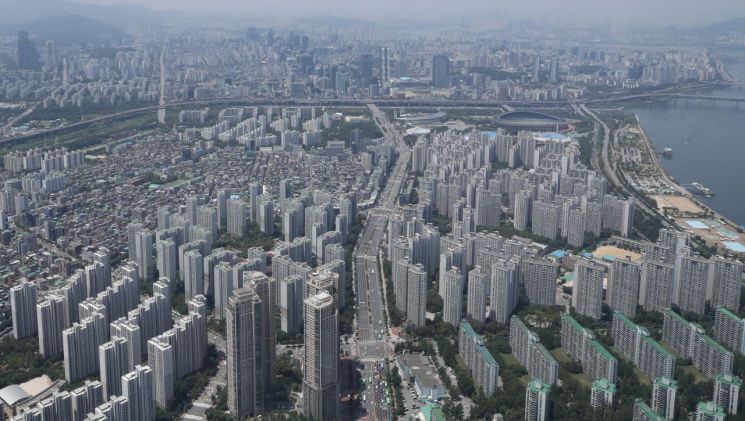
[Asia Economy Reporter Moon Jiwon] Although the government has introduced strong real estate measures to curb soaring housing prices, apartment prices in Seoul and the metropolitan area continue to rise. In particular, areas such as Gimpo in Gyeonggi-do, which were excluded from the recent regulations, showed a sharp increase in apartment prices due to a 'balloon effect.'
According to the "Weekly Apartment Price Trends for the 4th Week of June" released by the Korea Real Estate Board on the 25th, as of the 22nd, apartment prices in Seoul rose by 0.06%. Although this is slightly less than the 0.07% increase the previous week, the upward trend was maintained.
The Korea Real Estate Board analyzed, "The rise is driven by abundant liquidity due to the low-interest rate environment and the impact of development prospects. However, the increase has narrowed due to the June 17 measures and the designation of restricted zones in the Gangnam area."
In the Gangnam 3 districts, the increase narrowed somewhat due to strengthened regulations following the June 17 measures. In Songpa-gu (0.07%), prices rose slightly as transactions suddenly increased before the Jamsil area was designated as a land transaction permission zone. Gangnam-gu (0.05%) and Seocho-gu (0.07%) saw increases mainly in major complexes such as Dogok and Banpo-dong.
Gangdong-gu (0.07%) continued its upward trend mainly in new buildings, while Yangcheon-gu (0.13%) saw price increases centered around Mok-dong and Sinjeong-dong, where reconstruction prospects exist. Guro-gu (0.11%) experienced apartment price rises mainly around the Guro and Gaebong-dong station areas.
The upward trend also continued north of the Han River. Dongdaemun-gu (0.09%) saw increases mainly in areas with expectations for the Cheongnyangni station area (GTX-AB), and Nowon-gu (0.08%) rose mainly in mid- to low-priced complexes in Junggye and Wolgye-dong. Gangbuk-gu (0.07%) showed a clear upward trend in new complexes in Mia-dong.
Gimpo, which was not included in the regulated areas in this measure, showed a sharp rise of 1.88% this week. This is interpreted as a result of a significant increase in purchase inquiries for apartment complexes around the Hangang New Town, while the number of listings decreased.
Other areas such as Ansan (0.74%), Guri (0.62%), Suwon Jangan-gu (0.58%) and Paldal-gu (0.58%), and Yongin Giheung-gu (0.58%) also showed upward trends in apartment prices.
Incheon, which was largely included in the regulated areas this time, also saw an expanded increase of 0.34% compared to 0.26% the previous week. Bupyeong-gu (0.59%) rose mainly in Bugae-dong, influenced by redevelopment projects and transportation benefits, and Yeonsu-gu (0.53%) increased mainly in Songdo and Yeonsu-dong. Seo-gu (0.39%) saw an expanded increase mainly in new buildings in Cheongna and Sinhyeon-dong.
Sejong also saw a sharp rise in apartment prices, increasing by 1.55% this week. The Korea Real Estate Board explained, "The increase was larger mainly in Goun, Areum, and Jongchon-dong areas with good transportation accessibility and residential environment, as well as in low-priced complexes in Jochiwon-eup."
On the other hand, Cheongju, which was newly designated as a regulated area after showing a recent rapid rise, only rose by 0.46%. Purchase sentiment weakened in most areas such as Cheongwon (0.84%) and Heungdeok-gu (0.54%), resulting in a narrowed increase.
© The Asia Business Daily(www.asiae.co.kr). All rights reserved.
![Clutching a Stolen Dior Bag, Saying "I Hate Being Poor but Real"... The Grotesque Con of a "Human Knockoff" [Slate]](https://cwcontent.asiae.co.kr/asiaresize/183/2026021902243444107_1771435474.jpg)
















