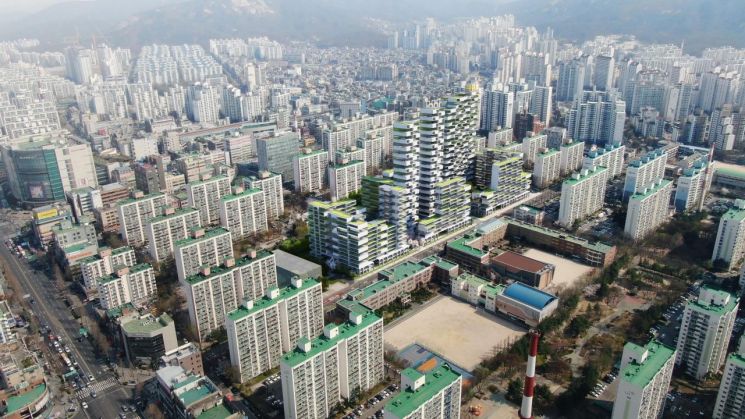
 Aerial perspective of the reconstruction of Sangye Jugong Complex 5 in Sangye-dong, Nowon-gu, Seoul.
[Asia Economy Reporter Donghyun Choi] Seoul has completed the preliminary plans for 2 out of 4 pilot sites for the 'Urban and Architectural Innovation' project. This project has been underway since March last year, aiming to create innovative new landscapes in place of monotonous apartment complexes.
On the 25th, Seoul unveiled the drafts for the pilot projects: the reconstruction of Sanggye Jugong Complex 5 in Nowon-gu and the redevelopment of the area around 1 Beonji, Geumho-dong 3-ga, Seongdong-gu. These projects involved multiple discussions by teams composed of city and district departments, public planning advisory groups, and public architects. Various opinions from maintenance associations and local residents were also incorporated into the basic plans during this process.
◆ Sanggye Jugong Complex 5: From an isolated island to an open communication space = Sanggye Jugong Complex 5 will transform from a large-scale apartment complex isolated like an island within the city, disconnected from its surroundings, into an open residential complex that communicates with the local community. It will introduce building-integrated solar power and electric vehicle-only parking lots, becoming the first private reconstruction project to be developed as an eco-friendly zero-energy complex.
Sanggye Jugong Complex 5 particularly reflects the 'Seoul Apartment Development Standards' by incorporating five principles into its basic plan. These principles are ▲ small-scale block design ▲ creation of shared living streets connecting to surrounding complexes ▲ introduction of lifestyle service facilities needed by the community ▲ a skyline plan combining open courtyard types and high-rise towers considering views of Bulamsan Mountain ▲ adoption of adaptable floor plans that respond to life cycles.
What was once a single massive block will be restructured into several small blocks, connected to the surroundings by shared living streets between the blocks. Convenience facilities such as daycare centers and playgrounds, used jointly by local residents, will be placed along the streets.
Additionally, considering that 85.7% of the total households are existing tenants and the proportion of 1-2 person households is increasing, various unit sizes will be actively introduced. This is intended to accommodate diverse future demands according to life stages.
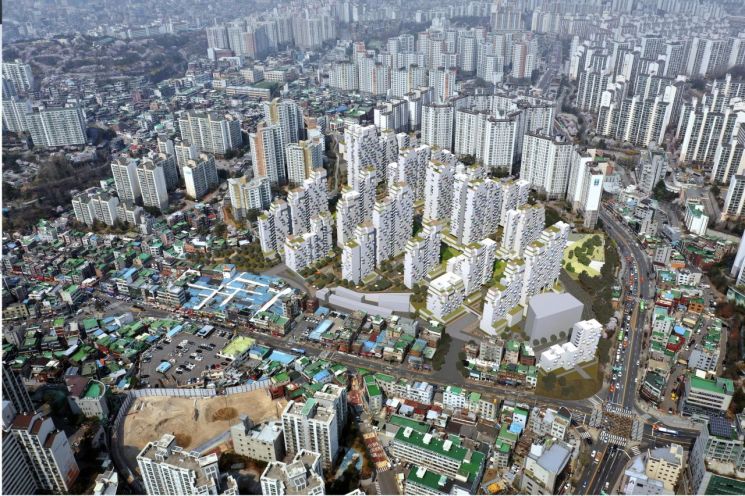
◆ Redevelopment of 1 Beonji, Geumho-dong 3-ga: Creating a green-rich pedestrian path = The area around 1 Beonji, Geumho-dong 3-ga is a densely populated, aging low-rise residential area scheduled for redevelopment. It presents a new residential model with a 'hill-friendly' design among the existing screen-like apartments that form an imposing landscape along the slopes of Eungbongsan Mountain by the Han River.
The basic plan includes four principles under the goal of 'opening the complex along the hills and connecting parks along the contours': ▲ public planning contributing to the surrounding community ▲ creation of parks and public pedestrian paths following the original terrain ▲ building small villages for an open complex ▲ diverse skyline plans.
To adapt to the hilly terrain with elevation differences of 40 to 50 meters, the plan proposes arranging several small villages centered on north-south pedestrian green axes. Additionally, a slope elevator will be installed on the steep stairway leading to Geumnam Market to improve mobility for local residents. Architect Jin Jinbok said, "Through urban and architectural innovation, we hope to contribute to transforming Seoul’s apartment culture by creating open villages that break the closed communities of apartments and realizing diversity in living within multi-family housing."
Seoul expects to complete the maintenance planning procedures within the year, as both projects were developed with public interest and business feasibility considered jointly by the city, experts, and residents. Furthermore, the city plans to take full responsibility to ensure that these basic plans are consistently maintained through actual project implementation and completion, not just remaining as plans.
This year, Seoul will select more than 18 additional project sites to actively promote urban and architectural innovation. Five new sites have already been selected in the first half of the year. These include ▲ Ogeum Hyundai Apartments ▲ the area around 397-419 Cheonho-dong ▲ Sillim 1 District ▲ Euljiro 3-ga District 6 Zone ▲ Wangsimni Station area. Seoul plans to select sites and promote projects considering factors such as regional balanced development, revitalization of station areas, protection of downtown industries, and large-scale apartment management urban planning, which are key policies and projects currently pursued by the city. A Seoul city urban planning official explained, "This project is just taking its first steps and has a long way to go. We plan to institutionalize it naturally so that any complex can apply in the future."
Jin Heeseon, Seoul’s Deputy Mayor for Administration 2, said, "Urban and architectural innovation is significant because the public sector has proactively realized achievable ideals. We will do our best to apply urban and architectural innovation measures to all future maintenance projects to change and innovate Seoul’s apartment culture."
© The Asia Business Daily(www.asiae.co.kr). All rights reserved.
!["The Woman Who Threw Herself into the Water Clutching a Stolen Dior Bag"...A Grotesque Success Story That Shakes the Korean Psyche [Slate]](https://cwcontent.asiae.co.kr/asiaresize/183/2026021902243444107_1771435474.jpg)

















