Conservative Think Tank CSIS Holds US-ROK Strategic Forum Keynote Speech
Deputy Minister Cho: "Tensions on the Korean Peninsula Have Risen, but Turning Back the Clock Is Too Risky"
Targeting US Pressure for Large Defense Cost Increase: "Last Year's 8.2% Defense Cost Increase Is Four Times South Korea's Economic Growth Rate"
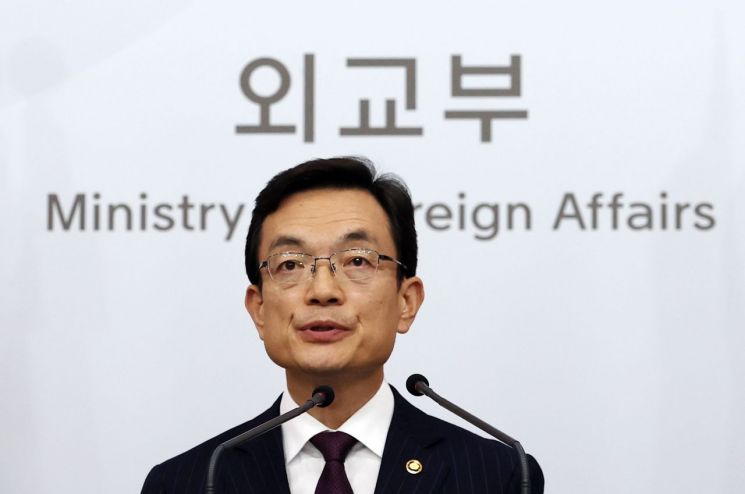
[Asia Economy Reporter Lim Cheol-young] “There has been significant progress over the past two years, but unfortunately, we are once again facing a reality where tensions between the South and North have escalated. Nevertheless, the South Korean government will continue its efforts to prevent further escalation. Turning back the clock now carries too great a risk and would lead to frustration due to difficulties.”
Cho Se-young, First Vice Foreign Minister of the Ministry of Foreign Affairs, who delivered the keynote speech at the 5th Korea-US Strategic Forum jointly hosted by the Center for Strategic and International Studies (CSIS), representing conservative voices in the United States, and the Korea Foundation on the 24th, emphasized that cynicism rejecting peace as a pipe dream must be firmly rejected.
Vice Minister Cho also highlighted the balanced development of the Korea-US alliance, stressing that achieving denuclearization and peace on the Korean Peninsula are important areas that require joint efforts. He stated, “Dialogue, steady engagement, and healthy prescriptions for patients are the only constructive options to move forward.”
He continued, “Peace and denuclearization on the Korean Peninsula are areas where the United States and China can cooperate for a common goal,” adding, “Bringing North Korea back to the negotiating table to achieve denuclearization and establish a peace regime on the Korean Peninsula opens opportunities not only for South Korea but also for Washington to fulfill strategic objectives in the region.”
Amid recent hardline moves by North Korea, such as the demolition of the Kaesong Inter-Korean Joint Liaison Office, and the controversy over former White House National Security Council (NSC) advisor John Bolton’s memoir, which has increased critical voices within the US regarding the resolution of Korean Peninsula issues, Vice Minister Cho once again emphasized the importance of dialogue.
He also made pointed remarks aware of the stalled Korea-US Special Measures Agreement (SMA) negotiations, which have been in a six-month agreement gap. Since US President Donald Trump has not relented on his plan for a significant increase, negotiations that began in September have reached a deadlock. The US initially demanded an increase in defense cost-sharing from about $900 million to $5 billion. After adjustments, they are requesting $1.3 billion, a 50% increase from last year, but it remains an unreasonably high level.
Vice Minister Cho emphasized, “South Korea has supported US forces under the SMA for 30 years and has been increasing its financial contributions,” adding, “The increased defense cost-sharing last year was 8.2% compared to the previous year, which is more than four times South Korea’s economic growth rate.” He further noted, “South Korea is the largest importer of US weapons, has increased its defense budget by an average of 7.5% since 2017, and currently spends 2.6% of its Gross Domestic Product (GDP) on defense.”
He added, “Although the two countries are currently engaged in difficult negotiations, as the saying goes, ‘April showers bring May flowers,’ we will find creative solutions.”
He also addressed the issues of wartime operational control transfer and missile guidelines revision. Vice Minister Cho said, “An early transfer of wartime operational control will help Koreans accept the United States as an ally,” and “The Korean people believe it is time for South Korea to protect its own peace and security.”
He went on to say, “Lifting the long-standing restrictions on space and satellite development that were applied to South Korea decades ago would also be a good starting point.” This is interpreted as signaling the Moon Jae-in administration’s intention to complete the wartime operational control transfer within its term and indirectly expressing the need to improve the Korea-US missile guidelines.
© The Asia Business Daily(www.asiae.co.kr). All rights reserved.
![Clutching a Stolen Dior Bag, Saying "I Hate Being Poor but Real"... The Grotesque Con of a "Human Knockoff" [Slate]](https://cwcontent.asiae.co.kr/asiaresize/183/2026021902243444107_1771435474.jpg)
















