Mandatory Employment Insurance for Special Employment Rapidly Advancing
Concerns Over Structural Reorganization of Design Organizations Due to Cost Burden
"Alternatives Such as Voluntary Enrollment Need to Be Discussed"
[Asia Economy Reporter Oh Hyung-gil] As discussions on mandatory employment insurance for special employment workers such as insurance planners gain momentum, disputes over the scale of insurance premium burdens are expected to resurface.
If the insurance premiums that insurance companies must bear are high, it could trigger restructuring and mass layoffs of planners, leading to significant differences in opinions among stakeholders regarding the burden scale.
According to the government and insurance industry on the 24th, the Ministry of Employment and Labor plans to prepare a "Employment Insurance Act Amendment" within the year to apply employment insurance to special employment workers. Minister Lee Jae-gap of the Ministry of Employment and Labor stated, "By the end of this year, we will prepare a 'Roadmap to Eliminate Blind Spots in Employment Insurance' for an era of employment insurance for all citizens, and thereafter, through social dialogue, gradually expand the scope of application."
Movements in the National Assembly are also becoming visible. Assemblywoman Han Jeong-ae of the Democratic Party recently proposed an amendment to the Employment Insurance Act aimed at expanding the coverage of employment insurance to special employment workers.
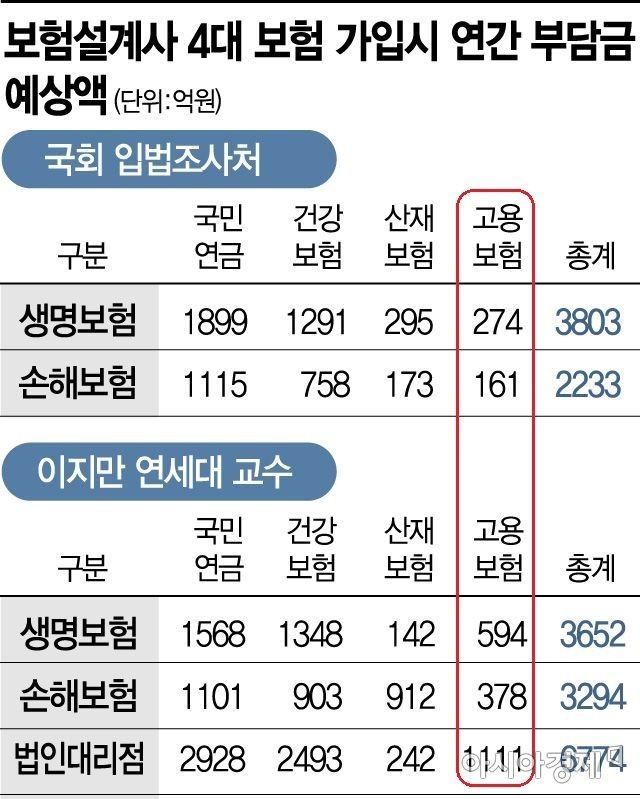
As the mandatory employment insurance gains momentum, the insurance industry is on high alert. The industry estimates that annual costs exceeding 200 billion KRW will occur if planners enroll in employment insurance. This estimate is based on data presented by Professor Lee Ji-man of Yonsei University at a National Assembly forum in 2018.
According to Professor Lee, if employment insurance becomes mandatory, life and non-life insurance companies will incur monthly costs of 8.1 billion KRW and 9.26 billion KRW for General Agencies (GA), respectively. Annually, this amounts to 97.2 billion KRW and 111.1 billion KRW, totaling over 200 billion KRW in costs.
Furthermore, if planners are required to enroll in the four major insurances, the monthly burden for insurance companies and GAs is estimated at 107.5 billion KRW, exceeding 1 trillion KRW annually. These results are inferred based on the incomes of 224,492 planners out of 407,250 planners affiliated with insurance companies and corporate agencies (GA).
On the other hand, planners argue that these figures are excessively inflated. According to data submitted by the insurance industry to the National Assembly Legislative Research Office in 2017, the costs were calculated to be excessively high.
According to the Legislative Research Office's report titled "Issues and Future Tasks Regarding the Application of the Four Major Insurances to Insurance Planners," if employment insurance is introduced for approximately 194,200 exclusive planners, life insurance companies would bear an annual cost of 27.4 billion KRW, and non-life insurance companies 16.1 billion KRW.
They counter that even if 400,000 planners enroll in employment insurance, the industry's annual insurance premium burden will not exceed 100 billion KRW. They explain that even if enrollment in the four major insurances is mandatory, the annual burden would be only about 603.7 billion KRW.
An industry official emphasized, "If employment insurance for planners becomes mandatory, insurance companies will inevitably feel the cost burden," adding, "Considering the impact on the industry, various alternatives such as voluntary enrollment methods should be discussed."
© The Asia Business Daily(www.asiae.co.kr). All rights reserved.
![Clutching a Stolen Dior Bag, Saying "I Hate Being Poor but Real"... The Grotesque Con of a "Human Knockoff" [Slate]](https://cwcontent.asiae.co.kr/asiaresize/183/2026021902243444107_1771435474.jpg)











