Ignoring the Role and Characteristics of National Policy Banks, Focusing Only on the Development of Local Cities
Parliament Criticized for Increasing Confusion Amid COVID-19 Financial Support Situation
[Asia Economy Reporter Jo Gang-wook] With the emergence of a dominant ruling party holding 177 seats, discussions on the 'Public Institution Relocation Season 2' have resurfaced rapidly, causing headaches for financial public institutions. There is even an imminent proposal of a bill to transfer these institutions to relevant ministries. Financial institutions are strongly opposing this unilateral move, calling it unrealistic. Some argue that amid the COVID-19 pandemic, when financial support should be focused on companies and ordinary citizens facing cash flow shortages, the National Assembly is only adding to the confusion.
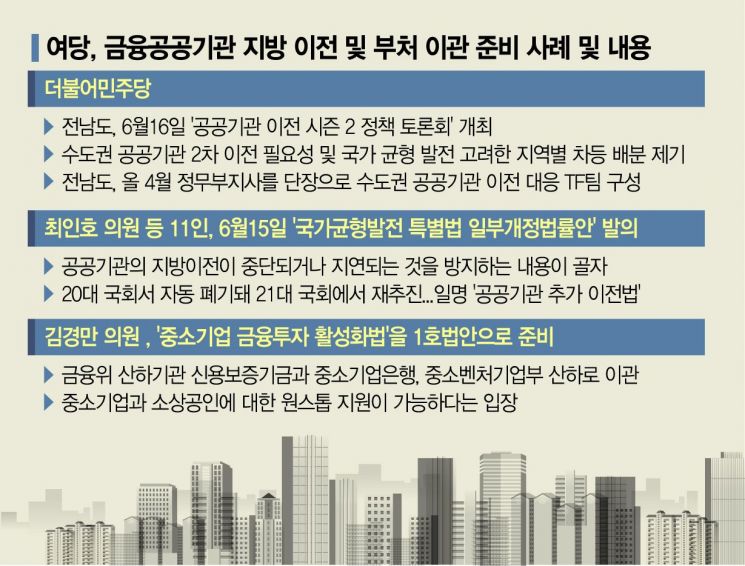
According to the National Assembly and financial circles on the 24th, the Democratic Party of Korea and Jeonnam Province recently held a 'Public Institution Relocation Season 2 Policy Forum.' About 100 people, including Jeonnam Governor Kim Young-rok, former Democratic Party floor leader Woo Won-shik, Jeonnam Party Chairman Seo Sam-seok, other lawmakers from the Honam region, experts, and public officials, attended the forum held at the National Assembly Library Auditorium. At the event, Governor Kim stated, "The first relocation alone is insufficient for public institutions to grow into 'regional growth hubs'." Jeonnam Province had already formed a task force (TF) team led by the Deputy Governor for Political Affairs in April this year to respond to the relocation of public institutions from the metropolitan area, reviewing 23 target institutions and their linkage with local industries, and establishing attraction strategies and implementation tasks.
Earlier, on the 15th, 11 lawmakers including Democratic Party member Choi In-ho proposed a partial amendment to the 'Special Act on Balanced National Development' (hereinafter referred to as the Balanced Development Act), which includes regular annual reviews of public institutions subject to relocation. This bill, known as the 'Additional Public Institution Relocation Act,' was initially proposed in the 20th National Assembly but was automatically discarded due to the expiration of the term and is now being reintroduced in the 21st National Assembly. The core of the bill is to prevent the suspension or delay of public institution relocations.
Additionally, Kim Kyung-man, a member of the National Assembly’s Industry, Trade, Small and Medium Enterprises Committee from the Democratic Party, plans to promote the 'Small and Medium Enterprise Financial Investment Activation Act' as his first bill. This bill, which Kim has emphasized since before his election, aims to unify institutions related to SME funding support. Specifically, it proposes placing the Korea Credit Guarantee Fund and Industrial Bank of Korea under the Ministry of SMEs and Startups. Currently, the Financial Services Commission oversees the Credit Guarantee Fund and Industrial Bank of Korea, but Kim argues that unifying their jurisdiction under the Ministry of SMEs and Startups would enable one-stop support for SMEs and small business owners. Minister Park Young-sun of the Ministry of SMEs and Startups is also known to have consistently expressed similar intentions since taking office.
The industry is opposing this move, saying it completely disregards the characteristics of each sector. In fact, if the Industrial Bank of Korea and the Credit Guarantee Fund are transferred to the Ministry of SMEs and Startups, there are concerns that the organic cooperative relationship centered on the Financial Services Commission, which acts as the control tower for COVID-19 financial support, could be disrupted. There are also criticisms that demands for relocating national policy banks such as KDB Industrial Bank and Export-Import Bank, ignoring their roles and characteristics, could potentially undermine policy finance functions. This is because competitiveness deterioration and workforce attrition are considered inevitable. The Financial Labor Union has formed a task force (TF) to block the relocation of national policy banks and is jointly responding, with both labor and management united in opposition to the relocation.
A financial sector official said, "Financial public institutions must follow government directives, but the problem is that the relocation criteria do not consider the circumstances of the financial industry at all," adding, "The ruling party only views the relocation criteria as a plus for the development of local cities and pays no attention to the damage to the development of financial public institutions such as national policy banks, which are the actual parties to the relocation."
© The Asia Business Daily(www.asiae.co.kr). All rights reserved.
![From Hostess to Organ Seller to High Society... The Grotesque Scam of a "Human Counterfeit" Shaking the Korean Psyche [Slate]](https://cwcontent.asiae.co.kr/asiaresize/183/2026021902243444107_1771435474.jpg)
















