Swimming District Landscape Review Unanimously Conditionally Approved on 23rd ... Busan City Building Review Pending
Developer 'TI Busan' Must Meet Public Interest Expansion and Hold Resident Briefings
Local Economy Sector Calls to "Revive Economy"
[Asia Economy Yeongnam Reporting Headquarters, Reporter Kim Yong-woo] The development project of the former ‘Mi World’ site in Suyeong-gu, Busan, has set sail after passing the first hurdle of landscape review.
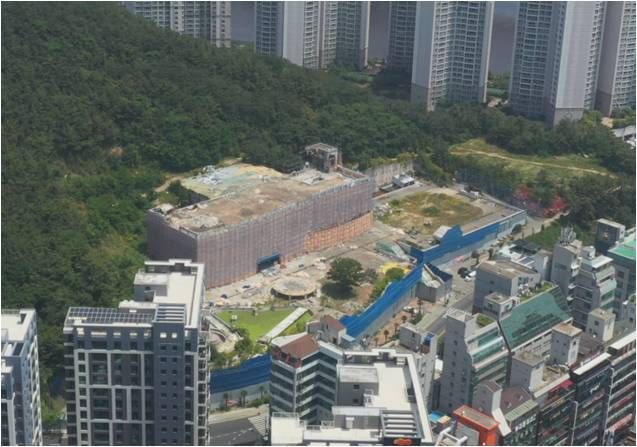
The lifestyle accommodation facility being promoted on the Mi World site has passed the landscape review of the jurisdictional Suyeong-gu unanimously with conditions, leaving only the architectural review by Busan City.
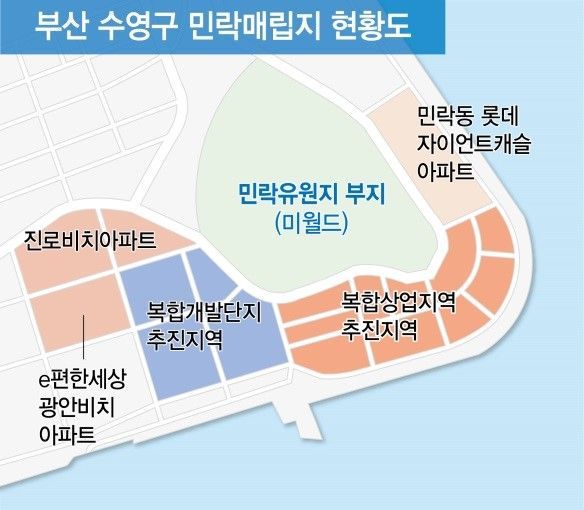
According to Suyeong-gu and the implementing company TI Busan PFV Co., Ltd., the residence construction project on the 27,813㎡ area of the former Mi World, which was held at the Suyeong-gu Landscape Committee on the 23rd, was unanimously conditionally approved.
Accordingly, among the three residence buildings, two will be constructed with 42 floors, and the remaining one will have 41 floors.
The condition set by the Landscape Committee that day was that this development project must enhance public interest and hold resident briefing sessions, so the implementing company plans to actively meet these conditions.
The project owner, TI Busan, plans to open some facilities, including the ‘Sky Bridge’ connecting the two residence buildings, to the public for public interest.
Going forward, this project will receive final project implementation approval from Busan City after going through the Busan City Architectural Committee review and traffic and environmental impact assessments.
A TI Busan official said, “Since this is not a project proceeding unilaterally, we will cooperate well with related organizations such as Busan City and Suyeong-gu, and communicate sufficiently with residents to establish a landmark in Gwangalli.”
Surrounded by the splendid scenery of Gwangalli Beach and Haeundae, this last prime land remaining in Busan has seen the Mi World site development drift for over 10 years. Left as ruins in the city center, many citizens have longed for its development, but due to complex administrative regulations and complaints, the final step has failed, leaving it as a ‘painful’ land for Busan citizens.
Many opinions say the situation is different this time. With the construction industry shrinking due to various regulations and the local economy pushed to the brink by the prolonged COVID-19 pandemic, there is a sense of crisis that a breakthrough is needed.
At an emergency breakfast meeting held at the end of April with local business leaders and Acting Mayor Byun Seong-wan of Busan, various difficulties causing the construction and economic crisis in the region poured out like a flood.
At an emergency meeting held on the 5th of this month, local economic figures including the Busan Chamber of Commerce and local construction industry strongly urged the Busan Mayor to promptly proceed with delayed construction permits and reviews due to COVID-19, abolish regulations in the construction sector, and actively support administrative measures for various development projects to revitalize the local economy.
The construction industry cited cases where, despite complying with permit-related laws, administrative processing delays or other excuses such as complaints caused difficulties in project promotion, requesting prompt administrative processing from the competent authorities.
Acting Mayor Byun Seong-wan said, “We will try to accept the industry's requests as much as possible,” adding, “Especially since the construction industry is a pillar of the local economy, we will immediately reflect the voices of the construction industry in city administration and actively support the revitalization of the construction market.”
The economic ripple effect report commissioned by the implementing company to the Korea Institute for Industrial Economics and Trade in April regarding the Mi World site development project is drawing notable attention.
According to the report, during the six years of development, the production inducement effect is expected to reach about 1.8095 trillion KRW, the value-added inducement effect about 736.1 billion KRW, and the employment inducement effect about 9,865 people.
Even after the development is completed, operating lifestyle accommodation facilities and tourism commercial facilities within the complex is predicted to spend 66.4 billion KRW annually, generating an annual production inducement effect of about 138 billion KRW, a value-added inducement effect of about 55.3 billion KRW, and an employment inducement effect of 1,445 people.
The investment scale revealed by TI Busan amounts to about 897.5 billion KRW for the construction of the complex facilities and about 9.7 billion KRW for land compensation and donation in Minrak Amusement Park, totaling 907 billion KRW. This is a mega project equivalent to about 24% of the total construction cost of Lotte World Tower in Jamsil, Seoul.
A TI Busan official said, “Across the Suyeong River in Haeundae-gu, the ‘Haeundae MICE (Meetings, Incentives, Conferences, Exhibitions) Belt’ is established, connecting Centum City, Marine City, and LCT, but Suyeong-gu has no landmark to boast about. If the site is properly developed, it will serve as a link connecting Haeundae’s tourism infrastructure with Suyeong-gu in terms of location.”
Attention is focused on which direction the ‘triggers’?Busan City, Suyeong-gu, the implementing company, and nearby residents?that will change the blighted Mi World site will take in voicing their intentions.
© The Asia Business Daily(www.asiae.co.kr). All rights reserved.
![Clutching a Stolen Dior Bag, Saying "I Hate Being Poor but Real"... The Grotesque Con of a "Human Knockoff" [Slate]](https://cwcontent.asiae.co.kr/asiaresize/183/2026021902243444107_1771435474.jpg)

















