[Asia Economy Reporter Yang Nak-gyu] On the 70th anniversary of the Korean War, the remains of 147 fallen Republic of Korea (ROK) soldiers are returning to their homeland after a long journey of 70 years.
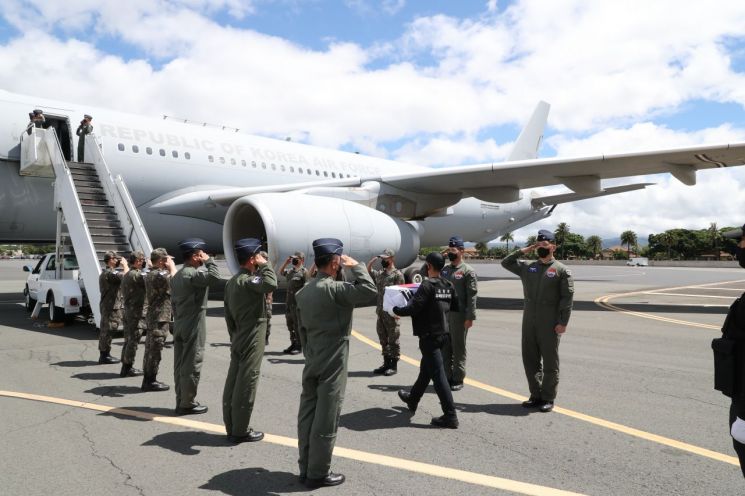
On the 23rd (local time), the Ministry of National Defense and the U.S. Department of Defense's Defense POW/MIA Accounting Agency (DPAA) held a remains transfer ceremony at Joint Base Pearl Harbor-Hickam (JBPHH) in Hawaii to repatriate the remains of 147 ROK soldiers who died in the Korean War back to Korea.
Regarding this, on the 24th, the Ministry of National Defense announced, "The remains of 147 'Korean War heroes' will be repatriated by the Air Force aerial refueling aircraft Cygnus (KC-330), and are scheduled to arrive at Seoul Airport around 4:50 p.m. that day," adding, "The remains of the fallen soldiers will be placed in passenger seats rather than the cargo hold of the aerial refueling aircraft, showing respect to the heroes returning home."
When Cygnus enters the Korean Air Defense Identification Zone (KADIZ) around 4 p.m. that day, six Air Force fighter jets will begin escort flights. The fighters belong to the 101st, 102nd, and 103rd Fighter Squadrons, which participated in the Korean War, and include a total of six aircraft: F-5, F-15K, and FA-50. Captain Kang Byung-jun, an F-15K pilot, is the grandson of the late Reserve Brigadier General Kang Ho-ryun, a Korean War veteran pilot.
The 147 remains include those excavated between 1990 and 1994 from areas such as Kaechon in South Pyongan Province, Unsan in North Pyongan Province, and the vicinity of the Battle of Chosin Reservoir in South Hamgyong Province. After the first North Korea-U.S. summit, some remains sent by North Korea to the U.S. in 2018 were identified as ROK soldiers through joint U.S.-ROK examination, finally allowing them to return to their homeland. The U.S. and ROK military authorities plan to further confirm the identities of the fallen ROK soldiers through battle records and casualty lists of the U.S. 7th, 2nd, and 25th Divisions, which fought in the excavation areas, as many ROK soldiers were attached to U.S. forces during the Korean War.
The transfer ceremony lasted about 50 minutes in a solemn atmosphere with over 100 military officials from both countries attending. Following a memorial service, the U.S., ROK, and United Nations Command (UNC) each signed agreements for the transfer of remains, and the caskets containing the remains were handed over to the Korean side. At the ceremony, the UNC Chief of Staff replaced the U.S. flag draping one casket with the UN flag, after which Deputy Minister of National Defense Park Jae-min (head of the repatriation team) re-draped it with the Taegeukgi (Korean national flag) and handed the remains to the head of the remains excavation and identification team. After completing the transfer procedures, the remains were moved to the waiting aerial refueling aircraft Cygnus.
Deputy Minister Park said, "The repatriation of remains at the 70th anniversary of the outbreak of the Korean War will further strengthen the ROK-U.S. alliance," adding, "It is the result of joint efforts between the two countries to fulfill the noble mission of the state taking full responsibility for those who sacrificed for the nation."
Previously, the ROK and U.S. jointly repatriated 92 remains of fallen ROK soldiers in three rounds of joint examinations. Twelve remains were repatriated in 2012, 15 in 2016, and 65 in 2018. With the repatriation of 147 remains this time, a total of 239 remains will have returned to their homeland.
© The Asia Business Daily(www.asiae.co.kr). All rights reserved.

















