'Post-Corona Era Digital Government Innovation Development Plan' Announced at Cabinet Meeting
Leap to a World-Leading Nation through Full Digital Transformation
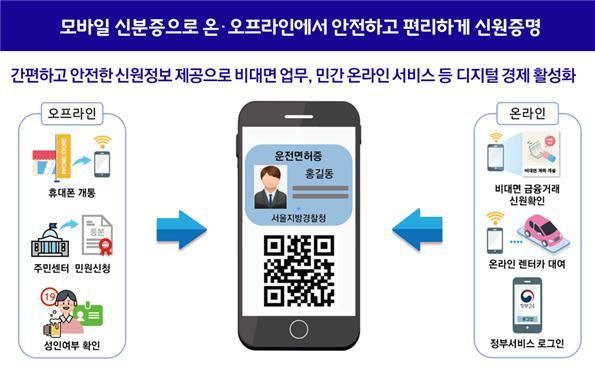
[Asia Economy Reporter Jo In-kyung] From now on, when renting a car, you can simply open your smartphone and show your mobile driver's license instead of the physical driver's license in your wallet. When purchasing alcohol or cigarettes at convenience stores, showing a mobile driver's license instead of a resident registration card will immediately verify whether you are over 19 years old. For bank loans or housing subscription applications, instead of submitting various required documents, you can select and send only the necessary information from 'MyData.'
On the morning of the 23rd, the Ministry of the Interior and Safety reported this plan, titled the 'Digital Government Innovation Development Plan for the Post-COVID-19 Era,' jointly with related ministries at the Cabinet meeting. This plan is an advancement of the 'Digital Government Innovation Promotion Plan' announced last October, responding proactively to the growing need for contactless culture across society due to the COVID-19 pandemic.
First, the government decided to accelerate the introduction of mobile IDs to expand contactless services. This year, a pilot introduction of mobile government employee IDs will take place, and the introduction of mobile driver's licenses, originally planned for the year after next, will be moved up to next year.
Additionally, the MyData service, which allows individuals to search, download, and easily transmit personal information held by public institutions directly to government offices or banks, will be introduced within this year. The number of documents that can be issued as electronic certificates, such as resident registration certificates, driving history certificates, and military service certificates, will increase to 100 types by the end of this year and 300 types by the end of next year.
Wi-Fi will be installed in elementary, middle, and high school classrooms, and online textbooks will be expanded to transition to a blended online and offline education system. Civil servant training will also expand non-face-to-face education through video training and private sector collaboration. Some industrial technician exams will be conducted online (CBT) this year, with plans to expand to all exams next year.
Personalized service innovation will also accelerate. Users of the 'National Secretary' function, to be introduced this year, will receive notifications about health checkups, national scholarship applications, civil defense training, and tax payments, and will be able to apply or pay via messenger chatbots or AI speakers.
All benefits available to individuals will be accessible and applicable in one place on 'Government24.' This year, various subsidies provided by central government ministries will be aggregated and displayed, expanding to local governments next year and to public institutions and private organizations the year after next.
Lifecycle-based personalized services will increase from the current three types?birth, inheritance, and moving?to six types by the end of this year, adding pregnancy, caregiving, and veterans services, and will expand to 11 types by the year after next.
A government-wide integrated call center will be established to conveniently resolve civil complaints with a single call, so that callers do not have to repeat their explanations when transferred to other relevant agencies. Starting next year with the integration of 11 central government call centers, the government plans to eventually integrate a total of 156 call centers, including those of local governments and public institutions.
Alongside this, the government will improve the entire process of data opening and utilization from the demand-side perspective and lay the foundation for creating new industries such as autonomous driving and healthcare. Following the enactment of the Data-Based Administration Act in May, a government-integrated data analysis center for joint use across the government to solve social issues will be established by the end of this year.
Furthermore, the government will open public services such as public facility use and daily inconvenience reporting to private apps, and will transition public sector information resources to private or public clouds to enhance security, reduce costs, and improve rapid response capabilities in emergencies.
Minister Jin Young of the Ministry of the Interior and Safety emphasized, "We will do our best to leap forward as a world-leading country through full digital transformation," and added, "We will speed up digital government innovation together with related ministries so that citizens’ lives become more convenient through the expansion of non-face-to-face services and innovation in personalized services."
© The Asia Business Daily(www.asiae.co.kr). All rights reserved.

















