Bank of Korea 'Producer Price Index for May 2020'
[Asia Economy Reporter Kim Eun-byeol] The producer price index, which had been declining for three consecutive months due to the impact of the novel coronavirus disease (COVID-19), has stabilized. As consumption increased following the government's distribution of emergency disaster relief funds, producer prices also appeared to be affected.
According to the "Producer Price Index for May 2020" released by the Bank of Korea on the 23rd, the producer price index last month was 101.98 (2015=100), nearly the same level as the previous month (101.93). After three months of decline since January, it has risen above negative territory for the first time in four months. The producer price index refers to the price changes of goods and services supplied to the market by domestic producers.
The increase in consumption following the government's emergency disaster relief payments led to a simultaneous rise in prices of agricultural, livestock, and fishery products, which was a factor driving up the producer price index. The price of agricultural, forestry, and fishery products rose 2.7% compared to the previous month, with notable increases in livestock products (5.8%) and fishery products (3.0%).
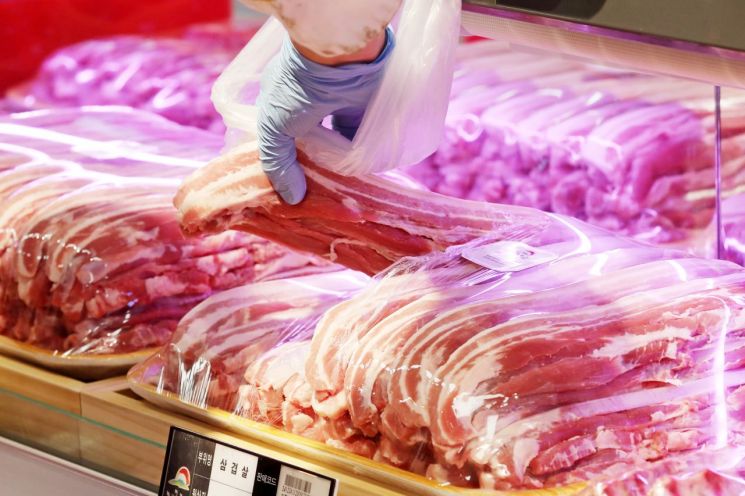
Looking at major items, apple prices jumped 42.8% month-on-month, and cabbage prices rose 33.3%. Prices of agricultural, forestry, and fishery products that saw increased consumption due to the disaster relief funds, such as pork (17.4%) and beef (4.8%), also increased.
Service prices, which were heavily impacted by COVID-19, also rose 0.1% compared to the previous month. This was influenced by price increases in financial and insurance services (0.9%) and restaurant and accommodation services (0.2%). This too can be seen as an effect of the disaster relief payments. Among items, hotel prices rose 2.1%, and air cargo prices increased 9.1%.
On the other hand, chemical products fell 0.7% month-on-month, marking a decline for nine consecutive months, and prices of computers, electronics, and optical equipment dropped 0.5%, turning downward for the first time in four months. LCDs for TVs fell 4.8%, and organic light-emitting diode (OLED) prices also decreased 1.5% month-on-month. As a result, producer prices for manufactured goods fell 0.2% compared to the previous month. Prices for electricity, gas, water, and waste also declined 0.1% month-on-month.
By special classification, food prices rose 1.5% month-on-month, and fresh food prices increased 2.3%. Energy prices fell 1.6% month-on-month, and IT prices dropped 0.2%. Excluding food and energy, prices remained stable.
Compared to the same month last year, the producer price index fell 1.7%, continuing a three-month downward trend. Prices of agricultural, forestry, and fishery products rose 9.6% year-on-year, but prices of manufactured goods fell 5.0%. This was influenced by a 45.5% drop in coal and petroleum product prices due to falling oil prices.
The domestic supply price index, which reflects prices of both domestically shipped goods and services as well as imported goods and services, fell 1.2% month-on-month and 5.1% year-on-year. This decline was centered on raw materials (-11.8%) and intermediate goods (-0.7%).
The total output price index, which measures price changes of goods and services based on total output including exports as well as domestic shipments, also fell 0.1% month-on-month and 3.2% year-on-year. The decline was mainly driven by manufactured goods (-0.4%).
© The Asia Business Daily(www.asiae.co.kr). All rights reserved.

















