Increased Summer Sales of Ice Cups
Subscription Service for Fruit Wine
Customers Visiting Stores More Frequently
Full-Scale Launch of Online-Offline Linked Service
[Asia Economy Reporter Lim Hye-seon] The distribution industry, which saw a sharp decline in performance after the outbreak of the novel coronavirus infection (COVID-19), is turning its attention to the subscription economy to link online and offline channels and secure loyal customers. Although still in the experimental stage, subscription services where customers subscribe online at a low price and receive products through offline visits are becoming more active.
Subscription for Ice Cups, Fruits, and Wine
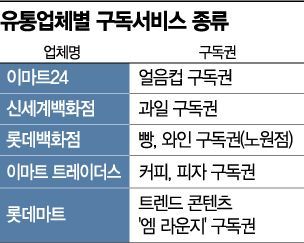
Emart24 announced on the 22nd that it will sell two types of Ifresso ice cup subscription passes (7-day and 14-day passes), limited to 100 each. The price per ice cup is 600 won. The 7-day pass can be purchased at 2,940 won, a 30% discount from the regular price, and the 14-day pass at 4,200 won, a 50% discount. The passes can be used once a day for one to two weeks. Emart24 selected ice cups as a subscription service product because it is a representative item with explosive sales growth in summer. From January 1 to June 18 this year, ice cup sales at Emart24 increased by 83.9% compared to the same period last year. Especially due to the early arrival of the heatwave, ice cup sales from June 1 to 18 rose by 76.7% compared to the previous month. Besides ice cups, Emart24 is piloting subscription services for its private label (PL) products such as refrigerated coffee and snacks. Subscription passes (7-day and 14-day) for new products like Dalgona Latte, Min-saeng Pouch Americano (2 types), and Min-saeng Potato Chips (45g) are 30-50% cheaper than the regular price. GS25 launched a coffee subscription service through 'Cafe25.' CU offers a 'Lunchbox Reservation Purchase Service' that allows customers to order by date and time.
Department stores are also paying attention to subscription services. Shinsegae Department Store started a fruit subscription service this month. By paying a monthly subscription fee of 180,000 won, customers can receive 3 to 5 types of seasonal fruits carefully selected by Shinsegae Department Store's produce buyers every Thursday. The service provides a mixed fruit box weighing 5 to 10 kg worth about 200,000 won once a week. Shinsegae Department Store explained, "Last month, we piloted the service for some VIP customers at the Gangnam branch, and since 85% of users requested re-subscription, we expanded the service to all VIP customers at the Gangnam branch this month."
Lotte Department Store, which first launched a cosmetics subscription service in 2016, has been piloting bread, wine, and coffee subscription services at its Nowon branch since April. The bread subscription service provides one bread daily from the 'Six Oven' bakery for 50,000 won per month, effectively receiving 30 breads at half price. Wine is offered at 50,000 won per month for 4 bottles, and coffee at 40,000 won per month for 30 Americanos. Lotte Department Store plans to expand subscription services from food and beverages such as side dishes, meat, and fruits to flowers, shirts, and more.
Emart Traders launched coffee and pizza subscription services in March and May, respectively. The coffee subscription service offers 31 coffee exchange tickets and 2 scone set exchange tickets for a monthly fee of 4,000 won, allowing one coffee per day. The pizza subscription service allows customers to purchase one pizza per week by paying 25,000 won, the price of two pizzas, as a subscription fee. Last month, Lotte Mart introduced the magazine service 'M Lounge,' which offers trend content subscriptions through a content partnership with Seoul Munhwasa.
Encouraging Store Visits Instead of Delivery
The characteristic of offline retailers' subscription services is focusing on securing loyal customers and increasing the number of offline store visits. Since the COVID-19 outbreak, online sales have surged, prompting offline retailers to try various methods to attract customers. Subscription services are part of these efforts. They aim to provide benefits to consumers through subscriptions and naturally induce store visits.
The coffee subscription passes sold by Emart Traders in March and April exceeded 4,000 units. Customers who purchased the coffee subscription visited Emart Traders an average of 12 days per month, about once every 2.5 days. Since Traders is a warehouse-style discount store where customers buy in bulk per visit, the average monthly visit frequency per customer is about twice. The company explained that customers with coffee subscription passes visited Traders about six times more frequently per month than regular customers. An industry insider said, "Consumers who pay an annual fee are more likely to continue using the platform once they start. Utilizing big data from consumers' regular purchase behavior patterns can improve efficiency and help enhance profitability."
© The Asia Business Daily(www.asiae.co.kr). All rights reserved.
![Clutching a Stolen Dior Bag, Saying "I Hate Being Poor but Real"... The Grotesque Con of a "Human Knockoff" [Slate]](https://cwcontent.asiae.co.kr/asiaresize/183/2026021902243444107_1771435474.jpg)
















