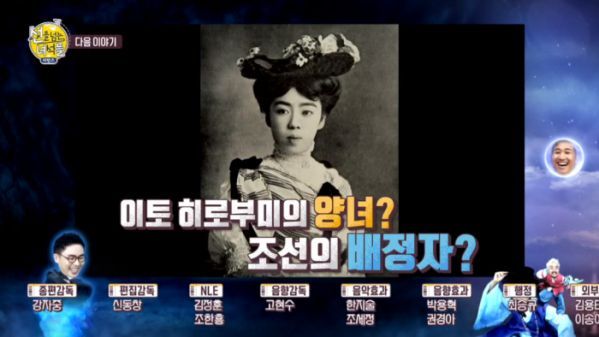
[Asia Economy Reporter Kim Jeong-ho] Bae Jeong-ja, who collaborated with the Japanese colonial regime during the Japanese occupation, is scheduled to be featured on "The Guys Who Cross the Line."
On the afternoon of the 21st, MBC's "The Guys Who Cross the Line - Returns" aired a segment where they learned about world history beyond Korean history in Saipan.
Near the end of the broadcast, a preview for next week was introduced, mentioning the pro-Japanese collaborator Bae Jeong-ja.
In response, Yoo Byung-jae and Jeon Hyun-moo stated, "Bae Jeong-ja, the adopted daughter of Ito Hirobumi, sent over 100 Korean women to be comfort women."
Kim Hye-yoon expressed anger, saying, "I don't understand why these things are not covered much in textbooks or elsewhere."
Bae Jeong-ja became the adopted daughter of Ito Hirobumi during the Japanese colonial period and acted as an informant for Japan. She was given the name Tayama Sadako by Ito Hirobumi.
There is an anecdote about her. It is said that Bae Jeong-ja laughed three times and cried three times in her life. She laughed when Empress Myeongseong was assassinated, when the Eulsa Treaty was signed, and when Emperor Gojong passed away.
Additionally, it is said that she cried when Ito Hirobumi was killed by Ahn Jung-geun, when the independence of her homeland was declared, and when she was arrested by the Anti-People Punishment Committee.
Furthermore, in the 1940s, Bae Jeong-ja forcibly took over 100 Korean women and compelled them to live as sexual slaves for the Japanese military.
Meanwhile, after independence, Bae Jeong-ja was arrested as the first female pro-Japanese collaborator under the "Punishment of Anti-National Acts Act," but was released due to her old age.
She later died during the Korean War in 1952.
© The Asia Business Daily(www.asiae.co.kr). All rights reserved.

















