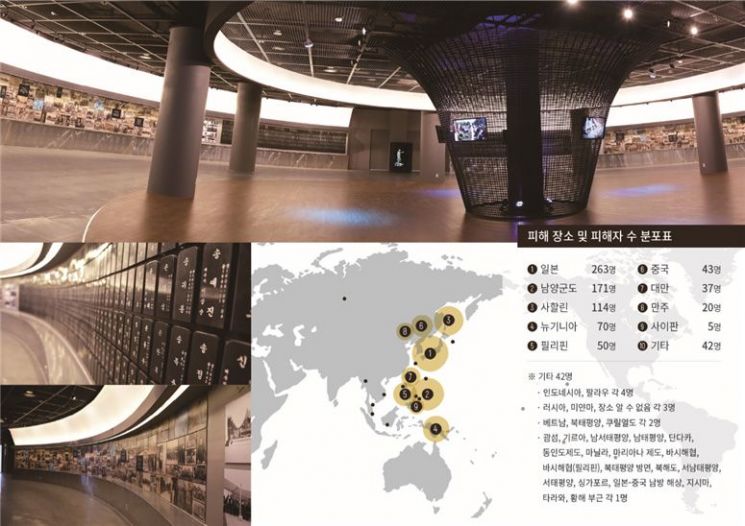
[Asia Economy Reporter Jo In-kyung] The Ministry of the Interior and Safety will hold an opening ceremony for the 'Memorial Hall (Place of Memory)' on the 19th at the National Museum of Forced Mobilization under Japanese Occupation in Nam-gu, Busan, attended by bereaved families of the victims. The hall honors the souls of the sorrowful victims who were forcibly mobilized during the Japanese colonial period and whose remains have not returned to their homeland.
Located on the 5th floor of the museum, the Memorial Hall is a space for mourning the restless spirits of the victims of forced mobilization under Japanese rule and comforting their bereaved families, as well as an educational space for the general public. It was established from March to December last year with a national budget of over 800 million won.
The 1,097㎡ (330 pyeong) space can enshrine up to 4,000 memorial tablets, currently housing 815 tablets. It features a central sculpture symbolizing the victims of forced mobilization, a hologram of the Statue of Peace representing the victims of the Japanese military’s comfort women issue, a hologram of the forced laborers statue, and over 410 donated photographs transferred from the former Committee for Investigation of Forced Mobilization Victims during the Greater East Asia War and Support for Overseas Forced Mobilization Victims.
According to the 815 memorial tablets currently enshrined here, the region where the most Koreans were mobilized during the Japanese colonial period was Japan itself, and it has been confirmed that many Koreans were also mobilized to coal mines and mineral mines in Sakhalin for labor supply during the late stages of the war.
Since the enactment and enforcement of the National Mobilization Law in 1938, 497 deaths occurred between 1939 and 1945. By year, there were 83 deaths in 1943, 168 in 1944, and 206 in 1945, showing a sharp increase in deaths toward the end of the war. During this period, a large number of deaths occurred especially in the Nanyo Islands and within Japan.
The opening ceremony will be attended by Vice Minister Yoon Jong-in of the Ministry of the Interior and Safety, Park Seong-hoon, Deputy Mayor for Economic Affairs of Busan, Kim Yong-duk, Chairman of the Forced Mobilization Victims Support Foundation, and Song Ki-in, Chairman of the Busan Democratic Uprising Memorial Foundation. Considering the COVID-19 pandemic, side events will be refrained from, and the ceremony will be held simply and solemnly.
Vice Minister Yoon said, "I deeply appreciate that the Memorial Hall (Place of Memory), a space to honor the souls of the victims and comfort the bereaved families, has opened its doors and can enshrine 815 tablets initially. We will continue to strive to heal the painful wounds of the victims not only in Japan but also in Sakhalin and China."
© The Asia Business Daily(www.asiae.co.kr). All rights reserved.

















