US Announces Large-Scale Icebreaker Investment... Greenland Consulate Operations Resume After 47 Years
Greenland's Rare Earths and Uranium: Strategic Resource Paradise... Arctic Route Logistics Also Facilitated
Russia and China Jointly Respond to US Blockade... Future Intensification of Hegemony Competition Expected
[Asia Economy Reporter Hyunwoo Lee] Following the announcement of a large-scale icebreaker investment plan to pioneer the polar regions, the United States has resumed consular operations in Greenland after 47 years, drawing significant attention. The U.S. had relatively less interest in the polar regions compared to Russia, but recently indicated a change in this strategy. This is due to the enormous underground resources such as rare earth elements and uranium, and as global warming opens polar routes where Russia currently holds an advantage, competition for dominance in this area is expected to intensify.
According to the American political media outlet Politico on the 17th (local time), the Donald Trump administration resumed consular operations in Greenland on the 10th after 47 years. The U.S. consulate in Greenland operated only from 1940 during World War II until 1953, when the Korean War ended, and was then closed. However, it has now been reopened under President Trump's directive. The U.S. government announced that through the consulate, it will provide an annual economic aid package of $12.1 million for natural resource development and education in the Greenland Self-Government, aiming to narrow the gap with the Greenland Self-Government.
The U.S. hurriedly reopened the consulate in Greenland with the region's vast strategic resources in mind. According to Greenland Minerals, a rare earth mining specialist company in Greenland, the total rare earth deposits across the island amount to 38.5 million tons, accounting for about one-third of the world's deposits. Rare earth elements are essential resources for producing strategic weapons such as stealth fighter jets. It is estimated that only in the Kvanefjeld area in southwestern Greenland, there are about 10.33 million tons of rare earth elements and approximately 9.56 billion tons of uranium deposits. If this rare earth mine is developed, it is expected to produce about 40,000 tons of rare earth elements annually, which is about 30% of the current global annual production.
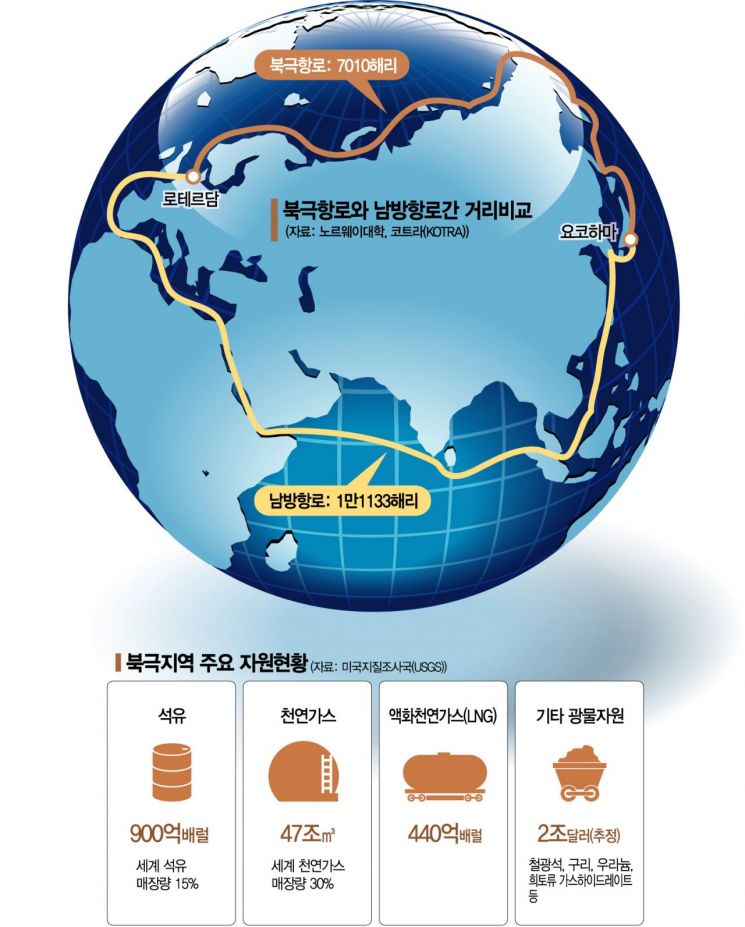
Not only Greenland but the entire Arctic is called a treasure trove of resources. According to the U.S. Geological Survey (USGS), the total oil reserves in the Arctic Ocean amount to 90 billion barrels, about 15% of the world's oil reserves, and natural gas reserves total 1,670 trillion cubic meters, accounting for 30% of the world's natural gas reserves. Additionally, liquefied natural gas (LNG) reserves amount to 44 billion barrels, about 20% of the global reserves, and mineral resources such as iron ore, copper, uranium, and rare earth elements are estimated to be worth $2 trillion (approximately 2,408 trillion KRW). The World Petroleum Council (WPC) forecast report also estimates that from 2030, 30% of the world's oil and natural gas production will come from the Arctic. Furthermore, the previously frozen Arctic shipping routes have opened due to global warming, facilitating logistics.
The country most actively developing Arctic resources is Russia. Russia has secured 61 oil production sites across the Arctic region and is increasing crude oil production on the Arctic continental shelf. The current annual production of 14 million tons is planned to increase more than fourfold to 54 million tons by 2035. According to TASS news agency, statistics from the Russian Ministry of Energy predict that annual oil production from existing domestic reserves will decrease by 23% by 2035 due to depletion of existing resources. Russia expects to compensate for this decline by increasing production in the Arctic Ocean. Since 2014, the Chinese government has been involved in the Kvanefjeld rare earth exploration project at the request of the Greenland Self-Government.
The U.S. entry into polar development is a strategic move to counter Russia and China, who have already established a presence in the region. Uranium is the main raw material for nuclear weapons manufacturing, so from the U.S. perspective, if other powers such as China and Russia secure it, it could pose a security threat. Especially, the expected sharp decline in oil production from traditional oil-producing countries such as the Middle East and Russia after the 2030s is another reason why the U.S. must pay more attention to the strategic value of the Arctic.
The rapid decline of Arctic sea ice and the opening of Arctic routes are also factors accelerating competition among major powers. As cargo volumes increase, the region is also important from a logistics perspective. Using the Arctic route from Rotterdam, Netherlands to Yokohama, Japan, the shipping distance is 7,010 nautical miles, which is 37% shorter than the existing southern route through the Suez Canal at 11,133 nautical miles. This leads to reduced transportation costs. The Russian government announced that the volume of cargo in its Arctic region increased from 5.43 million tons in 2015 to 30 million tons last year, and is expected to exceed 100 million tons by 2030.
China and Russia have taken joint measures to block U.S. entry. According to Hong Kong's South China Morning Post (SCMP), China and Russia have been cooperating on Arctic route development since last year and are jointly developing liquefied natural gas (LNG) resources in the Arctic Ocean. SCMP analyzes that this is not just economic cooperation but a measure to block U.S. influence over the Arctic route in the future.
© The Asia Business Daily(www.asiae.co.kr). All rights reserved.
![User Who Sold Erroneously Deposited Bitcoins to Repay Debt and Fund Entertainment... What Did the Supreme Court Decide in 2021? [Legal Issue Check]](https://cwcontent.asiae.co.kr/asiaresize/183/2026020910431234020_1770601391.png)















