Domestic and International Experts' Views... Prolonged Deadlock in North Korea-US Talks
North Korea's Hardline Moves Amid Sanctions Relief Setbacks... Steps Including Complete Dismantling of Kaesong Industrial Complex
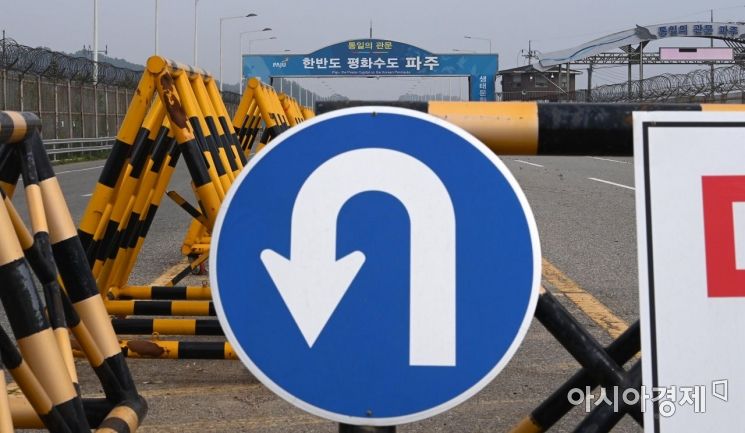 Tension is mounting on June 17 at the Unification Bridge in Paju, Gyeonggi Province, as North Korea hinted at breaking the military agreement by resuming military exercises in the border area. On June 16, North Korea abruptly blew up the Kaesong Inter-Korean Joint Liaison Office. Photo by Kim Hyun-min, Paju kimhyun81@
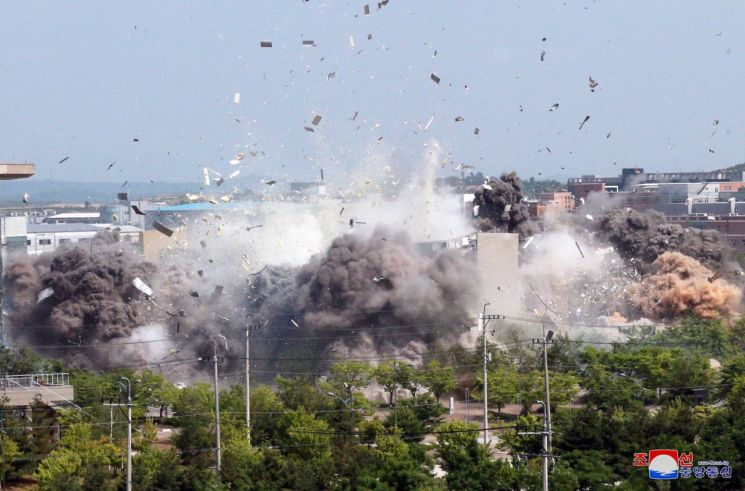
[Asia Economy Reporter Lim Cheol-young] Following North Korea's demolition of the Kaesong Inter-Korean Joint Liaison Office and the announcement of measures that effectively nullify the September 19 Inter-Korean Military Agreement, domestic and international experts anticipate that North Korea's pressure on South Korea and the United States will intensify for the time being. The prolonged stalemate in North Korea-U.S. relations, with no significant breakthroughs such as sanctions relief or humanitarian aid in the near term, is analyzed to have hardened North Korea's stance.
Experts on the Korean Peninsula in the United States expect that North Korea will increase pressure not only on South Korea but also on the U.S., judging that raising tensions will be advantageous for future negotiations. Victor Cha, Korea Chair at the Center for Strategic and International Studies (CSIS), analyzed that North Korea is reverting to previous military provocations without engaging in dialogue with the Moon Jae-in administration. According to Yonhap News Agency, Victor Cha stated, "North Korea expresses displeasure over anti-North Korean leaflets, but I do not think this is the main reason," adding, "North Korea sees no reason to negotiate until the U.S. presidential election and is increasing pressure on both South Korea and the U.S."
There is also an analysis that this is retaliation against South Korea for failing to extract sanctions relief from the U.S. After retaliating against South Korea, North Korea is expected to continue a hardline approach toward the U.S. ahead of the November presidential election as part of a so-called 'leverage strategy.' Sumi Terry, Senior Fellow at CSIS, explained, "North Korea, having failed to obtain any sanctions relief, is particularly signaling dissatisfaction toward South Korea," adding, "Tensions will continue to escalate, and North Korea may even move troops into the Demilitarized Zone (DMZ)."
Domestic Korean Peninsula experts also cite the gap in North Korea-U.S. dialogue and the absence of substantive sanctions relief measures as the background for North Korea's hardline actions, predicting that the level of retaliation will increasingly intensify.
Professor Lim Eul-chul of the Institute of Far Eastern Studies at Gyeongnam National University stated, "North Korea has clearly indicated through this demolition action that it will not seek to improve inter-Korean relations for a considerable period," forecasting "the worst inter-Korean relations since the division." Jeong Seong-jang, Director of the North Korea Research Center at the Sejong Institute, said, "Kim Yo-jong, First Deputy Director of the Workers' Party, hinted on the 4th about the complete dismantling of the Kaesong Industrial Complex and the possible nullification of the September 19 Military Agreement, and North Korea is expected to swiftly proceed with the complete dismantling of the Kaesong Industrial Complex." Jeong added, "Despite the South Korean government's clear intention to strongly regulate defector groups that have been distributing leaflets after Kim Yo-jong's statement on the 4th, North Korea is implementing its stance to revert inter-Korean relations to Cold War-era hostility because it has concluded that there is no longer any expectation from the Moon Jae-in administration."
North Korea's hardline actions are expected to become increasingly severe and rapid. Professor Jeong Dae-jin of Ajou University predicted, "According to North Korea's announcement, it will proceed with 'continuous actions,' accelerating the nullification of the military agreement through fortification (arming) of the DMZ and retaliatory leaflet campaigns." Professor Park Won-gon of Handong University also analyzed, "Considering North Korea's rapid offensive against South Korea, the next step could be the nullification of the September 19 Inter-Korean Military Agreement mentioned on the 4th."
Foreign media such as those in the U.S. and Japan reported a high possibility of further provocations by North Korea. The Washington Post reported on the 16th (local time) that North Korea is continuing hardline actions to pressure both South Korea and the U.S. amid a stalemate in negotiations with the U.S., stating, "The demolition of the liaison office is a move to attract U.S. attention and to escalate tensions again to gain new concessions." The Associated Press (AP) also interpreted the demolition as a "carefully staged, highly symbolic act of anger," calling it the most provocative act since 2018.
The New York Times (NYT) and Bloomberg News forecast that tensions will further escalate, noting that North Korea has various means of pressure. The NYT reported that North Korea is expected to re-enter areas demilitarized under inter-Korean agreements, further heightening tensions with South Korea. Bloomberg also mentioned North Korea's various pressure tactics on South Korea, including the dismantling of the Mount Kumgang tourism complex, military deployments in the Mount Kumgang area, and missile test launches.
Japanese media also reported that North Korea's demolition of the inter-Korean liaison office deals a blow to the Moon Jae-in administration's engagement policy toward North Korea, escalating tensions on the Korean Peninsula and likely continuing efforts to unsettle U.S. President Donald Trump. The Mainichi Shimbun viewed North Korea's severe food and supply shortages following the spread of the novel coronavirus (COVID-19) as a factor fueling hostility toward South Korea to foster internal unity, which is also a background for the provocations. The Yomiuri Shimbun analyzed that North Korea is targeting President Trump, who considers easing tensions on the Korean Peninsula as his achievement, by pressuring the South Korean government.
© The Asia Business Daily(www.asiae.co.kr). All rights reserved.
![Clutching a Stolen Dior Bag, Saying "I Hate Being Poor but Real"... The Grotesque Con of a "Human Knockoff" [Slate]](https://cwcontent.asiae.co.kr/asiaresize/183/2026021902243444107_1771435474.jpg)












