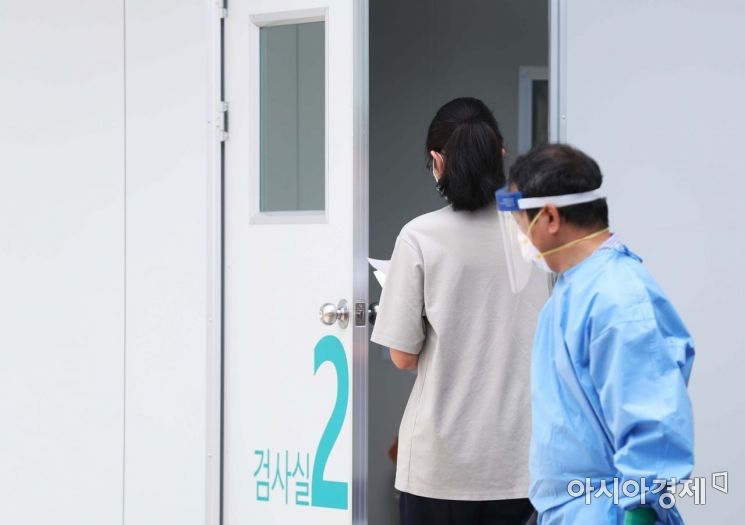
 On the 14th, a citizen is entering the COVID-19 testing room at the Walking Through screening clinic in Jungnang-gu Office, Seoul. (Unrelated to the article) / Photo by Moon Honam munonam@
[Asia Economy Reporter Junho Hwang] A non-human primate infection model has been developed in South Korea to verify the efficacy of novel coronavirus disease 2019 (COVID-19) treatments and vaccines developed domestically. Preparations for efficacy experiments on treatments and vaccines targeting non-human primates, which show responses most similar to humans upon viral infection, have been completed. The government will begin animal testing on two treatments and one vaccine using this infection model starting this month. The speed of domestic COVID-19 treatment and vaccine development is expected to accelerate further.
According to the Ministry of Science and ICT on the 17th, a non-human primate infection model for COVID-19 treatment and vaccine development has been developed, and efficacy experiments will commence.
Development of Non-Human Primate Infection Model
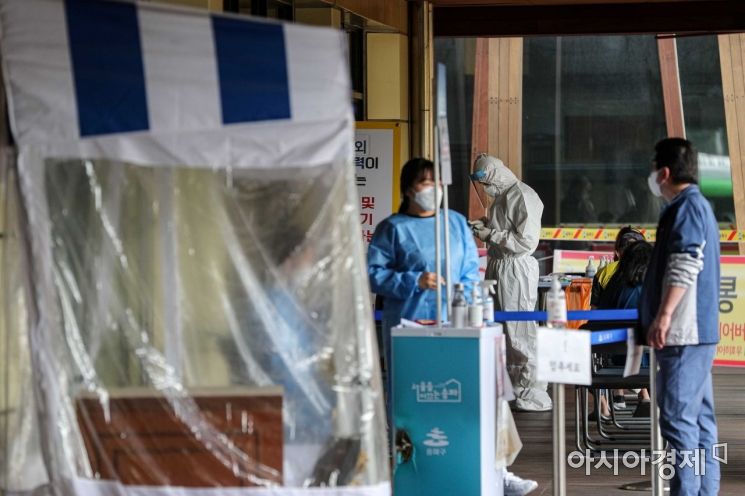 Citizens who visited the screening clinic set up at Songpa-gu Public Health Center in Seoul on the 10th are waiting to be tested as health authorities continue testing contacts, including students, after a staff member at Gangnam Daesung Academy was confirmed positive for COVID-19. (Unrelated to the article) Photo by Kang Jin-hyung aymsdream@
For treatment development, candidate drugs must undergo cell experiments, animal experiments, and clinical trials. Non-human primate animal experiments are one of the preclinical animal tests conducted before clinical trials. These experiments involve infecting non-human primates, which exhibit clinical symptoms similar to humans, with COVID-19 and administering candidate drugs to verify efficacy and side effects. The World Health Organization has designated non-human primate animal experiments as an essential preclinical item for COVID-19 treatment and vaccine development.
The non-human primate animal experiments are conducted at the Korea Research Institute of Bioscience and Biotechnology (KRIBB). Since receiving the COVID-19 virus in February, KRIBB has initiated the development of the non-human primate infection model and established an experimental platform. Non-human primate model experiments can only be conducted at facilities with Animal Biosafety Level 3 (ABL-3), such as KRIBB.
KRIBB can conduct non-human primate animal experiments on three candidate substances per month. The government collects demand from domestic companies, universities, and research institutes, then selects three substances for experiments this month through an expert selection evaluation committee that assesses the likelihood of success for treatments and vaccines.
Two Treatments and One Vaccine to be Tested This Month
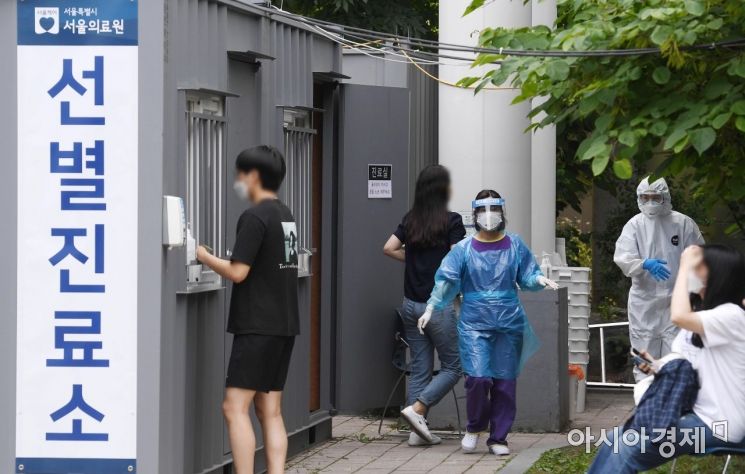 On the 8th, at the screening clinic of Seoul Medical Center in Jungnang-gu, Seoul, medical staff were busy as the city of Seoul began free proactive COVID-19 testing for the general public to prevent community cluster infections caused by asymptomatic carriers of the novel coronavirus. This measure by the Seoul Metropolitan Government aims to identify "silent spreaders" through active proactive testing amid increasing sporadic infections with unclear transmission routes, including asymptomatic cases. After applying through the Seoul city website, individuals can visit designated municipal hospitals to receive free testing. (Unrelated to the article) / Photo by Kim Hyun-min kimhyun81@
This month, two treatment candidates and one vaccine candidate will be tested. Company A will conduct non-human primate experiments on a treatment candidate aiming to enter clinical trials next month. Company B will perform pharmacokinetic studies to confirm whether the treatment reaches the virus-affected sites, followed by efficacy testing. Company C will conduct efficacy verification by inoculating non-human primates vaccinated with the vaccine candidate with the virus (challenge inoculation).
The government plans to conduct non-human primate animal experiments on up to three substances per month. Through KRIBB (Research and Development Support Council), the Bio Association, and the Research Foundation, demand for non-human primate infection model experiments will be continuously collected, and support targets will be selected monthly. The Ministry of Science and ICT will cover the costs to minimize the burden on domestic companies so that they can focus on research.
Ko Seogon, Director of Basic and Fundamental Policy at the Ministry of Science and ICT, stated, "Currently, only a few countries worldwide, such as the Netherlands, the United States, and China, have successfully developed COVID-19 non-human primate infection models, making it a technically challenging task internationally. The government will fully support non-human primate infection model experiments to expedite the development of treatments and vaccines."
© The Asia Business Daily(www.asiae.co.kr). All rights reserved.



















