[Special Inaugural Interview] Listening to Sung Kyung-ryung, Chairman of the Korea Institute for Economic and Social Research
Learning from Failed Cases Like Canada and Finland Struggling to Secure Funding
Urgent Need to Introduce Korea-style Unemployment Support 'National Employment Support System'... Pursuing Flexible Security
Post-Corona Era, Accelerating Smart Economy While Concerned About Employment Crisis
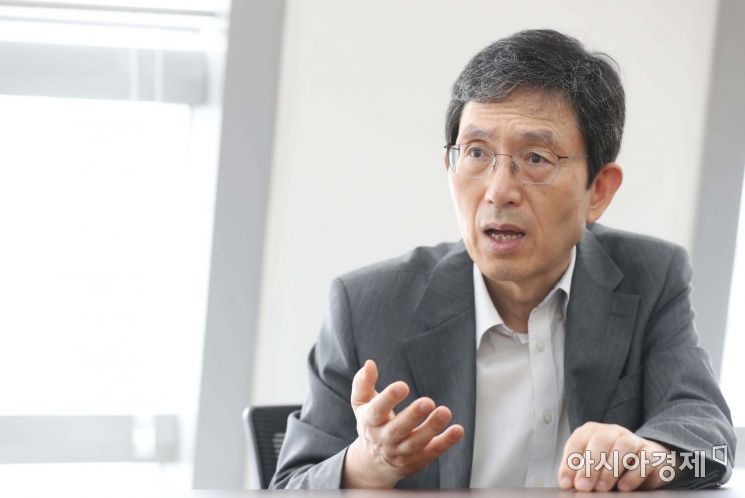 Sung Kyung-ryong, Chairman of the Korea Institute of Social Sciences and Humanities, is being interviewed by Asia Economy. / Photo by Moon Ho-nam munonam@
[Asia Economy Reporter Kwangho Lee] Sung Kyung-ryung, chairman of the Economic and Humanities and Social Sciences Research Council, which leads 26 national policy research institutes including the Korea Development Institute (KDI), recently addressed the hot political issue of introducing a basic income system, which has sparked heated debate. He stated, "It is desirable to first introduce it targeting the youth generation rather than the entire population, applying about 1 million KRW per month for approximately four years."
In an interview with Asia Economy on the 10th, Chairman Sung said, "The basic income system is not a matter to be rushed to a conclusion, but if I were to specify the necessary area, it would be the youth." His remarks imply that, as seen in overseas cases, the success or failure of the basic income system ultimately depends on securing funding, thus requiring a phased approach.
Previously, Ontario, Canada conducted an experiment from 2017 for three years, providing 4,000 low-income individuals with 1,320 Canadian dollars (about 1.15 million KRW) monthly, but it was discontinued after one year due to funding depletion. Finland also conducted an experiment in 2017 targeting 2,000 unemployed individuals aged 25 to 58, randomly selected, paying 560 euros (about 730,000 KRW) monthly for two years aiming to reduce unemployment and create jobs, but the employment promotion effect was analyzed as not significant. Switzerland also proposed a referendum in 2016 to provide a basic income guarantee of 2,500 Swiss francs (about 3 million KRW) monthly to all citizens, but it was rejected with 77% opposition. The uncertain funding plan was cited as the biggest reason for the rejection.
Chairman Sung emphasized, "Youth are the generation that gives birth to and raises future succeeding generations, so the issue of childbirth is no longer a social matter but a public good." He added, "Primarily, a youth basic income system should be introduced to support university graduates for four years (ages 24?28), and for high school graduates (ages 20?24), it should be operated flexibly to help develop their future work capabilities." He further mentioned, "Considering various reasons including funding, about 1 million KRW per month is appropriate." However, he added, "Since moral hazard is a concern, institutional measures to reduce mismatches must be designed." In other words, designated educational training institutions recognized by the state or private companies should be appointed to strengthen practical skills and create quality jobs.
◆ "Active labor market policies by the government are necessary" = Chairman Sung expressed concern over the deterioration in both quantity and quality of employment due to COVID-19 and argued for the need for active labor market policies by the government. Regarding the employment trend in May, he said, "Including the unemployed (1,278,000 people) and those who took a break (2,286,000 people), the total economically inactive population is 3,564,000, and employment is decreasing across all age groups with declining quality and quantity, which is worrisome." He advised, "We need to strengthen social security systems such as vocational training and quickly introduce the Korean-style unemployment assistance system called the 'National Employment Support System' under the goal of universal employment insurance."
Above all, he suggested pursuing a direction to strengthen 'Flexicurity' throughout the labor market. Flexicurity is a term combining flexibility and security. It refers to increasing both labor-management flexibility and the security of vulnerable groups simultaneously. It was first systematized in the Netherlands and introduced in some European countries such as Denmark from the mid-1990s.
Chairman Sung said, "If such a comprehensive social security system is established, a joint conclusion can be reached through social dialogue, combining flexibility and security." He added, "Cooperation and trust between labor and management will increase productivity and accelerate the pace of technological innovation in companies and industries. We must bet on this."
◆ "In the post-COVID era, future anticipatory management is necessary" = Chairman Sung proposed that future anticipatory national management is more necessary than ever to respond to the complex economic and social crises that will come after COVID-19. To this end, the Economic and Humanities and Social Sciences Research Council and 26 national policy research institutes started the 'Emergency COVID-19 Response Research' in February and are dedicating themselves to policy research to timely support the government's COVID-19 response policies. A 'Response Research Team' is also operating, divided into short, medium, and long term.
Chairman Sung expressed concern, saying, "In the post-COVID era, some things are predictable and some are not. Even the first shock is a huge problem, but there is much concern about whether a second or third shock will come and when." He observed, "Unlike the past, the positive aspect is that in the past, during the Great Depression in the 1930s and World War II in the 1940s, production facilities were destroyed, but with the improvement of the COVID-19 situation, production facilities are not damaged, so supply capacity will be restored quickly."
He predicted, "The future post-COVID economy will move to a stage that is more efficient, automated, and productive than now. As smartification spreads, such as smart factories and smart farms (intelligent agricultural systems), the supply capacity of industrial production will be advanced, and rapid changes will occur through digitalization such as 5G, artificial intelligence, and big data." However, he expressed concern, "Significant damage to employment is expected, and a full-scale employment crisis may occur."
◆ "For the successful conclusion of the Moon administration, wartime cabinet operation is necessary" = Chairman Sung said that for the Moon Jae-in administration to successfully conclude its fifth year and realize its status as a government that achieved stability and shared prosperity, "complacency is forbidden."
He said, "I recently attended a Thursday dialogue chaired by Prime Minister Chung Sye-kyun, where Professor Moon Myung-jae of Yonsei University's Department of Public Administration cited Jim Collins' book 'Good to Great: Why Some Companies Make the Leap... and Others Don't,' saying that doing well in COVID-19 quarantine (Good) could become an obstacle to achieving even greater (Great) results (i.e., achieving both quarantine success and economic success) if complacency sets in, so we must never be complacent." He emphasized, "We must operate with the determination to run a wartime emergency cabinet, maintain vigilance, and do our best."
© The Asia Business Daily(www.asiae.co.kr). All rights reserved.
![Clutching a Stolen Dior Bag, Saying "I Hate Being Poor but Real"... The Grotesque Con of a "Human Knockoff" [Slate]](https://cwcontent.asiae.co.kr/asiaresize/183/2026021902243444107_1771435474.jpg)
















