Industry "Concerns Over Declining Profitability of Redevelopment Projects"
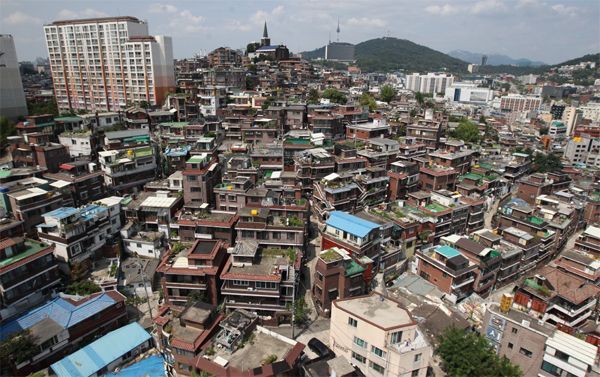
[Asia Economy Reporter Lee Chun-hee] Starting in September, the mandatory construction ratio of rental housing in redevelopment projects within Seoul and the metropolitan area will increase from a maximum of 20% to 30%.
The Ministry of Land, Infrastructure and Transport announced on the 16th that the "Enforcement Decree of the Urban and Residential Environment Improvement Act," which includes this content, passed the Cabinet meeting. The enforcement decree will take effect from September. On the same day, the Ministry also issued an administrative notice for the amendment of the "Rental Housing and Construction Ratio by Housing Size in Maintenance Projects," which specifies the delegated contents in the law.
From now on, the upper limit of the mandatory rental housing ratio in redevelopment projects will increase to a maximum of 30% based on the metropolitan area standard. This is the maximum limit set by law.
Until now, the enforcement decree stipulated a maximum ratio of 20%, which is lower than the legal upper limit. The basic mandatory ratio was within 15%, and if there were many tenants in the area, an additional 5 percentage points could be added at the discretion of the local government head. Currently, Seoul City requires most redevelopment projects to supply rental housing at a level of 15-20% based on these laws.
However, going forward, the basic ratio in redevelopment projects will be expanded to 20%. In addition to cases with many tenants in the area, the rental housing ratio can also be increased when "housing supply and demand stabilization is necessary," and the discretionary ratio will be expanded from the existing 5 percentage points to 10 percentage points. Accordingly, the basic mandatory rental housing ratio upper limit for redevelopment in Seoul, Incheon, and Gyeonggi will increase from 15% to 20%, and with an additional 10 percentage points discretionary ratio, local governments will be able to require up to 30% rental housing construction. However, regions outside the metropolitan area will maintain the existing mandatory ratio of 5-12%.
Along with this, redevelopment projects in commercial areas with urban maintenance types, which previously had no rental housing construction obligation, will now have a rental construction obligation. However, considering the characteristics of commercial areas with a small number of tenants, the lower limit of the rental obligation is set at 5% for Seoul and 2.5% for Incheon and Gyeonggi, which is half the level of general redevelopment.

As the mandatory rental ratio increases, frontline redevelopment projects are expected to face profitability deterioration. According to the Seoul City Redevelopment and Reconstruction Clean-up System, currently, 299 redevelopment projects, including 77 urban environment maintenance projects, are underway in Seoul. Most of these projects currently set the rental housing ratio at 15-20%. In the case of Mia 2 District, which has a total of 3,521 households, it is estimated that to meet the 30% rental housing ratio, the number of rental housing units must increase by 452 units from the current 604 units to 1,056 units. A redevelopment association official said, "The purpose of redevelopment projects is to improve areas with poor living conditions, but if 30% rental housing is included, it is obvious that project promotion will become difficult."
© The Asia Business Daily(www.asiae.co.kr). All rights reserved.
![Clutching a Stolen Dior Bag, Saying "I Hate Being Poor but Real"... The Grotesque Con of a "Human Knockoff" [Slate]](https://cwcontent.asiae.co.kr/asiaresize/183/2026021902243444107_1771435474.jpg)

















