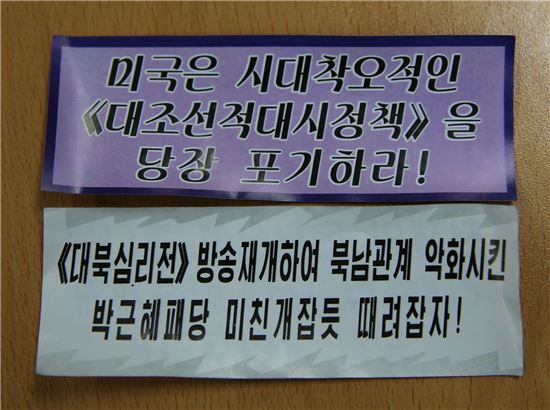
 The leaflets sent to North Korea contain content praising the North Korean regime and criticizing our military's loudspeaker broadcasts directed at the North.
[Asia Economy Yang Nak-gyu Reporter] North Korea has declared the "fortification of the demilitarized zone" and expressed its intention to redeploy North Korean troops in the frontline area. This is interpreted as an intention to restore the withdrawal of guard posts (GPs) and the demilitarization of the Joint Security Area (JSA) in Panmunjom, which were initially carried out according to the September 19, 2018 inter-Korean military agreement.
The inter-Korean military agreement symbolizes the Moon Jae-in administration's policy toward North Korea. The military agreement reached by the two Koreas in 2018 included measures in five areas to prevent accidental armed conflicts. Since then, the two Koreas have implemented ▲ suspension of military exercises around the Military Demarcation Line (MDL) ▲ establishment of no-fly zones near the MDL ▲ partial withdrawal of guard posts (GPs) within the Demilitarized Zone (DMZ) ▲ demilitarization of the Panmunjom Joint Security Area (JSA). However, if North Korea proceeds with fortifying the DMZ, the September 19 military agreement will effectively be broken after just two years.
Experts on North Korea predict that if North Korea takes military action, it will first carry out the large-scale leaflet distribution it mentioned, followed by the withdrawal of GPs or demilitarization of the JSA. Nam Sung-wook, Dean of the Graduate School of Public Administration at Korea University, said, "It seems North Korea will distribute leaflets in response to the South Korean pro-North groups planning to distribute leaflets on the 25th," adding, "After a low-level violation of the military agreement through leaflet distribution, North Korea will continue with direct violations such as GP withdrawal or JSA demilitarization."
The JSA is, in principle, an unarmed area within the DMZ. However, during the defection of a North Korean soldier in November 2017, it was confirmed that the pursuing unit used AK-series automatic rifles against the defector, which sparked controversy over North Korea violating the armistice agreement. If North Korea pushes for rearming the JSA, it is expected to increase security personnel within the JSA and redeploy automatic rifles and pistols. If North Korean outposts are redeployed at GPs, South Korea will inevitably have to increase the number of GPs on its side as well.
Concerns about escalating military tensions during the leaflet distribution process have also been raised. Kim Dong-yeop, a professor at the Institute of Far Eastern Studies at Gyeongnam National University, said, "If North Korean fishing boats distribute leaflets around the Northern Limit Line (NLL) in the West Sea, North Korean patrol boats and nearby coastal artillery will prepare for it, and even if leaflets are distributed on land, the North Korean military, assuming North Korean residents, is likely to respond, which will inevitably raise military tensions."
Redeployment of troops around Kaesong and Mount Kumgang is also possible. Kaesong has been considered the top invasion route in case of emergency in the past. Until the start of the Kaesong Industrial Complex in 2003, the 6th Division, 64th Division, and 62nd Artillery Brigade of the 2nd Corps were stationed around Kaesong and Bongdong-ri in Panmun Town. North Korea could redeploy troops to these areas again.
© The Asia Business Daily(www.asiae.co.kr). All rights reserved.
















