Listen to Global Futurist Thomas Frey
Opportunities for Change in the COVID Era
Entering a Super-Employment World... Hundreds of Thousands of New Industries to Emerge
Major Changes in Education Combined with IT, Thousands of Universities Disappear Due to Cost Issues
De-globalization Restricts Movement of Goods, Services, Capital, Labor, and Data
The Era of Rule by Guns Ends... Bio, Cyber, and Psychological Wars Begin
Korea's 'Gold Standard' in the COVID Era Draws Global Attention
[Asia Economy New York=Correspondent Baek Jong-min] The novel coronavirus infection (COVID-19) has become a significant turning point worldwide. The sharing economy, which was spotlighted as a new business before COVID-19, has come to an end, and contactless (untact) businesses are filling the gap. However, as uncertainty dominates the entire world, finding a breakthrough remains a distant prospect.
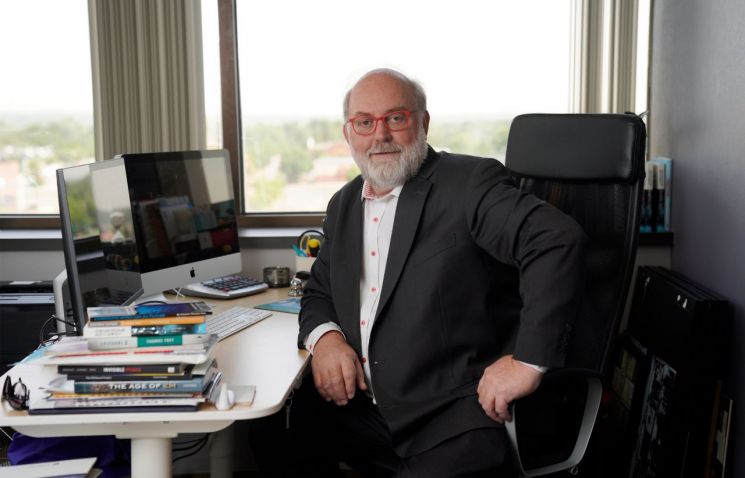
Thomas Frey, a global futurist and director of the Da Vinci Institute, in an interview commemorating the 32nd anniversary of Asia Economy Newspaper, described the crisis caused by COVID-19 as an "endless pandemic," offering a bleak outlook. He further called it "the most expensive crisis in history," advising that those who establish sustainable strategies to overcome this turbulent era amid uncertainty will be able to write success stories. Regarding South Korea, he praised its COVID-19 quarantine efforts as the "gold standard," encouraging that "the world will pay close attention to what South Korea has done going forward."
◆Disasters will boost creativity and change the job landscape= Frey emphasized that regarding the future of humanity in the 'post-COVID' era, "Since it leaves deep scars on society and industry, every country must consider bailouts and measures for workers to resolve the situation." He added, "Governments worldwide will try to regain much of the power and control lost to multinational corporations by becoming more digitalized." However, he pointed out that in response to the global crisis, "To face a common enemy of humanity, unified strength is needed, but differences in nations, races, religions, and cultures are exacerbating the difficulty of overcoming hardships."
He also stressed that crisis is opportunity. When asked "What efforts are needed to create jobs and foster new industries?" he replied, "Seizing opportunities is not easy, but one thing is certain: disasters are a good way to stimulate creativity." Regarding growing concerns about jobs, he began by saying, "We are entering a hyper-employment world," and evaluated that "potential job seekers will have more choices than ever, and freelancing will become an attractive alternative to traditional employment."
In this context, Frey predicted that unprecedented waves of innovation and creativity will be seen over the coming decades. He also said that hundreds of thousands of new industries capable of employing hundreds of millions of people will emerge during this period. He stated, "Those who embrace these kinds of changes and companies that study and accept the changing job landscape will thrive."
He was particularly confident that significant changes will occur in the education sector. He said, "The home learning experiment will change education forever," predicting that "many students will not want to return to school, and combined with IT, it will bring a 'perfect storm' that makes education much more hyper-personalized." He added, "Perhaps thousands of universities will disappear soon due to cost issues. The indirect costs of university education are too high," and questioned, "Aren't there various certification systems now that can double income in a much shorter time at a much lower cost than university education?"
Frey expressed concerns about the possible spread of protectionism and worldview contraction after COVID-19. Citing recent research, he said, "It has been revealed that when we fear viruses or infectious diseases, we tend to be more critical of others," adding, "This could signal that people are willing to break rules to prevent disease." In this regard, he analyzed, "A contraction of worldview may occur." He added, "The logic of 'safety over apology' will operate, making concerns about infection more conservative politically and religiously, further rigidifying ethical judgments." According to him, such notions lead to deglobalization, meaning that the movement of goods, services, capital, labor, technology, data, and information will be further restricted.
◆The emergence of a sensor-covered society= On the other hand, untact technology is expected to grow rapidly. Explaining changes in the aviation industry, he cited a recent online seminar he participated in. An airline executive attending the seminar introduced preparations to make contact unnecessary from the airport entrance to airplane seats.
Untact can extend into the expansion of a surveillance world. When asked about the relationship between nations and corporations, and between nations and civil society, he declared, "The era of ruling the world with guns is over," and "The curtain has risen on bio, cyber, and psychological warfare." He continued, "Most countries will fully implement AI detection networks designed to monitor invisible threats," predicting that "all borders, international terminals, and ports will be covered with drone fleets and various sensors for surveillance." He pointed out that remote scanners and AI networks are likely to be deployed for this purpose.
He also predicted that issues of human rights protection related to national surveillance will arise due to citizens' backlash. He said, "Europe is leading the 'right to be forgotten,' but if national surveillance strengthens, rights such as 'the right to be digitally invisible,' 'the right to be physically invisible,' and 'the right to be completely undetectable' may be promoted."
However, he emphasized positive aspects regarding the advent of a 'Big Brother' society where the state tracks and monitors people. Frey questioned, "If problems can be solved before they occur, don't we have a moral obligation to do so?" His view is that IT, including the internet, can be used under the recognition that it is necessary to prevent negative events in the future. He stated, "With increased predictive ability and the possibility of preemptive intervention, there are economic benefits," adding, "If spending one million dollars on early warnings and responses can prevent billions of dollars in damage, it is worthwhile."
◆"South Korea will be a fast mover"= Regarding South Korea in the post-COVID era, he praised it as "striving to reach levels beyond normal, beyond what anyone could have imagined." He evaluated, "South Korea has transformed from poverty and technological deficiency to one of the wealthiest and most technologically advanced countries in the world in just a few decades," and expressed expectations that "the world will ask 'How does South Korea handle complex problems?' and it will be a 'fast mover,' not a 'fast follower.'"
▶Who is Thomas Frey= Thomas Frey, director of the Da Vinci Institute, is recognized as a global futurist who predicts the coming future based on his understanding of technology. Google's classification of Frey as a top-level futurist signifies that his credibility is acknowledged even in the technology field. He is a former IBM employee and a member of the Triple Nine Society, a group of IQ geniuses.
© The Asia Business Daily(www.asiae.co.kr). All rights reserved.

















