'Aiming for a "1-Hour Bicycle Living Zone," Densely Establishing Radial Trunk Network and Circular Branch Network'
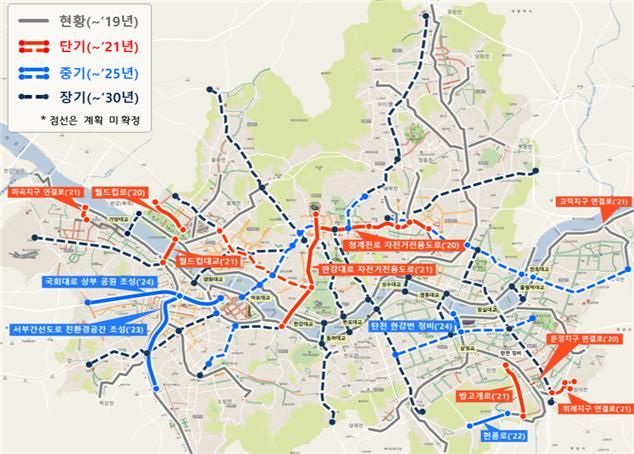
[Asia Economy Reporter Jo In-kyung] Seoul City announced on the 15th that by the first half of next year, it will establish a total of 16 km of arterial road networks on Hangang-daero (4.2 km) and Cheonggyecheon-ro (11.88 km round trip), and add 7.2 km of bicycle-only roads on six bridges including Yanghwa and Dongjak, following the existing six bridges.
This is to densely connect bicycle paths within Seoul, completing a bicycle arterial network linking north-south (Gwanghwamun∼Hangang-daero∼Hangang Bridge∼Yeouido) and east-west (Cheonggyecheon∼Seongbukcheon∼Jeongneungcheon∼Jungnangcheon∼Hangang) centered around the city center and the Hangang River.
First, on one of the main arterial road networks, the Hangang-daero section (Seoul Station intersection to the northern end of Hangang Bridge, 4.2 km) will complete a 2-meter-wide two-way bicycle-only road by the first half of next year through lane diet of 1-2 lanes. Once the bicycle-only road is established in this section, it will be connected with the 'Sejong-daero bicycle-only road (1.5 km)' to be completed by the end of this year, creating a north-south bicycle network in the city center stretching from Gwanghwamun to Yongsan~Nodeul Island~Yeouido and Hangang Park. Accessibility to Yongsan Park and Yeouido Park is also expected to improve.
Additionally, on Cheonggyecheon-ro (Cheonggye Plaza to Gosan Bridge, 5.94 km), bicycle-only roads will be created on both sides of Cheonggyecheon by the end of the year. These will be installed by adding decks or balconies or utilizing road level differences without reducing existing vehicle lanes or sidewalks.
These will also connect with existing bicycle paths along Seongbukcheon and Jeongneungcheon, which link to Cheonggyecheon, making bicycle travel easier to university-dense areas in the northeast such as Korea University and Sungshin Women's University.
Efforts will also be made to connect bicycle paths across the Hangang bridges between Gangnam and Gangbuk. In addition to the six bridges currently equipped with bicycle paths, six more bridges will have bicycle-only roads installed by the end of 2021, greatly expanding mobility.
Some disconnected sections within 'living zone bicycle specialized districts' such as Magok, Munjeong, Godeok·Gangil, and Wirye districts, where bicycle infrastructure is already in place, will also be connected by the first half of next year. Although most of these connection sections are less than 1 km, accessibility to major hubs such as Hangang Park and subway stations is expected to improve significantly.
Visibility improvement projects for 'bicycle priority roads' will also begin, with pictograms and bicycle waiting lines installed in four priority implementation sections (about 5 km) within green transportation zones such as Sajik-ro in the second half of this year, and plans to expand this annually throughout the city starting next year.
Along with this, various measures will be tried to allow bicycles to be carried on subways, buses, and taxis, such as installing racks on the rear of buses for quick bicycle loading. Considering Seoul's terrain with many hilly and sloped areas and existing road conditions, sections where bicycle road construction is limited will be overcome by linking with public transportation.
To promote convenience for bicycle commuters, an ordinance amendment has been completed to reduce transportation demand charges for owners of corporate buildings installing bicycle convenience facilities (showers, racks), which will be implemented starting in August.
Park Won-soon, Mayor of Seoul, said, "Bicycles, which have so far been only a complementary means, are rapidly emerging as a 'contactless' transportation mode favored in the post-COVID era. As one of Seoul's core 'Green New Deal' policies to respond to the climate crisis, Seoul will continue the people-centered bicycle revolution with the goal of becoming the world's best bicycle paradise, beyond just a pedestrian-friendly city."
© The Asia Business Daily(www.asiae.co.kr). All rights reserved.
![Clutching a Stolen Dior Bag, Saying "I Hate Being Poor but Real"... The Grotesque Con of a "Human Knockoff" [Slate]](https://cwcontent.asiae.co.kr/asiaresize/183/2026021902243444107_1771435474.jpg)
















