[Asia Economy Reporter Hwang Junho] This Sunday (21st) at 3:53 PM, a partial solar eclipse, where the moon covers part of the sun, can be observed. It is expected to present a spectacular view with 45% of the sun obscured. The partial eclipse, lasting 2 hours and 11 minutes, can be observed nationwide if the weather is clear. In South Korea, this partial eclipse is expected to be the last one observable for the next 10 years.
The Korea Astronomy and Space Science Institute forecasted on the 15th that, based on Seoul time, a partial solar eclipse where the moon covers part of the sun will occur from 3:53 PM and last about 2 hours and 11 minutes on the 21st.
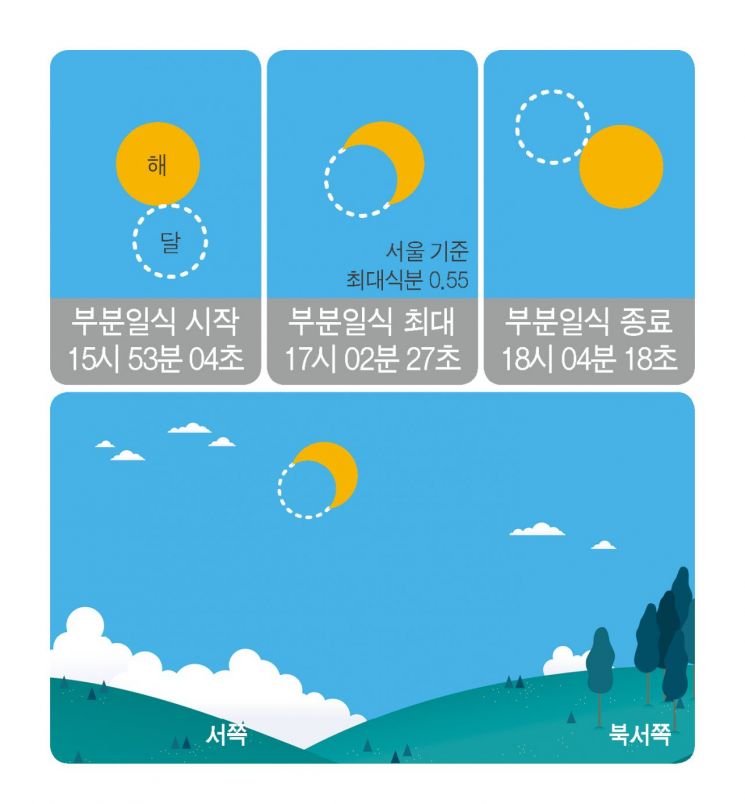
This partial eclipse can be observed from all regions of South Korea if the weather is good. In Seoul, it is expected that 45% of the sun’s surface area (maximum obscuration 0.55) will be covered, creating a magnificent spectacle. In Jeju Island (based on Jeju City), 57.4% of the sun’s surface area will be obscured, offering the most prominent eclipse view.
For Seoul, the partial eclipse will begin at 3:53:04 PM, reach its maximum at 5:02:27 PM, and end at 6:04:18 PM. This eclipse is the first and last solar eclipse observable this year. The next eclipse visible in South Korea is expected on June 1, 2030.
This partial eclipse can be observed from locations with a clear view of the western horizon. Observing the sun without proper protective equipment during the eclipse can cause eye damage and is dangerous. It is necessary to use telescopes equipped with solar filters or special eclipse glasses. However, even with these filters, continuous observation for more than 3 minutes is risky. Especially, viewing the sun through telescopes without solar filters, cameras, or sunglasses can cause blindness, so extreme caution is required.
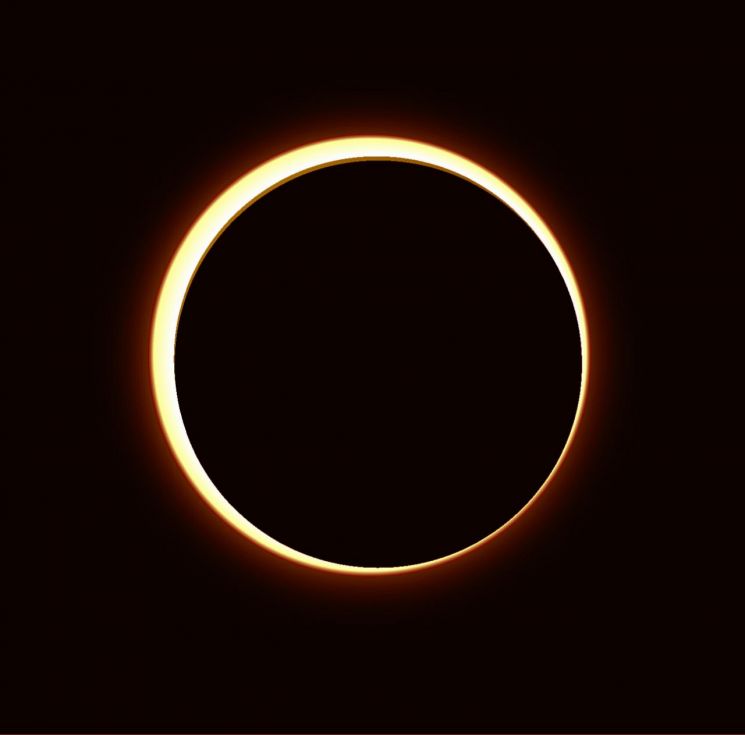
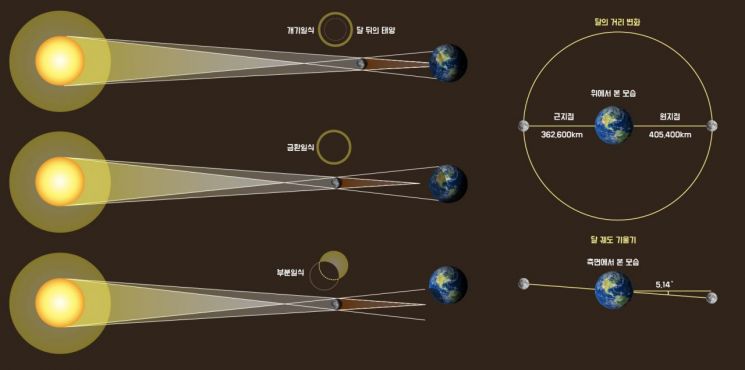
Solar eclipses are classified based on the extent to which the sun is obscured: partial eclipse, total eclipse, and annular eclipse. A partial eclipse occurs when part of the sun is covered, a total eclipse when the entire sun is obscured, and an annular eclipse occurs when the moon’s orbit distance from Earth prevents full coverage of the sun, leaving a ring-like appearance called a “ring of fire.”
Meanwhile, observation events related to this partial eclipse can be confirmed through local science museums, observatories, and the Korea Amateur Astronomical Society. The Korea Astronomy and Space Science Institute plans to provide live streaming on Facebook via SNS.
© The Asia Business Daily(www.asiae.co.kr). All rights reserved.
![Clutching a Stolen Dior Bag, Saying "I Hate Being Poor but Real"... The Grotesque Con of a "Human Knockoff" [Slate]](https://cwcontent.asiae.co.kr/asiaresize/183/2026021902243444107_1771435474.jpg)


















