Exhibition of Testimonies Saying "I Have Never Been Bullied"
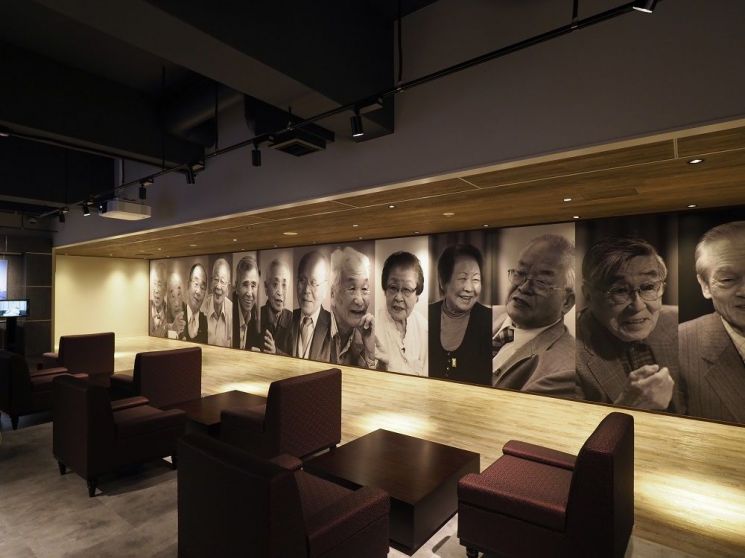 Survivors of Hashima (端島, also known as 'Gunkanjima') introduced at the 'Industrial Heritage Information Center' installed in the Ministry of Internal Affairs and Communications 2nd Government Building Annex located in Shinjuku Ward, Tokyo Metropolis on the 14th. [Image source=Yonhap News]
[Asia Economy Intern Reporter Kim Bong-ju] The Japanese government registered Hashima Island in Nagasaki Prefecture, infamously known as "Hell Island" for forcibly conscripting Koreans during the Japanese colonial period, as a UNESCO World Heritage site. They promised to inform the public that "Koreans were forcibly conscripted and suffered harsh labor," but this promise has not been properly kept, and repercussions are expected.
Various records about Hashima Island, better known as Gunkanjima (Battleship Island) due to its shape resembling a warship, will be publicly displayed at an exhibition hall set up in Tokyo on the 15th. However, the exhibition hall opening on this day omits information about the forced conscription victims, which was promised to Korea and the international community.
The Japanese government is opening this center, established in the annex of the Ministry of Internal Affairs and Communications' 2nd building in Shinjuku, Tokyo, through an organization called the "Industrial Heritage National Conference," starting at 10:30 a.m. on this day.
Originally opened on March 31, the center's opening was delayed due to the spread of the novel coronavirus disease (COVID-19).
Covering an area of 1,078 square meters, the center is composed of 23 Meiji-era industrial heritage sites, including seven forced labor facilities for Koreans such as Hashima.
When Japan registered the Meiji industrial heritage as a UNESCO World Heritage site in 2015, it promised to introduce forced conscription victims at the information center.
However, the center does not introduce the fact that hundreds of Koreans were forcibly conscripted and suffered harsh labor, and the exhibition mainly glorifies the achievements of Meiji industrialization.
Instead, photos and testimonies of 36 Gunkanjima residents denying forced conscription and labor are displayed.
A notable feature is a video testimony of Suzuki Fumio (鈴木文雄), a second-generation Korean-Japanese who spent his childhood on Gunkanjima during the Pacific War.
In the video, when asked, "Did you ever suffer harassment?" Suzuki replied, "I never suffered harassment. The people around me were very kind."
When asked, "Were you whipped?" he answered, "At that time, mining as much coal as possible was the country's policy. Would it have been possible to whip people?"
Center director Kato Goko defended the forced conscription issue, saying it was a "victim of circumstances," and that "Koreans, Taiwanese, and Japanese are all included here. No one claims to have been abused."
Meanwhile, among the Meiji industrial heritage sites, including Gunkanjima, Yahata (八幡) Steelworks, Takashima (高島) and Miike (三池) coal mines, and Nagasaki Shipyard, 33,400 Koreans were forcibly conscripted. On Gunkanjima, between 1943 and 1945, 500 to 800 Koreans were forced to work, and 122 are known to have died.
© The Asia Business Daily(www.asiae.co.kr). All rights reserved.
![Clutching a Stolen Dior Bag, Saying "I Hate Being Poor but Real"... The Grotesque Con of a "Human Knockoff" [Slate]](https://cwcontent.asiae.co.kr/asiaresize/183/2026021902243444107_1771435474.jpg)
















