Public Land Price Ceiling System Faces Local Government Review Struggles
Concerns Over Private Land Implementation Next Month
Controversy Over Price Review in Gwacheon and Wirye
Lack of Clear Standards Leads to Arbitrary Judgments and Complaints
Unclear Private Land Price Costs Raise Conflict Risks
Concerns Over Project Delays and Quality Decline
[Asia Economy Reporter Lee Chun-hee] With just over a month left before the expiration of the grace period for the private land price ceiling system, signs of potential side effects from the system's implementation are emerging in various places. Even in public land where the price ceiling system is already applied, there are repeated cases of project delays due to difficulties in the price review process. Additionally, there are criticisms that excessive price reductions by local governments are preventing proper reflection of construction costs and additional expenses. Some express concerns that the price ceiling system may lead to a decline in apartment quality, ultimately harming consumers.
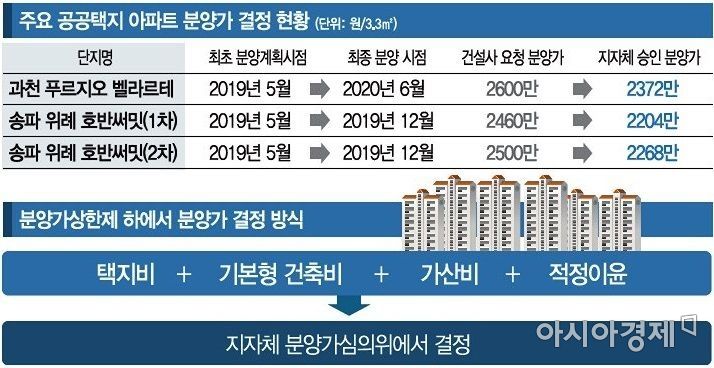
According to industry sources on the 11th, the Daewoo Construction consortium (Daewoo Construction, Taeyoung Construction, Kumho Industrial) plans to supply 'Gwacheon Prugio Bellarte' in S6 Block of the Knowledge Information Town in Gwacheon City, Gyeonggi Province, around the end of this month. This follows the recent notification from the Gwacheon City Price Review Committee setting the average price at 23.72 million KRW per 3.3㎡. The consortium had hoped to sell at an average price of 26 million KRW per 3.3㎡ last May. However, the Gwacheon City Price Review Committee set the price at 22.05 million KRW, 15.2% lower than the requested price.
This outcome is reportedly due to significant cuts in additional costs for specialized design, along with construction cost, land installment interest, and basic construction costs. Under the price ceiling system, the sale price is determined by adding land cost, construction cost, and additional expenses.
The industry points out that local governments excessively reduced construction costs and land installment interest during the review process. A Daewoo Construction official lamented, "The decision completely disregards the context where public sector supplies, such as nearby Happy Housing, are provided almost for free, and losses are compensated through private sales."
The consortium requested multiple re-reviews and even considered rental-to-sale options but ultimately decided to sell at a price 7.6% higher than the local government's original decision. This is still 8.8% lower than the initially requested price.
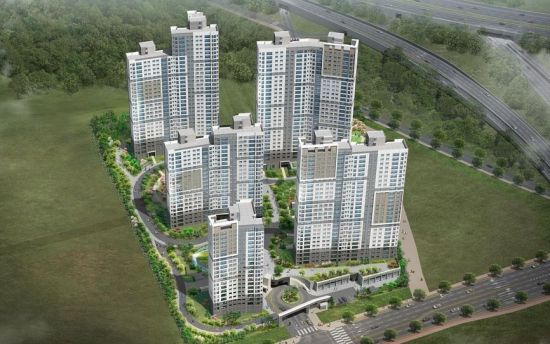 Perspective view of Gwacheon Prugio Bellarte, S6 Block, Knowledge Information Town, Gwacheon-si, Gyeonggi Province (Provided by Daewoo E&C)
Similar cases have occurred previously in Wirye New Town. The 'Songpa Wirye Hoban Summit,' sold at the end of last year in Wirye New Town, also had its sale price finalized lower than the company’s requested price during the review process. For this complex, sold in two phases, Hoban Group applied for an average price of 24.6 million KRW and 25 million KRW per 3.3㎡, respectively.
However, the Songpa District Price Review Committee notified prices of 22.04 million KRW and 22.68 million KRW, reducing the prices by 1.6% and 2.8%, respectively. As a result, the company, which had planned to supply the complex in May last year, ended up supplying it in December after a seven-month delay at the price set by the local government.
The industry points out that under the current structure of the Price Review Committee, price reviews inevitably depend on the discretion of individual committee members. Even if construction companies submit various documents, in the absence of clear standards, the recognition of costs is determined by the subjective judgment of the reviewers.
Even when companies appeal for re-review, local governments often respond, "There is no change in the supporting data, so it is questionable whether changing the price is appropriate," and tend to decide on the same price. Due to these issues, some companies experiencing delays have reportedly considered administrative lawsuits.
Therefore, there are concerns that controversies over the appropriateness of reviews will intensify once the private land price ceiling system is implemented starting next month. In particular, redevelopment and reconstruction projects, where land costs are unclear, are likely to face greater disputes during the land cost calculation process.
Delays in sales also negatively affect buyers. Since construction is carried out using the construction company’s own funds rather than sales proceeds, financial costs such as interest arise. If these costs are included in the project expenses, they become factors that increase the sale price. Additionally, some in the industry worry that the lowered sale prices will inevitably lead to reduced quality of finishing materials, resulting in a decline in housing quality.
© The Asia Business Daily(www.asiae.co.kr). All rights reserved.


















