Union: "Political motives become blatant at term end... Regulations must be lifted and competitive bidding enforced to ensure fair pricing"
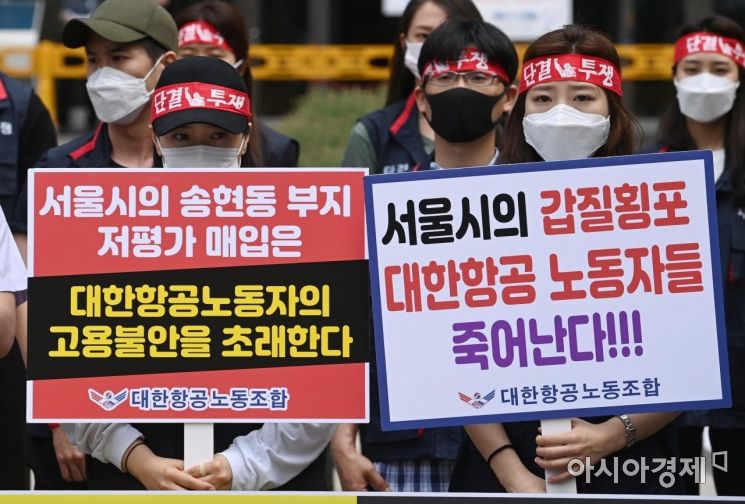 Korean Air union members hold a press conference in front of Seoul City Hall on the 11th, urging for a free competitive bidding for the Songhyeon-dong site. Photo by Kim Hyun-min kimhyun81@
[Asia Economy Reporter Yu Je-hoon] It has been confirmed that not a single company participated in the preliminary bidding for the sale of the Seoul Songhyeon-dong site, a key asset in Korean Air's self-rescue plan. This was an expected outcome following Seoul City's decision to designate the site as a 'park.' As the Songhyeon-dong site, known as the last 'golden land' remaining in downtown Seoul, faces the risk of becoming a 'burden' due to Seoul City's policy, the Korean Air labor union has strongly opposed the move, stating, "Rather than begging, they are breaking the piggy bank."
According to industry sources and Hanjin Group on the 11th, no one submitted related documents by the 4 p.m. deadline yesterday for the Letter of Intent (LOI) submission for the sale of Korean Air's Songhyeon-dong site, which was managed by Samjong KPMG and Samsung Securities. Although about 15 parties had received the investment briefing materials before the preliminary bidding, the situation became uncertain as Seoul City pushed forward with its parkification plan.
The publicly announced land price of the site (36,642㎡) and building (605㎡) in Songhyeon-dong, Jongno-gu, which Korean Air sought to sell, is around 310 billion KRW. The industry estimates the market price to be at least 500 billion KRW, with a maximum range of 700 to 800 billion KRW. Accordingly, Korean Air planned to pursue capital expansion demanded by creditors such as KDB Industrial Bank through a capital increase of about 1 trillion KRW along with the sale of this site. The creditors had previously agreed to support Korean Air with 1.2 trillion KRW, conditional on a capital increase of 2 trillion KRW by the end of next year.
However, this plan has been disrupted by Seoul City's obstinacy. Seoul City designated the site as a special planning zone within the Bukchon district unit plan, changed its use to a 'cultural park,' and announced its intention to purchase the site through a private contract while also indicating it could forcibly expropriate the land if the deal fails. Since the site’s use is limited to a 'cultural park,' the industry had long expressed concerns that no willing buyer would readily participate in the preliminary bidding. An industry insider said, "Designating the site as a park is essentially a silent pressure not to participate in the bidding," adding, "Although the main bidding remains, the results are unlikely to differ significantly."
In particular, Seoul City set the compensation for the site at 467.133 billion KRW, which is significantly lower than the market's estimated cost. Seoul City plans to pay this amount in installments: 46.713 billion KRW in 2021 and 420.42 billion KRW in 2022. This condition is difficult for Korean Air, which needs a large sum of money to meet the 2 trillion KRW capital expansion requirement by the end of next year.
Cho Won-tae, chairman of Hanjin Group, also stated on the 28th of last month at a press meeting held at the funeral of Sohn Kyung-shik, chairman of the Korea Employers Federation, "If the parkification proceeds, we will keep the site as is." A Korean Air official lamented, "While the government promises active support to protect key industries, the city is in a frustrating situation trying to take away core assets."
As Seoul City shows such determination to proceed, the Korean Air labor union is also strongly opposing the move. The union held a protest rally in front of Seoul City Hall at around 10:30 a.m. on the same day. The union criticized, "While the government is implementing employment retention support measures for companies maintaining employment through furloughs instead of layoffs due to the COVID-19 pandemic, Mayor Park Won-soon and Seoul City are purchasing private company land at a low price, preventing liquidity funds from being secured," adding, "Seoul City is effectively defying government policy."
The union further stated, "Suddenly moving to parkify the remaining land after more than 10 years in office blatantly reveals Mayor Park's political intentions," and urged, "The shackles on the Songhyeon-dong site must be removed so that it can be competitively bid on according to free market economic principles and a reasonable price can be paid."
Meanwhile, as the COVID-19 crisis accelerates, Korean Air is continuously downsizing. While furloughs have been implemented for 70% of employees, the company is also expanding its voluntary leave system. Korean Air is accepting applications until the 17th for an unpaid voluntary leave program lasting a minimum of six months and a maximum of one year, targeting cabin crew members with more than two years of service. This is a step beyond the short-term voluntary leave of one to three months implemented at the end of last year.
© The Asia Business Daily(www.asiae.co.kr). All rights reserved.

















