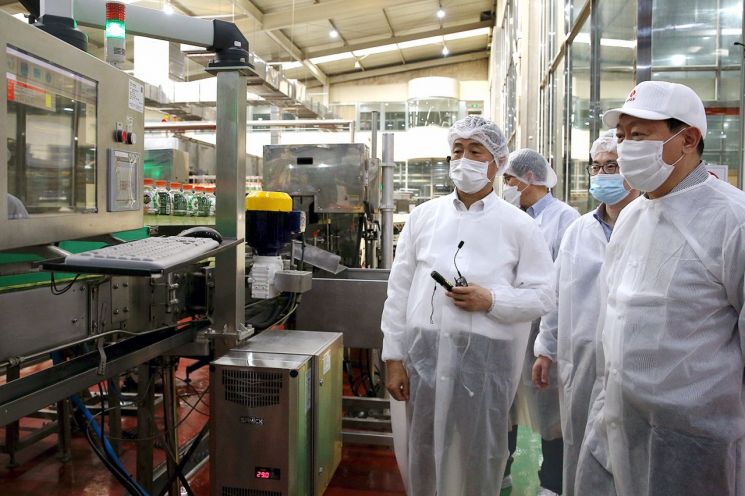
 Shin Dong-bin, Chairman of Lotte Group, is touring the facilities during his visit to the Lotte Chilsung Beverage Smart Factory on the 4th. (Photo by Lotte)
[Asia Economy Reporter Seungjin Lee] Owners in the distribution industry, hit hard by the impact of the novel coronavirus infection (COVID-19), have embarked on on-site visits. They have urged preparation for the 'post-COVID' era by securing new growth engines.
According to the industry on the 7th, Shin Dong-bin, chairman of Lotte Group, visited the Lotte Chilsung Beverage smart factory located in Anseong, Gyeonggi Province, on the 3rd and emphasized, "Due to the impact of COVID-19, digital transformation will accelerate further and its scope will expand."
This is the first time this year that Chairman Shin has visited a production site. Taking this visit as an opportunity, he is expected to frequently visit sites within the limits of quarantine measures and embark on on-site management activities for the post-COVID era.
Chairman Shin stated that food safety will be a key issue in the post-COVID era and urged, "Since the smart factory enables traceability of manufacturing history from raw materials to product production, let us contribute to public safety through a food safety response system."
The smart factory construction project at Lotte Chilsung Beverage and Lotte Information & Communication's Anseong plant is a representative case of the digital transformation strategy that Lotte is promoting across the group. A smart factory refers to an intelligent production plant that utilizes digital new technologies throughout the entire process of demand, production, inventory, and distribution to improve factory productivity and quality.
Established in 2000, the Anseong plant is the largest among Lotte Chilsung's six domestic plants. Lotte is investing approximately 122 billion KRW in the Anseong plant to promote the construction of a smart factory.
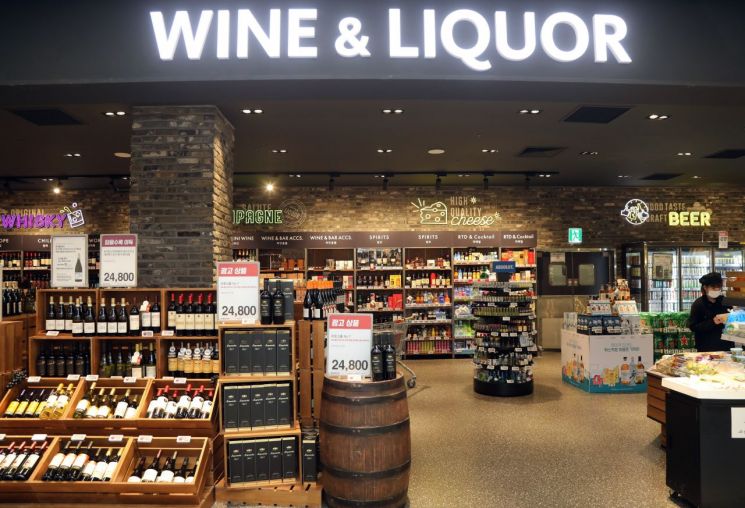
On the 4th, Jung Yong-jin, vice chairman of Shinsegae Group, also made a surprise on-site visit. Vice Chairman Jung visited 'Emart Town Wolgye Branch' in the morning as his first on-site activity of the year, showing his intention to continue investing to strengthen offline competitiveness.
Emart recorded its first deficit last year due to the development of the online environment and intensified competition among offline stores. In response, Emart reopened the Wolgye branch on the 28th of last month after a 10-month renovation as a strategic store introduced to find the future of offline retail.
Vice Chairman Jung, along with key executives including Kang Hee-seok, president of Emart, first visited the core grocery store of the Wolgye branch and toured the fresh food section.
At the site, Vice Chairman Jung said, "Fresh foods that customers seek must be available at Emart, and furthermore, there must be differentiated products that can only be found at Emart to attract customers. From this perspective, I expect the fresh food store at the Wolgye branch to receive a good response from customers."
He especially praised the upgraded fresh food store, including the fruit and vegetable corner with a diverse assortment and the seafood and livestock corner featuring the personalized 'Order Made Service,' and ordered that these upgrades be expanded to renovations of other stores in the future.
Vice Chairman Jung said, "I express my gratitude to the employees for successfully opening Emart Town Wolgye, Emart's first future-oriented store, despite the difficult environment. The more difficult the situation, the more we should not be complacent but strive together to find new opportunities through innovation and challenge."
© The Asia Business Daily(www.asiae.co.kr). All rights reserved.


















