Democratic Party Prepares Bill to Exhume Pro-Japanese Collaborators Buried at National Cemetery
Controversy Over Pro-Japanese Actions of Korean War Hero General Baek Seon-yeop
Protest Rally in Front of Office of Rep. Lee Su-jin Who Prepared the Bill
Political Sphere Heated Debate Over 'Pro-Japanese Exhumation' Bill
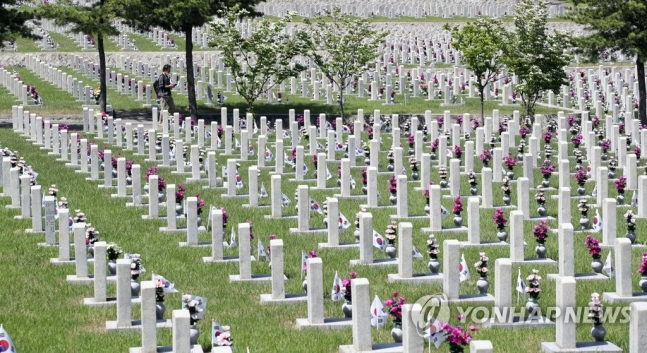
[Asia Economy Reporter Han Seung-gon] On the 6th, Memorial Day, controversy over the "pro-Japanese grave removal" has intensified. The term "pro-Japanese grave removal" refers to the so-called "grave removal theory" proposed by some members of the Democratic Party of Korea, who argue that a bill is needed to eliminate the burial sites of pro-Japanese figures buried in the National Cemetery.
In particular, regarding former General Baek Seon-yeop, who made various contributions during the Korean War, there is also a stance that burial in the National Cemetery is not possible due to his service in the Gando Special Unit, which was involved in suppressing independence fighters during the Japanese colonial period.
General Baek was commissioned as a second lieutenant in the Manchukuo Army in April 1943 and served for two years in the Gando Special Unit. The Gando Special Unit was a special unit filled with Koreans except for a few positions such as battalion commander, under the pretext that "Korean independence fighters should be governed by Koreans." Until the unit was disbanded due to Japan's defeat, it led the extermination of independence fighters, and its activities are known to have been particularly brutal.
General Baek's name came up during the explanation of the grave removal issue. On the 24th of last month, then-elect Democratic Party member Lee Su-jin visited the National Seoul National Cemetery in her constituency along with Democratic Party electee Kim Byung-gi and others, participating in the "2020 Sites of Pro-Japanese and Anti-Japanese, Correcting the History of the National Cemetery" event hosted by the Unam Kim Seong-suk Memorial Association.
At the event, Electee Kim said, "There are problems with those buried so far, but in the future, for example, in the case of Baek Seon-yeop, there is a possibility of issues arising." He added, "If the grave removal issue is not resolved by law, conflicts will intensify."
Electee Lee said, "To set history right, it is appropriate to remove pro-Japanese collaborators from the National Cemetery," adding, "Several attempts were made until last year, but the 'pro-Japanese grave removal' bill did not pass." She emphasized, "After coming to the National Cemetery, I thought that a bill to remove the burial sites of pro-Japanese collaborators should be made."
Regarding pro-Japanese activities such as serving in the Gando Special Unit, General Baek stated in an interview with the Chosun Ilbo in June last year, "When I was assigned to the Gando Special Unit in early 1943, the anti-Japanese independence fighters and Kim Il-sung's units had already moved from the Gando region to other areas due to large-scale Japanese military suppression operations," and "I have never engaged in combat with independence fighters."
About the description of battles with Korean anti-Japanese independence fighters during his service in the Gando Special Unit in his Japanese autobiography, he said, "It was a painful reflection as a fellow Korean on the unavoidable battles and sacrifices among compatriots in the early 1930s in the Gando Special Unit."
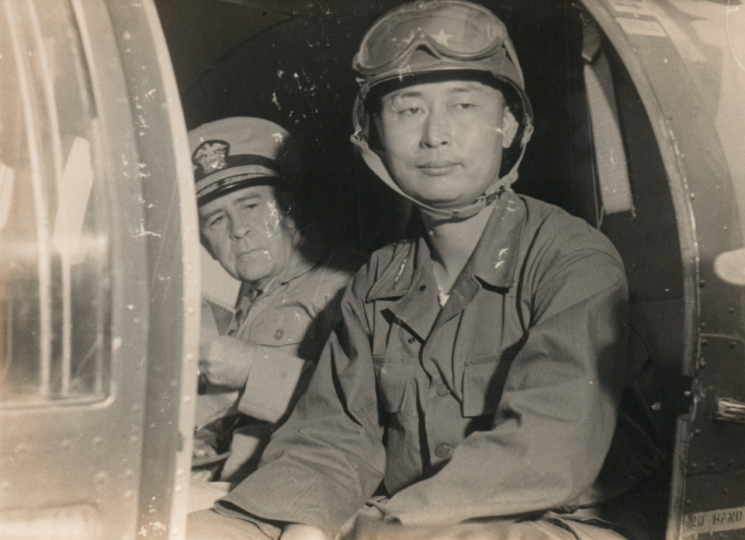 On August 25, 1953, Baek Sun-yeop, then a Major General, riding a US military helicopter to the Panmunjom Armistice Talks venue.
 [Image source=Yonhap News]
◆ "Opposition to Burial of Civilian Massacre Military Dictatorship Collaborators in the National Cemetery" vs "Must Be Established in Seoul National Cemetery"
This sparked intense debate in the political sphere. Kim Hong-gul, the third son of former President Kim Dae-jung and a Democratic Party member, wrote on his Facebook on the 28th of last month, "The crimes of pro-Japanese military personnel did not end during the Japanese colonial period; some also collaborated in civilian massacres during the Korean War and military dictatorship, so their wartime achievements alone cannot be forgiven."
He expressed opposition to General Baek's burial in the National Cemetery, saying, "In Baek Seon-yeop's book published in Japan, he confesses to his pro-Japanese activities during his time in the Manchukuo Army's Gando Special Unit, stating 'It is true that I pointed a gun at my compatriots, and even if I am criticized for that, it cannot be helped.'"
The opposition parties, including the United Future Party, have taken a stance against accepting the pro-Japanese grave removal bill.
On the 28th, Yoon Sang-hyun, chairman of the Foreign Affairs and Unification Committee of the National Assembly, criticized, "The absurd decision by the Moon Jae-in administration's Ministry of Patriots and Veterans Affairs that General Baek Seon-yeop cannot be enshrined in the Seoul National Cemetery must be immediately revoked," adding, "Even if there is a shortage of space in the Seoul National Cemetery, it is the nation's duty, courtesy, and dignity to make space somehow and enshrine him." He continued, "But to insult such a national hero by saying 'Even if enshrined in the Seoul National Cemetery, there may be cases of removal again' is not just the Ministry of Patriots and Veterans Affairs but a national disgrace."
Earlier that day, Park Sam-deuk, head of the Ministry of Patriots and Veterans Affairs, explained during a congratulatory visit to Joo Ho-young, floor leader of the United Future Party, "Upon checking, the Seoul National Cemetery's generals' burial area is full, so General Baek can be enshrined in the Daejeon National Cemetery."
Won Hee-ryong, Governor of Jeju Province, said, "General Baek is a hero of the Korean War who saved the free Republic of Korea, and he can be regarded as the 'Yi Sun-sin of the Korean War,'" adding, "It is very unfortunate if he suffers any damage under Korean law, and it should not happen." He continued, "A place for General Baek must be prepared in the Seoul National Cemetery."
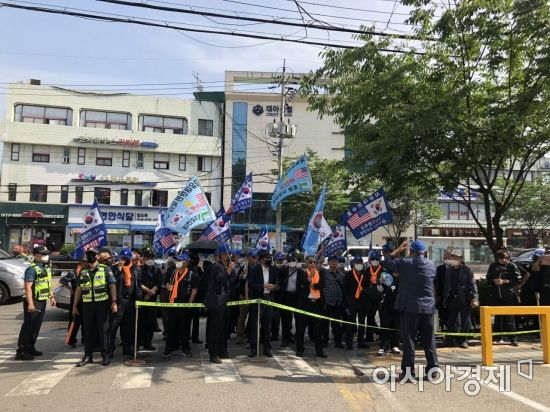 On the afternoon of the 5th at 3:30 PM, a group opposing the "Pro-Japanese Collaborators' Tomb Removal" bill held a protest rally in front of the office of Lee Su-jin, a Democratic Party of Korea local constituency office located in Sadang-dong, Dongjak-gu, Seoul. Photo by Kang Joo-hee, intern reporter kjh818@asiae.co.kr
◆ "The Concept of Pro-Japanese Is Subjective" vs "These Graves Must Be Relocated Soon"
Meanwhile, a conservative group visited Representative Lee's constituency office and held a protest rally. On the 5th, they held a rally in front of Lee's office in Sadang-dong, Dongjak-gu, Seoul, demanding the withdrawal of Lee's pro-Japanese grave removal bill and an apology.
They raised their voices, saying, "The concept of 'pro-Japanese' itself is arbitrary and extremely subjective. It is divisive," and asked, "Is it acceptable for a member of the National Assembly to recklessly utter outrageous remarks that go against humanity and provoke public outrage without any consequences?"
Amid political conflicts over the pro-Japanese grave removal bill, the Military Human Rights Center demanded the removal and relocation of graves, stating, "There are 56 pro-Japanese soldiers buried in the National Cemetery."
According to the Military Human Rights Center on the 4th, there are a total of 56 pro-Japanese soldiers buried in the National Cemetery, including 11 officers of the Japanese Army at the field officer level. Among the 11 field officers, three reached the ranks of colonel and lieutenant colonel in the South Korean Army.
The list of 56 pro-Japanese soldiers announced by the Military Human Rights Center that day, referencing the "Dictionary of Pro-Japanese Collaborators," includes former President Park Chung-hee, former Prime Ministers Kim Jong-ryeol and Jeong Il-gwon, and former Defense Ministers Shin Tae-young, Yoo Jae-heung, Lee Jong-chan, and Lim Chung-sik.
Of the 56 pro-Japanese soldiers buried in the National Cemetery, 32 are in the National Seoul National Cemetery, and 24 are in the National Daejeon National Cemetery. Among them, 20 served in the Japanese Army, and 36 in the Manchukuo Army, with 14 of the Manchukuo Army soldiers having served in the Gando Special Unit.
All 56 were commissioned into the South Korean Army after liberation. Among them, 46 were in the Army, 5 in the Air Force, and 5 in the Marine Corps, with 46 eventually promoted to general.
The Military Human Rights Center stated, "Judging from the fact that they received seven medals from Japan and 16 medals and decorations from Manchukuo, these were not people who were forcibly taken as colonial Koreans to serve as soldiers but actively served Japan for advancement," and urged, "The graves must be relocated as soon as possible through related legal amendments."
Meanwhile, according to the Ministry of Patriots and Veterans Affairs' "Status of Pro-Japanese Anti-National Act Collaborators Buried in National Cemeteries," 63 pro-Japanese collaborators listed in the Dictionary of Pro-Japanese Collaborators are buried in the Seoul National Cemetery and Daejeon National Cemetery.
© The Asia Business Daily(www.asiae.co.kr). All rights reserved.
![A Woman Who Jumps Holding a Stolen Dior Bag... The Mind-Shaking, Bizarre Con of a "Human Knockoff" [Slate]](https://cwcontent.asiae.co.kr/asiaresize/183/2026021902243444107_1771435474.jpg)


















