Interview with Eom Gi-an, CEO of Huons
Approval of Phase 3 Clinical Trial Plan
Anti-inflammatory and Eye Protection in One
Positive Signs for Overseas Expansion of Injectable Drugs
Fourfold Increase in Sales Over 10 Years

[Asia Economy Reporter Choi Dae-yeol] The complex eye drop (HU-007) developed by Huons recently received approval for its Phase 3 clinical trial plan in Germany. After completing clinical trials domestically, the company expects to submit the results report as early as this month and anticipates approval within the year. Eom Gi-an, CEO of Huons (pictured), recently told reporters, "Germany has well-established clinical trial infrastructure and stringent regulatory standards," adding, "If we receive approval in Germany, we expect it will be relatively easy to enter neighboring countries through the European Union (EU) centralized authorization system."
Complex Eye Drop Approved for Clinical Trial in Germany
HU-007, being developed as a treatment for dry eye syndrome, is characterized by being a combination drug. It conveniently contains both an anti-inflammatory agent and an eye-protective agent in one. Most of the global market consists of single-agent drugs, and in Europe, only one single-agent product containing the anti-inflammatory 'cyclosporine' is approved as a prescription drug for dry eye treatment. CEO Eom said, "Unlike oral pills, it is impossible to administer two different types of eye drops simultaneously," and added, "To achieve synergistic effects, eye drops that require two active ingredients must be developed as combination drugs."
Dry eye syndrome has attracted increasing attention from domestic and international pharmaceutical industries as the number of patients steadily rises due to the spread of smartphones and fine dust. The domestic and international treatment market is estimated to be worth 4 trillion KRW and is expected to grow by about 6-7% annually. The complex eye drop developed by Huons focuses on reducing irritation and pain experienced when using eye drops and has been patented in 11 countries worldwide, including Europe and Japan.
Alongside eye drops, Huons' other key area, injectable drugs, recently received additional product approval (ANDA approval) in the United States, signaling positive prospects for overseas expansion. Previously, three approvals were for ampoule injectables, and this time, approval was granted for vial injectables for the first time. Injectable drugs are classified by container type, such as ampoules and vials. CEO Eom said, "Since 2017, we have received one approval annually in the U.S., and we are currently undergoing approval procedures for local anesthetics," adding, "As basic pharmaceuticals experiencing shortages locally, we plan to strengthen our influence in the U.S. injectable drug market as an exclusive supplier in partnership with local partners."
Fourfold Growth in Scale Over 10 Years
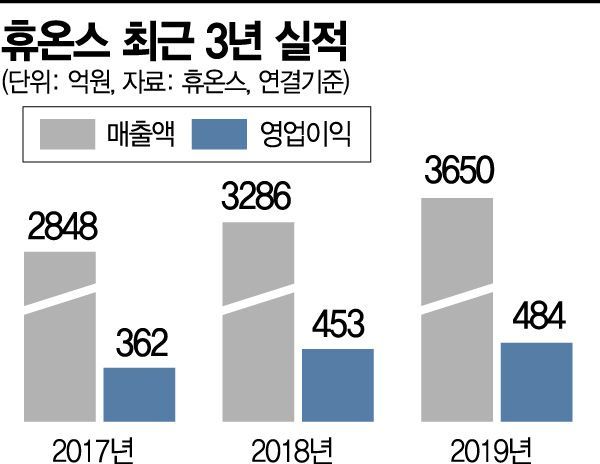
Huons' business is broadly divided into three areas: prescription drugs centered on injectables and eye drops, beauty and healthcare, and contract manufacturing. Through expanding product lines and mergers and acquisitions (M&A), sales increased more than fourfold from 80.9 billion KRW in 2009 to 333.1 billion KRW last year (separate basis).
Regarding concerns that diversification might weaken the essential expertise as a pharmaceutical company, CEO Eom said, "Since subsidiaries and product lines maintain certain connections, we satisfy both diversification and expertise simultaneously." Notable examples include expanding into beauty fields such as fillers and cosmetics using hyaluronic acid (HA), as well as syringes, artificial synovial fluid, artificial tears, and even botulinum toxin, followed by increasing contract manufacturing volumes from domestic and overseas companies after establishing facilities.
Growing scale and increasing profits aim to strengthen the foundation for M&A. This is for new drug development. He participated in the development of Sunpla-ju, the first domestic anticancer drug, and Joins tablets, the first natural product new drug, at his previous company SK Chemicals. CEO Eom said, "The pharmaceutical industry tends to resist recognizing achievements from latecomer countries in advanced countries," adding, "Although large domestic pharmaceutical companies often export technology due to improved 'research' capabilities, it is still difficult to develop and succeed in the market solely with domestic company capabilities."
© The Asia Business Daily(www.asiae.co.kr). All rights reserved.


















