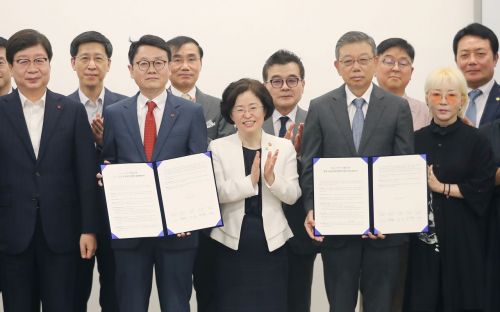
[Asia Economy Reporter Moon Chaeseok] The Korea Fair Trade Commission (KFTC) collaborated with consumer cooperatives (co-ops) and promoted win-win cooperation between large corporations and small and medium-sized enterprises (SMEs) during the COVID-19 pandemic. It decided to provide incentives to headquarters supporting dealerships and offer preferential policy fund support to 'Good Franchises.' The commission also plans to increase the number of small businesses that receive warnings instead of administrative sanctions such as fines, thereby easing unnecessary corporate penalties.
Under the Monopoly Regulation and Fair Trade Act (Fair Trade Act), the competition authority is an organization that promotes fair and free competition, encourages creative corporate activities, protects consumers, and fosters balanced development of the national economy. During the same period, there were controversies over lenient punishments for Mirae Asset Group and the fairness of complaints between Lee Hae-jin, Global Investment Officer (GIO) of NAVER, and Kim Beom-su, Chairman of Kakao. However, overall, the commission was evaluated as attempting to reduce criminal complaints and administrative actions.
The most notable aspect of the 'Cho Sung-wook administration's' policy enforcement in the first half of the year is the lowered level of administrative sanctions. During the tenure of former Chairman Kim Sang-jo, the law was enforced by expanding criminal complaints. Not only executives who committed violations but also employees were reported. However, many cases were dismissed at the prosecution investigation stage without indictment, a representative example being the Hyundai Mobis complaint. The KFTC filed criminal complaints against the company and its executives for forcing dealerships to purchase parts, but in November 2018, the prosecution dismissed the case due to 'no charges.' Recently, the Mirae Asset Daewoo case was settled with a fine of 4.4 billion KRW instead of prosecution. There was no concrete evidence that Chairman Park Hyun-joo ordered preferential treatment of work.
Although targeting small businesses, the commission also proposed amendments to reduce administrative actions against unfair trade practices. On the 28th of last month, it announced administrative notices for amendments to the 'Rules on the Operation of KFTC Meetings and Case Procedures' (notification) and the 'Guidelines for Reviewing Unfair Trade Practices' (directive). The rules and guidelines will be revised to expand the scope of small businesses that end with a 'warning' before administrative sanctions such as fines. The exemption from review for four types of unfair trade, including refusal to trade, will also be expanded from annual sales under 2 billion KRW to under 5 billion KRW.
The commission not only increased the number of win-win cases but also diversified their types. At the end of February, Chairman Cho visited Yuyang D&U, a manufacturer of power supply devices for displays located in Hwaseong, Gyeonggi Province, and announced that extra points would be given when evaluating fair trade agreements with large corporations supporting partners that have 'returned' to Korea. At the end of April, he visited Maeil Dairies and said that companies sharing losses with dealerships struggling due to COVID-19 would receive incentives related to fair trade agreements in the dealership sector.
On the 5th, the commission met with five co-op federations (University, Dure, iCOOP, Hansalim, and Happiness Centered) and agreed to promote the 'Urban-Rural Win-Win Prepayment Campaign' by next month. This aligns with the government's 'Good Prepayment Policy.' The core of the policy is to provide tax and income deductions when businesses and consumers prepay or pre-purchase from small business owners.
Through proactive administration, the commission encouraged corporate win-win cooperation and minimized merger procedures deemed necessary. As of the end of last month, it issued 'Good Franchise' certificates to 170 franchisors that alleviated financial burdens on franchisees. Businesses with certificates receive benefits such as reduced loan interest rates when submitting the certificate to financial institutions for policy fund applications.
In April, the commission approved Jeju Air's acquisition of Eastar Jet within six weeks of review. Generally, the review period is 30 days from the filing date, with possible extensions up to 90 days if necessary. Some cases take longer than 90 days.
However, some believe that the KFTC's imposition of fines on Delivery Hero (DH), operator of the delivery app 'Yogiyo,' for management 'gapjil' (abuse of power) may affect the corporate merger review with Woowa Brothers, operator of 'Baedal Minjok.' The commission has also been criticized for applying a more lenient standard in the controversy over Park Hyun-joo, Chairman of Mirae Asset Group's private interest appropriation, compared to Cho Won-tae, Chairman of Hanjin; Cho Hyun-joon, Chairman of Hyosung; Lee Hae-wook, Chairman of Daelim (Daelim Industrial); and Lee Ho-jin, former Chairman of Taekwang. Amid this, the commission's intention to sanction Hanwha Group for preferential treatment of work has drawn attention.
The KFTC explained, "Even for similar types of sanctions, the results of the plenary meeting (where nine commissioners including Chairman Cho gather, equivalent to a court ruling) always differ," and "there is no correlation between the previous and the next sanction cases."
© The Asia Business Daily(www.asiae.co.kr). All rights reserved.

















