Early Admission Decreases by 1.3%p Compared to Last Year
Regular Admission Increases Accordingly
Student Record Items Reduced
Mathematics and Calculus Are Popular Choices
English Requires Grade 3 or Higher
Korean History Answers Must Be Submitted in Advance
[Asia Economy Reporter Lee Hyun-joo] The 2022 university admission process, which will be taken by current high school sophomores, will differ significantly in content from this year. Formally, it will focus on a two-track system of early admission and regular admission, but the proportion of regular admission selection will increase, and the College Scholastic Ability Test (CSAT) will be reorganized into an integrated subject structure combining humanities and sciences. Based on four-year universities for the 2022 academic year, the total number of recruits is 346,553, a decrease of 894 compared to the 2021 academic year. Early admission will select 262,378 students (75.7%), and regular admission will select 84,175 students (24.3%). Early admission decreases by 1.3 percentage points compared to the previous year, while regular admission increases by the same amount. The expansion of regular admission is particularly noticeable among major universities in the Seoul area. Seoul National University's regular admission ratio will increase from 21.9% in 2021 to 30.1% in 2022. Yonsei University will rise from 30.7% to 40.1%, and Korea University from 18.4% to 40.1%.
◆Reduction of Student Records and Extracurricular Areas= In early admission, the items recorded in the school life record (student record) will be reduced. Activities outside the regular curriculum will basically not be reflected in university admissions. Essay-based admissions and special talent admissions will be abolished. The reduction is even greater in the extracurricular area. This was introduced to reduce the influence of factors such as parental background and private education rather than the student's individual ability or achievement on university admissions. Among club activities, only one autonomous club per year (30 characters) can be recorded, and for youth group activities, only the group name must be recorded. Small research papers are completely prohibited from being recorded. Only volunteer activities inside and outside school remain, and special notes are excluded.
Career aspiration fields can be recorded in the student record but will not be transmitted as admission data. Awards are limited to one school award per semester (six over three years) for admission consideration. For curricular activities, the current 500 characters per subject remain, but after-school activities (attendance) will not be recorded. The self-introduction letter evaluated in the comprehensive student record admission process will be phased out, with a reduction in questions and word count. Teacher recommendations will be abolished this year.
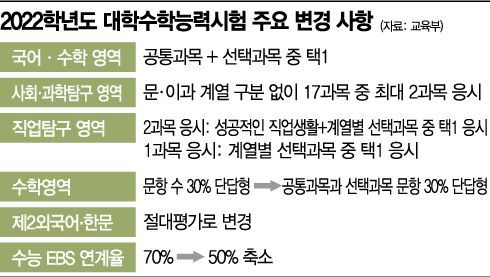
◆Integrated Humanities and Sciences, Major Changes in CSAT= The 2022 CSAT will be reorganized into an integrated humanities and sciences format according to the 2015 revised curriculum. For mathematics, scores will be calculated integrally without distinguishing between humanities and sciences, similar to Korean and English. The exam is scheduled for November 18, 2021.
Looking at subjects individually, Korean consists of common and elective subjects. Among the total 45 questions, common subjects (questions 1?34) are answered first, followed by elective subjects (questions 35?45). The common subjects are reading and literature, while the electives are language and media, and speech and writing. Speech and writing correspond to questions related to speech and writing in the previous CSAT, and language and media is newly added. Language and media questions involve understanding the composition and distribution methods of information according to media characteristics, with an example question from the Korea Institute for Curriculum and Evaluation asking about the appropriateness of 'gatekeeping' in the context of fake news. Specific example questions by subject can be found on the Korea Institute for Curriculum and Evaluation website.
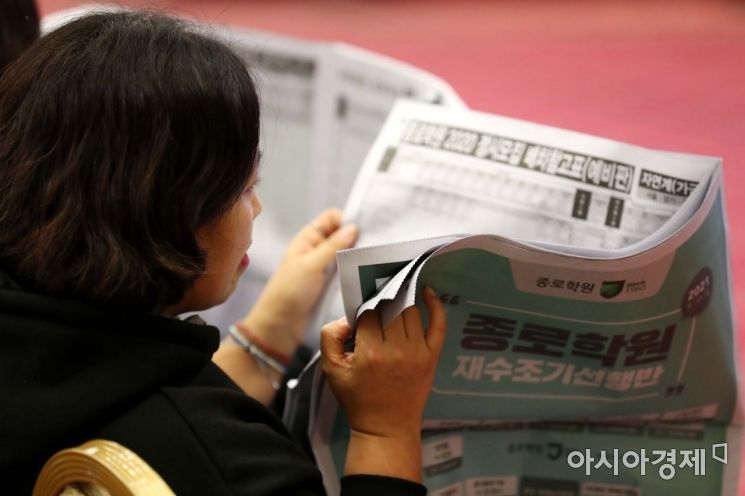 The day after the 2020 College Scholastic Ability Test, on the 15th, examinees and parents are listening to an admissions expert's explanation at a college entrance briefing session hosted by Jongno Academy at Sejong University in Gwangjin-gu, Seoul. Photo by Moon Honam munonam@
The mathematics section is expected to evenly cover units from Mathematics I and Mathematics II as common subjects. Elective subjects include Probability and Statistics, Calculus, and Geometry. Although elective, some schools designate specific subjects, so prior confirmation is necessary. Fifty-six universities require students to choose only one between Calculus and Geometry, excluding Probability and Statistics. The math question arrangement is common subjects from questions 1 to 22, electives from 23 to 30, with questions 16?22 and 29?30 being short-answer. Lee Mangi, director of the Uway Education Evaluation Research Institute, said, "In the 2021 CSAT, the 'Ga' type math covered Mathematics I, Probability and Statistics, and Calculus, so current high school seniors likely studied Geometry only for school grades and focused on Calculus for the CSAT. If these students fail the 2021 admission and retake the exam, most will choose Calculus. Considering the avoidance of Geometry among current students, Calculus will almost certainly be the dominant choice among mid-to-high-level students."
"Mathematics Changes the Most
Time Management Becomes More Important
Thorough Preparation with Mock Exams is Essential"
English, which was first implemented as an absolute evaluation in 2018, had a 10.0% top grade rate in 2018, 5.3% in 2019, and 7.4% in 2020, making it a subject with good differentiation. From 2022, many top-tier universities will increase the weight of English, so even if students perform well in Korean and math, scoring below grade 3 in English will practically make regular admission applications difficult.
◆Pre-submission of Korean History Answers= The fourth session, Korean History and Social, Science, and Vocational Exploration areas, will have 5 more minutes than the previous 102 minutes. Korean History, a mandatory subject, will have the question paper and answer sheet collected immediately after the exam.
For the exploration subjects, students choose two subjects regardless of humanities or sciences, but 62 universities require natural science students to select only from the science exploration area. Therefore, it is expected that cross-selection without distinguishing humanities and sciences will not be common.
The second foreign language and Chinese characters areas could be substituted for one exploration subject in humanities, but from 2022, they have changed to absolute evaluation, and due to differentiation issues, almost no universities reflect them in regular admissions. Oh Jong-woon, evaluation director at Jongro Academy Haneul Education, advised, "Compared to the current exam, the math question composition has changed, making time management important. Therefore, thorough preparation through mock exams is necessary."
© The Asia Business Daily(www.asiae.co.kr). All rights reserved.
![Clutching a Stolen Dior Bag, Saying "I Hate Being Poor but Real"... The Grotesque Con of a "Human Knockoff" [Slate]](https://cwcontent.asiae.co.kr/asiaresize/183/2026021902243444107_1771435474.jpg)

















