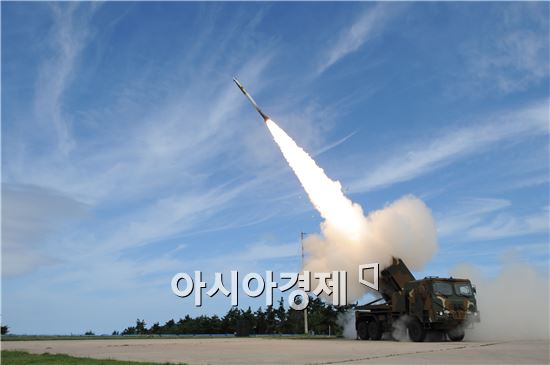
 Cheonmu is a new type of multiple launch rocket system with a maximum range of 80 km, more than twice the range of the current main multiple launcher, Guryong, and has greater destructive power. (Photo by Ministry of National Defense)
[Asia Economy Yang Nak-gyu Reporter] The military live-fire training, which had been postponed due to weather issues, commenced on the 5th. Since Kim Yo-jong, First Deputy Director of the Central Committee of the Workers' Party of North Korea, mentioned the possibility of nullifying the September 19 inter-Korean military agreement under the pretext of leaflet distribution by defector groups, the shooting training is being conducted amid heightened chances of North Korea's subsequent retaliation.
According to the military on the 5th, the Army fired about 100 rounds from the 'Biho Combined' at the Anheung firing range on the west coast. The Biho Combined is a weapon system that combines the 30mm twin-barrel self-propelled anti-aircraft gun 'Biho' and the portable surface-to-air missile 'Shingung' to enhance air defense capabilities. The Biho Combined supports mechanized and other mobile units in close proximity to defend against attacks from low-altitude infiltrating low-flying aircraft, slow aircraft, and drones. Originally, four units were scheduled to conduct the training starting last week, but due to sea fog, only the Army's 7th Corps participated.
Starting next week, a joint maritime live-fire exercise will be conducted privately off the coast of Jukbyeon, Uljin County, Gyeongbuk Province. The exercise will simulate North Korea's military provocations in the East Sea, identifying targets with advanced detection means and striking the point of provocation and support. It is reported that major land, sea, and air forces will participate, including the Cheonmu multiple launch rocket system (MLRS), the most powerful attack helicopter currently in service, the Apache helicopter, Harpoon missiles, Haeseong (precision-guided weapons), FA-50 fighter jets, destroyers, and maritime patrol aircraft.
The Air Force will also conduct the large-scale theater-level air combat training called 'Soaring Eagle' starting from the third week of this month. The exact dates will be finalized considering weather conditions. This year's training will include the deployment of the KC-330 aerial refueling tanker from European Airbus, newly introduced to the Korean Air Force. This is effectively the first time the KC-330 has been deployed in domestic training. Since the first KC-330 was introduced in January last year, up to the fourth unit has been fully operational. Additionally, about 50 aircraft including F-15K, (K)F-16, FA-50, F-4E, F-5 fighters, KA-1 airborne control attack aircraft, E-737 airborne control aircraft, CN-235 transport aircraft, and HH-60 helicopters will participate.
The training will be conducted by dividing teams into friendly forces called 'Blue Air (BA)' and simulated enemy forces called 'Red Air (RA)' according to various scenarios. The friendly forces will be composed of units deployed under the Air Combat Command's 10 flying units, while the simulated enemy forces will consist of veteran instructor pilots from the 29th Squadron. This setup aims to enhance air combat capabilities against infiltration scenarios applying North Korean Air Force's strength, tactical doctrines, and aerial maneuvers. Subsequently, a large-scale strike formation training applying the Kill Chain concept, one of the 'Korean-style 3-axis systems,' is expected to be conducted. The core of this training is striking time-sensitive targets (TST) such as mobile missile launchers (TEL) and other key enemy forces and points of provocation.
A military official stated, "Various exercises including the joint maritime live-fire training are annual drills conducted to maintain perfect readiness while adhering to the September 19 military agreement."
© The Asia Business Daily(www.asiae.co.kr). All rights reserved.
















