Korea Hydro & Nuclear Power Saewool Nuclear Plant and Wolseong Nuclear Power Plant Release Hatchery-Reared Juvenile Fish and Seedlings Grown with Warm Water Discharge to Increase Fisheries Income
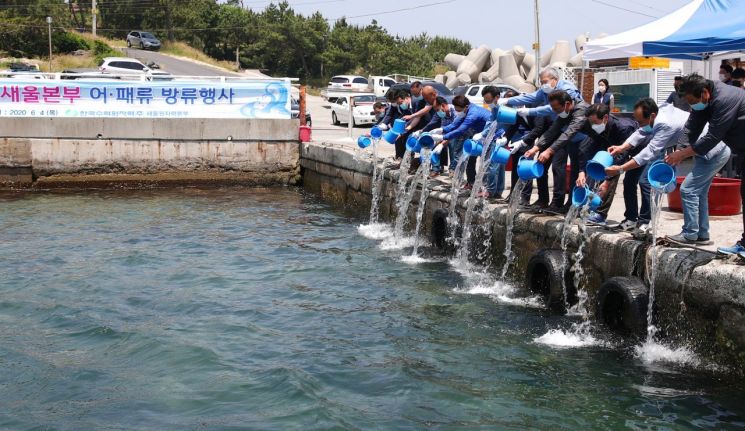 Korea Hydro & Nuclear Power is holding a release event for juvenile clams and fry raised in nuclear power plant warm water in celebration of Ocean Day.
[Asia Economy Yeongnam Reporting Headquarters Reporter Kim Yong-woo] An event releasing juvenile fish and shellfish raised with ‘warm water discharge’ from a nuclear power plant into the sea was held in Ulsan.
On the 4th, Korea Hydro & Nuclear Power Saewool Nuclear Power Headquarters released 30,000 juvenile Gangdodari fish and 20,000 juvenile abalone into the sea in front of Songjeong Port, Seosaeng-myeon, Ulju-gun, Ulsan. This was the fourth annual shellfish release event hosted by Saewool Headquarters this year.
The juveniles released that day were young Gangdodari and abalone farmed using warm water discharge from the Wolseong Nuclear Power Plant. The event was conducted like a campaign to demonstrate that warm water discharge is safe and has high utilization value due to its thermal energy.
Warm water discharge is warm water discharged into the sea or rivers after being used to cool the steam generated by turbines at nuclear power plants. Since its temperature is higher than seawater, it is suitable for fish farming and crop cultivation.
About 20 people attended the event, including the head of Saewool Headquarters, the chairman of Ulsan Fisheries Cooperative, and leaders of eight fishing villages.
On May 28, Saewool Headquarters also released a total of 112,000 juveniles, 16,000 each, to seven fishing villages in Ulju-gun?Sinri, Sinam, Nasa, Pyeongdong, Daesong, Jinha, and Gangyang.
Participants in the event overturned buckets containing juvenile fish and shellfish, hoping they would grow and greatly contribute to the income of local fishermen.
The shellfish released in coastal fishing grounds near the nuclear power plant will later return as abundant marine resources, contributing to increased income for local fishermen.
Han Sang-gil, head of Saewool Headquarters, said, “I hope the released juveniles grow well and help increase the actual income of local residents. I want to promote that nuclear power plant warm water discharge is clean and has high utilization value.”
Saewool Headquarters conducts an annual project releasing farmed shellfish using warm water discharge. So far, they have released a total of 1,138,000 juveniles worth about 790 million KRW, including red sea bream, Gangdodari, abalone, and sea cucumbers, into the sea off Ulsan, receiving positive responses from local fishermen.
© The Asia Business Daily(www.asiae.co.kr). All rights reserved.

















