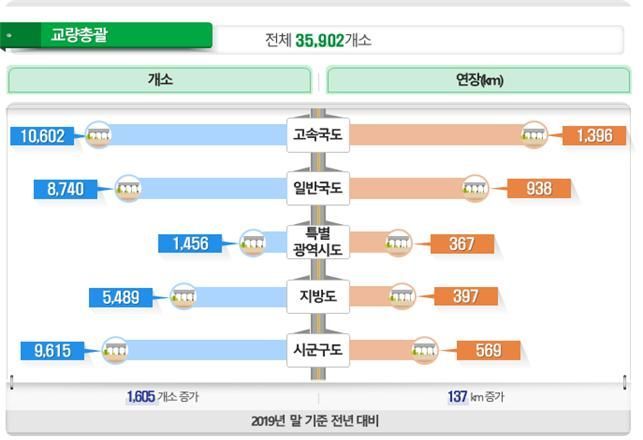
 Status of Bridges Nationwide as of December 2019 (Provided by the Ministry of Land, Infrastructure and Transport)
[Asia Economy Reporter Chunhee Lee] The Ministry of Land, Infrastructure and Transport announced on the 4th the "2019 Road Bridge and Tunnel Status Report," which contains basic status and statistical data on bridges and tunnels across national expressways, general national roads, and local roads nationwide.
As of December last year, a total of 38,584 bridges and tunnels nationwide were surveyed, spanning 5,744 km. This accounts for about 5.2% of the total road length of 111,314 km. The average service life was recorded as 17.3 years. Compared to the previous year, this represents an increase of 1,721 sites (4.7%) and 392 km (7.3%). Compared to 10 years ago in 2010, it increased by 9,821 sites (34%) and 2,151 km (59.9%).
The bridge and tunnel status report has been published annually since 2007. It is compiled based on data input by road management agencies such as the Ministry’s Regional Land Management Offices, local governments, and Korea Expressway Corporation for bridges and tunnels within their managed sections.
By type, bridges were surveyed at 35,902 sites, covering 3,667 km (3.3% of total road length), with an average service life of 17.8 years. The ratio of aging bridges used for more than 30 years was 12.5% (4,482 sites), with higher aging rates observed on local government-managed roads such as city/county/district roads (25.2%), special metropolitan city roads (20.7%), and local roads (17.3%).
Tunnels numbered 2,682 sites, covering 2,077 km (1.9% of total road length), with an average service life of 11.6 years. The aging ratio was 3.8% (101 sites), with higher aging rates also found on local government-managed roads such as special metropolitan city roads (20.3%) and city/county/district roads (8.4%).
Among the newly completed bridges included last year, cable-stayed bridges totaled six sites, including the Cheonsa Bridge in Sinan-gun, Jeollanam-do (Section 1: 3,584 m · Section 2: 3,640 m). Cable-stayed bridges, such as suspension and cable-stayed types, support the bridge deck using cables and are mainly installed over sea areas where longer spans are required due to ship traffic. The Incheon Bridge (11.86 km), currently the longest bridge in Korea, is also a cable-stayed bridge.
Among tunnels, 18 additional long tunnels over 1 km were added, including the Junggun Tunnel (3,490 m) in Gwangyang-gun, Jeollanam-do. The longest tunnel in Korea currently is the Inje-Yangyang Tunnel (10.96 km) on the Seoul-Yangyang Expressway.
Bridge and tunnel status information is currently made publicly available for use by various institutions such as research institutes and private organizations for policy formulation and research purposes. Detailed statistics can be checked on the Road Transport Statistics Nuri and the Bridge and Tunnel Status Information System operated by the Korea Institute of Civil Engineering and Building Technology.
Kang Seongseup, Director of the Advanced Road Safety Division at the Ministry of Land, Infrastructure and Transport, said, "We will actively collect feedback from users of statistical data to expand customized services for demand. In the future, we will also manage status information on roads under other laws such as the National Land Planning and Utilization Act, in addition to roads under the Road Act, thereby establishing a comprehensive management system for bridges and tunnels on all roads nationwide."
© The Asia Business Daily(www.asiae.co.kr). All rights reserved.

















