"Japanese Government Plans Countermeasures If Companies Suffer Damage"
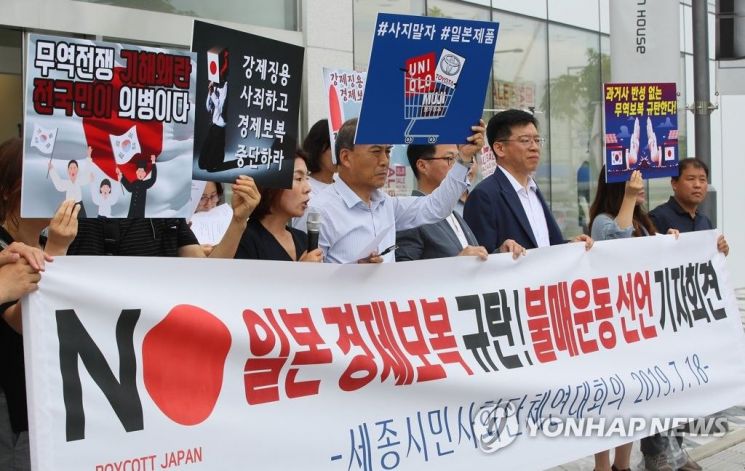 On July 18 last year, in front of the Uniqlo Sejong store in Sejong City, members of Sejong Civic Groups Solidarity, which organized the "Condemnation of Japan's Economic Retaliation! Declaration of Boycott Movement" press conference, condemned the Japanese government and urged participation in the boycott of Japanese products. [Image source=Yonhap News]
[Asia Economy Reporter Han Seung-gon] As it became known on the 3rd that the Japanese government made a virtually threatening statement saying, "If the cashing of (Japanese) company assets in Korea is carried out, Korea-Japan relations will face a serious situation," regarding the South Korean Supreme Court's ruling on compensation for forced labor victims during the Japanese colonial period against Japanese companies, opinions have emerged among citizens to further intensify the boycott of Japanese products.
According to Jiji Press and others, Japanese Foreign Minister Motegi Toshimitsu conveyed this stance during a phone call with South Korean Foreign Minister Kang Kyung-wha on the same day and repeatedly demanded a "cautious response" from the Korean side, according to the Japanese side.
The Supreme Court ruled in favor of the plaintiffs, forced labor victims, in a damages lawsuit filed against Nippon Steel (formerly Shin Nihon Steel) and Mitsubishi Heavy Industries, among others. However, the defendant Japanese companies have shown no movement toward compensation.
As a result, the forced labor victims have been proceeding with seizure and sale procedures of the assets of Japanese war crime companies such as Nippon Steel in Korea since May last year.
In response, the Japanese government has stated that it will take countermeasures if the sale of Japanese companies' assets in Korea becomes a reality.
This is not the first time Japan has issued such a warning. On December 9 last year, Deputy Prime Minister Aso said in the January 2020 issue of Bungeishunju magazine, "If the Korean side executes the cashing of Japanese private company assets subject to forced labor compensation rulings, the smaller economy of Korea will inevitably be the first to suffer economic damage," adding, "It depends on what judgment President Moon Jae-in makes."
Aso claimed, "The biggest issue is the relationship with Korea," and criticized, "The Moon Jae-in administration continues to ignore international law more than the state of Korea itself."
He also said, "Under the 1965 Korea-Japan Claims Agreement, Japan provided Korea with $300 million in grants and $200 million in loans. As a result, Korea's economic development, known as the 'Miracle on the Han River,' prospered. Now, if they say 'let's pretend it never happened,' all I can say is 'wait a moment.'"
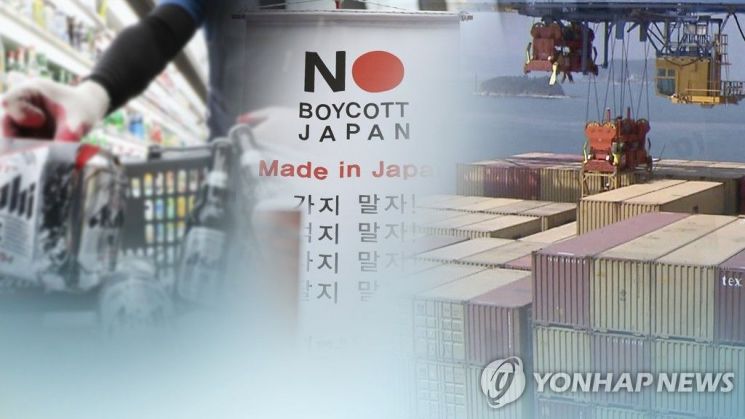
Meanwhile, citizens are showing a stance to make the boycott of Japanese products more active immediately. The intention is to solidify the boycott movement that started in July last year due to Japan's export restrictions.
A 30-year-old office worker, Mr. A, said, "The most effective way to pressure Japan is, of course, the boycott of Japanese products," adding, "Many people are already participating in the boycott, but I plan to make the boycott even more thorough on this occasion." He added, "Recently, Japan's position has been widely known around me, so I plan to join the boycott."
Another office worker in his 40s, Mr. B, said, "I know the boycott of Japanese beer, cars, and others is still active," emphasizing, "If the Japanese government does not reflect on the various crimes it committed against Korea, this boycott will inevitably continue."
The impact of the boycott of Japanese products is considerable. Last month, imports of Japanese consumer goods, centered on tobacco, beer, and automobiles, continued to decline sharply.
According to the Korea Customs Service and others, imports of Japanese consumer goods in April amounted to $249.626 million, down 37.2% compared to a year earlier. Total consumer goods imports in May also decreased by 9.5%, but the decline in imports of Japanese consumer goods was much larger.
The decline rate of imports of Japanese consumer goods slowed from 35.9% in January this year to 14.9% in February, then rose to 17.7% in March, and expanded again to the 30% range last month.
In particular, imports of Japanese beer amounted to $630,000, a staggering 87.8% decrease compared to a year earlier. As of 2018, Korea was the largest overseas market for the Japanese beer industry. However, since the export restrictions were imposed in July last year, imports have sharply declined, continuing with decreases of -92.7% in February and -87.1% in March this year.
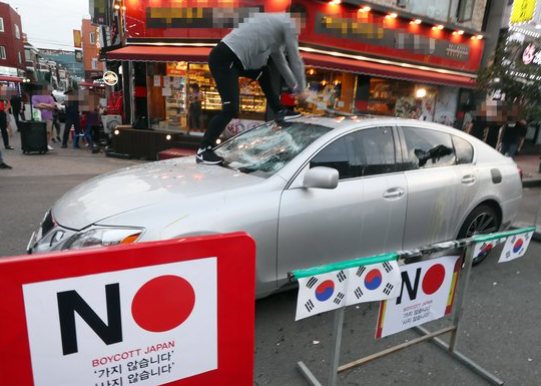 Last July, a citizen was performing a 'Japanese boycott movement' at a shopping mall in Incheon. [Yonhap News]
The automobile market situation is similar. According to statistics from the Korea Imported Automobile Association, sales of most Japanese brands such as Lexus, Toyota, Honda, Nissan, and Infiniti sharply declined last month.
Imports of Japanese automobiles amounted to $62.131 million, down 58.7% compared to April last year. It also decreased by 14.8% compared to the previous month. The share of Japanese automobiles in total automobile imports also dropped from 10.6% in February this year to 5.5% last month.
Japanese brands continue to struggle in the fashion industry as well. GU decided to withdraw from the domestic offline market around August. According to F&L Korea, which operates Uniqlo and GU, the GU online store will operate until the end of July.
Japanese lifestyle brand Muji recorded an operating loss of 7.1 billion won last year, turning to an operating deficit. Sports brand Descente Korea was also affected by the boycott. Since entering the domestic market in 2000, Descente Korea had continued to grow, but last year recorded an operating profit of only 8.99154 billion won, a decrease of 86.7% compared to the same period last year.
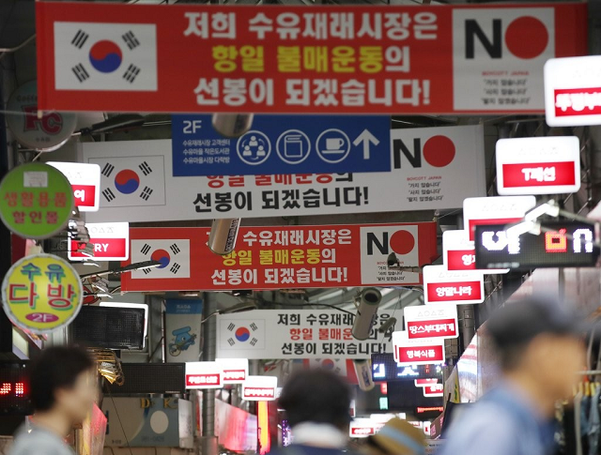 A banner related to the boycott of Japanese products hung at Suyu Traditional Market in Seoul last July. / Yonhap News
Meanwhile, according to a survey conducted by Realmeter, a public opinion research firm, in August last year titled "The 4th Survey on the Status of the Boycott of Japanese Products," more than six out of ten people (64.4%) are currently participating in the boycott. This corresponds to 27.8 million people out of 43.2 million adults aged 19 and over.
In the first survey, about one in two people (48.0%) participated, but participation increased to 54.6% in the second survey (on the 17th) and 62.8% in the third survey (on the 24th). Only 25.9% responded that they would not participate in the future.
A 40-year-old office worker, Mr. C, who has two elementary school children, said, "The boycott of Japanese products is not simply a consumer rights movement but a movement to set history right," emphasizing, "It is a boycott that sends a message to the Japanese people that they must apologize for historical wrongdoings."
Previously, in 2018, the Supreme Court ruled that Japanese war crime companies must compensate victims of forced labor during the Japanese colonial period. It also clarified that the right to claim compensation for forced labor victims does not expire under the Korea-Japan Claims Agreement.
Accordingly, in January last year, the court approved the seizure application for Nippon Steel's assets in Korea filed by forced labor victims, and sent a decision notifying the Japanese debtor of this through international service procedures.
However, the decision was returned in July last year, and there has been no response to the decision sent again a month later until now.
© The Asia Business Daily(www.asiae.co.kr). All rights reserved.



















