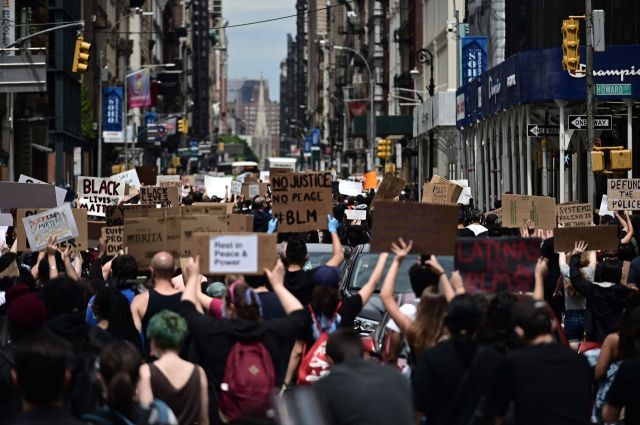
[Asia Economy Reporter Kwon Jae-hee] An analysis has emerged that the underlying cause of the protests intensified by the death of Black man George Floyd at the hands of a white police officer is deeply rooted in the economic inequality between races in American society. Over the past decade, although the U.S. economy has achieved record growth during the recovery process following the global financial crisis, Black people have not reaped the benefits of this growth. Furthermore, the COVID-19 pandemic overlapped with this, and the Floyd incident acted as a catalyst for the outbreak of protests.
According to the U.S. Census Bureau on June 3 (local time), the median income of Black households in 2018 was $41,361 (approximately 50.34 million KRW). This represents a 3.4% increase over the 10 years since the global financial crisis in 2008. In contrast, during the same period, the median income of white households grew by 8.8%, reaching $70,642 (approximately 85.97 million KRW).
The asset gap between white and Black households was also found to be about tenfold. According to a report published by the Brookings Institution in February, the net assets of white households in 2016 amounted to $171,000 (approximately 201.2 million KRW), whereas Black households had net assets of only $17,150 (approximately 20.87 million KRW), about one-tenth of that amount.
Professor General Daniels of the Department of Economics at Howard University in Washington, D.C., analyzed, "(The Black community) still has a long way to go to catch up in assets and income," adding, "It is undeniable that economic inequality exacerbates anxiety."
In terms of social advancement, which serves as a stepping stone to building wealth, Black people still face barriers compared to other races. Among the top 500 companies selected by the U.S. economic weekly magazine Fortune, only four CEOs are Black. They are Gede Zeitlin of Tapestry, the holding company of luxury brand Coach; Kenneth Frazier of pharmaceutical company Merck; Marvin Ellison of home goods retail chain Lowe's; and Roger Ferguson of financial firm TIAA.
Jobs predominantly held by Black people are also concentrated in low-wage labor. According to The New York Times (NYT), 17% of 'frontline' jobs, which involve direct customer service and pay low wages, are held by Black workers.
Meanwhile, three of the four Black CEOs of Fortune 500 companies sparked controversy by addressing the issue of racial discrimination in the U.S. following the Floyd death incident. Kenneth Frazier, CEO of Merck, said in an interview with CNBC, "It has become clear that Floyd was treated as less than human," adding, "As a Black person living in American society, disparities in opportunity still exist."
Gede Zeitlin, CEO of Tapestry, also appealed, "Broken windows can be replaced, but Floyd cannot be brought back to life," emphasizing, "Black lives matter."
© The Asia Business Daily(www.asiae.co.kr). All rights reserved.

















