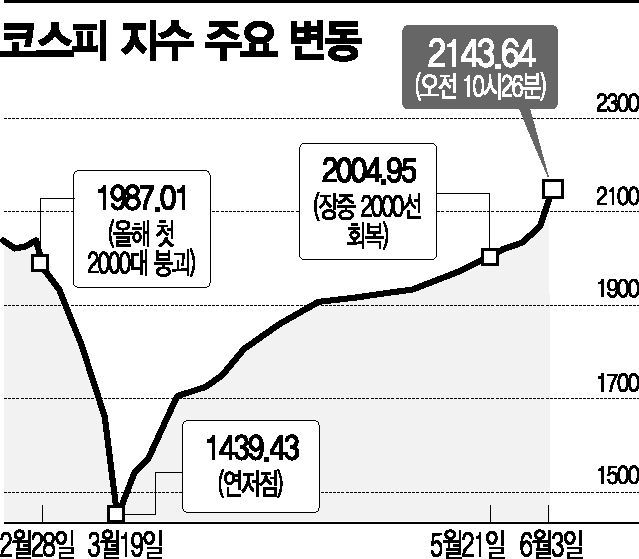
[Asia Economy Reporter Koh Hyung-kwang] The stock market is rebounding faster than expected due to renewed expectations for the resumption of economic activities and economic recovery, which were halted by the novel coronavirus infection (COVID-19). While there are forecasts that the stock rally, centered on growth stocks, will continue for the time being, there are also cautious views that it is too early to make assumptions since the spread of COVID-19 could reoccur and corporate earnings have not been properly reflected.
According to the Korea Exchange on the 3rd, the KOSPI index started the day at 2,111.39, up 1.16% (24.20 points) from the previous trading day, and surpassed the 2,140 level during the session. The last time the KOSPI index broke through the 2,140 level was over three months ago on February 21 (2,162.84), just before concerns about the COVID-19 pandemic (global outbreak) intensified. The KOSPI index has continued a steady upward trend, rising 11.2% (216 points) over the past three weeks since the 14th of last month.
Despite the US-China conflict, the stock market's upward rally is due to increased expectations for economic recovery. Major advanced countries, including the United States, have begun lifting lockdown orders, and signals of economic reopening have gradually been confirmed, raising market expectations. Moreover, it is analyzed that a liquidity-driven market is unfolding, where massive liquidity injected into the market is pushing the index upward.
Kim Yong-gu, a researcher at Hana Financial Investment, explained, "Although it takes some time to confirm the recovery of the real economy after the economic reopening, the stock market, which has preemptively reflected this, is rebounding more quickly. Since major countries, including the US, have lifted lockdowns, expectations for economic recovery are high, leading to positive market evaluations."
Lee Won, a researcher at Bookook Securities, also said, "US President Trump excluded the US-China trade negotiations from sanctions against Hong Kong, stabilizing the exchange rate, and foreign demand is maintained at a neutral or higher level, positively affecting the stock market. The Korean New Deal and the Bank of Korea's interest rate cuts are also factors supporting investor sentiment."
Although the resurgence of COVID-19 and US-China conflicts are considered potential risk factors, the securities industry places more weight on the possibility of the continuation of the upward trend rather than a correction. Jo Ik-jae, a researcher at Hi Investment & Securities, said, "In past shocks, when stock prices recover 60-70% of the drop, a first correction or sideways movement appears, leading to doubts about the short-term peak of the stock market. However, since the market has expectations for global economic recovery after the lockdown is lifted, the upward trend is expected to continue until this is confirmed." Seo Sang-young, a researcher at Kiwoom Securities, predicted, "The continued rise in the US stock market is favorable for the Korean stock market. However, considering that the economic reopening and China's stimulus policies, which are characteristics of the US stock market rise, have been pre-reflected, a process of digesting selling pressure is inevitable."
However, there are also many analyses cautioning against premature assumptions, given that the COVID-19 spread trend could reoccur at any time. It is explained that money moves caused by liquidity injections may have only short-term effects, and investors' doubts about rising indices without supporting evidence such as corporate earnings and valuations could surface at any time. Song Seung-yeon, a researcher at Korea Investment & Securities, said, "Risks that were buried under the COVID-19 crisis, such as large-scale protests in the US due to the death of a Black person and US-China conflicts over the Hong Kong National Security Law, are emerging, raising a sense of crisis. For major countries' stock markets to enter a second upward phase, a visible recovery in fundamentals is necessary." Ha In-hwan, a researcher at Meritz Securities, forecasted, "The dollar index still exceeds 100 points, and corporate earnings estimates are still being revised downward. Although some signals of foreign passive fund inflows have appeared, it is necessary to observe further whether full-scale fund inflows will occur."
Above all, there is an expectation that the return of foreign investors, who sold more than 20 trillion won over the past three months, will be the catalyst for further KOSPI gains. Yeom Dong-chan, a researcher at Ebest Investment & Securities, emphasized, "Individual investors have excellently filled the void left by foreign investors, leading to a rapid recovery of the domestic stock market, but for it to rise to a higher level, the return of foreign investors must be supported."
© The Asia Business Daily(www.asiae.co.kr). All rights reserved.

















