The Approval Date by the Promotion Committee is the Project Start Date
But if Prolonged, Considered '10 Years Before Completion'
Excess Profits Vary Like a Rubber Band Depending on Housing Market Conditions
Criticism on Discrepancy Between Reflected Nearby House Prices and Reality
[Asia Economy Reporter Lee Chun-hee] Although the government has expressed its intention to actively impose charges on excess profits from reconstruction, controversies surrounding this system continue. The Reconstruction Excess Profit Recovery System was constitutionally upheld by the Constitutional Court last year, resolving the issue of imposing charges on unrealized profits. However, fairness concerns remain unresolved in many areas, leading to increasing calls for system improvements.
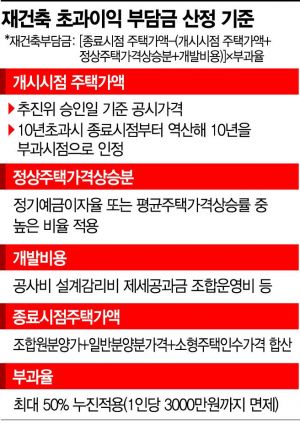
The most contentious issue regarding the Reconstruction Excess Profit Recovery System is the calculation process of excess profits. Under the current system, the basis for calculating excess profits inevitably fluctuates depending on market conditions. Currently, excess profits are calculated by subtracting the housing price at the start of the reconstruction project (starting housing price) from the housing price assessed after the reconstruction is completed (ending housing price), taking into account normal housing price increases and development costs.
The key point is the starting point. The principle is the approval date of the Reconstruction Promotion Committee. However, in cases where the project has been prolonged after the committee's approval, the starting point is considered to be 10 years before the completion date. Yet, many reconstruction projects have been prolonged due to conflicts among residents and administrative approval issues. For example, the representative reconstruction apartment, Eunma Apartment in Daechi-dong, Gangnam-gu, Seoul, received committee approval in 2003 but has yet to establish a union. This has led to complaints that the housing price at the starting point depends largely on 'luck.'
In the case of Banpo Jugong Complex 1, District 3 (formerly AID Vice Minister Housing) in Banpo-dong, Seocho-gu, which recently selected a construction company, the committee approval was in 2003, but construction has not yet started. Samsung C&T, the selected construction company, has proposed a move-in date of March 2024. In this case, the project start date changes to 2014.
2014 was a period when the housing market was sharply cooling. The publicly announced price of a 72.51㎡ (4th floor) unit in Banpo 3rd District, which was 840 million KRW in 2012, dropped to 731 million KRW the following year. In 2014, the likely project start date, it was 769 million KRW. The current publicly announced price of this unit is 1.581 billion KRW. Depending on which year is used as the base, excess profits can expand or contract like a rubber band.
The rate of increase is also problematic. If housing prices in the surrounding area have also surged, a significant portion of the increase is deducted from the excess profits. However, the index used here is the Korea Appraisal Board's index, which tends to conservatively evaluate housing price increases, specifically the 'Housing Sales Price Index by City/County/District.' Since this includes villas and detached houses, which generally have smaller price increases than apartments, and covers the entire district, the rate of increase is likely to be reflected lower.
Looking at actual transaction prices, a 72.51㎡ unit in Banpo 3rd District, which was in the 1 billion KRW range in January 2014, was traded at around 2.1 billion KRW last month, roughly doubling. 'Raemian Prestige' in the same neighborhood showed a similar increase from 1.3 billion KRW to 2.7 billion KRW during the same period. However, the monthly housing sales price index for Seocho-gu rose only 20.8%, from 90.0 to 108.7.
The calculation of the ending price also raises concerns about double standards. The housing price at the starting point is calculated solely based on the publicly announced price. However, the ending price includes not only the publicly announced price at completion but also the prices of general sale units and the purchase prices of small units. Even if the government tightly controls sale prices through the price ceiling system, if the proportion of general sale units increases, the charge inevitably rises.
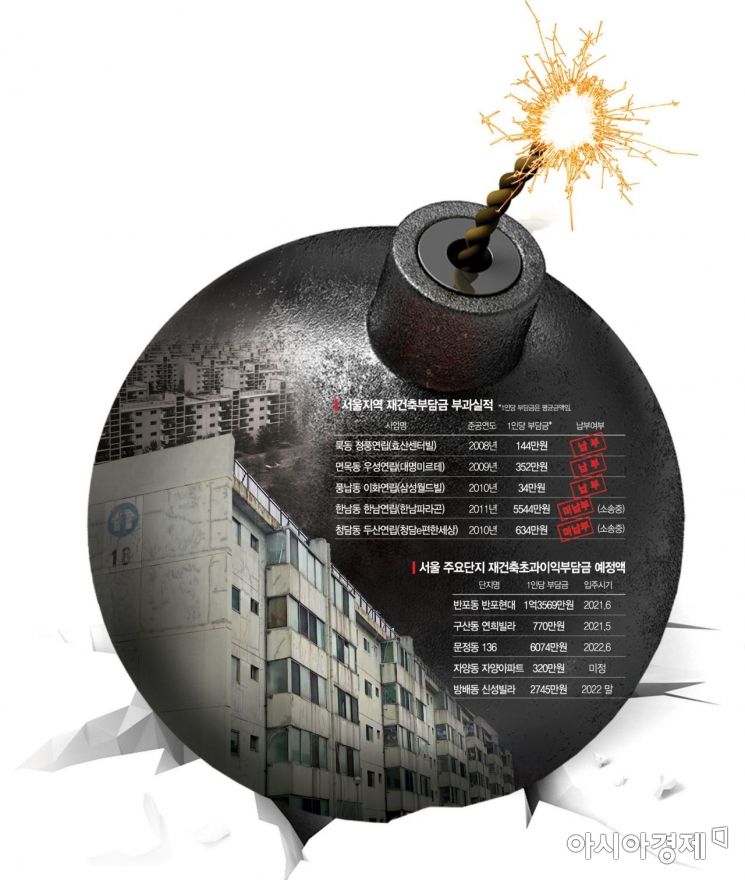
There are also ongoing issues regarding the imposition method. In Hannam-dong, Yongsan-gu, Hannam Yeonrip (currently Hannam Paragon), where a charge of 1.7 billion KRW was imposed on the entire union and 55.44 million KRW per person, the building was completed in 2011, but due to subsequent lawsuits, the charge was only paid after nine years. With significant penalties expected, and lawsuits taking five years, some union members have become unreachable, leading to projections that the actual charge could rise to around 100 million KRW.
While switching to a 'per-person imposition method,' where the government directly imposes charges on individuals, could resolve these issues, the government maintains that since the profits arise from reconstruction, the union should bear the payment obligation and distribute charges according to their own criteria. They argue that artificial government intervention could cause even bigger problems.
© The Asia Business Daily(www.asiae.co.kr). All rights reserved.
![Clutching a Stolen Dior Bag, Saying "I Hate Being Poor but Real"... The Grotesque Con of a "Human Knockoff" [Slate]](https://cwcontent.asiae.co.kr/asiaresize/183/2026021902243444107_1771435474.jpg)

















